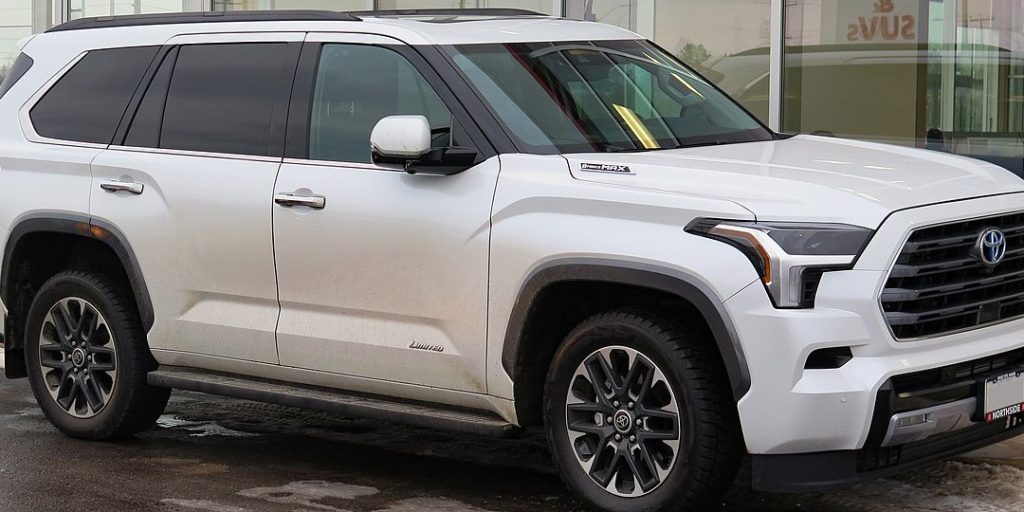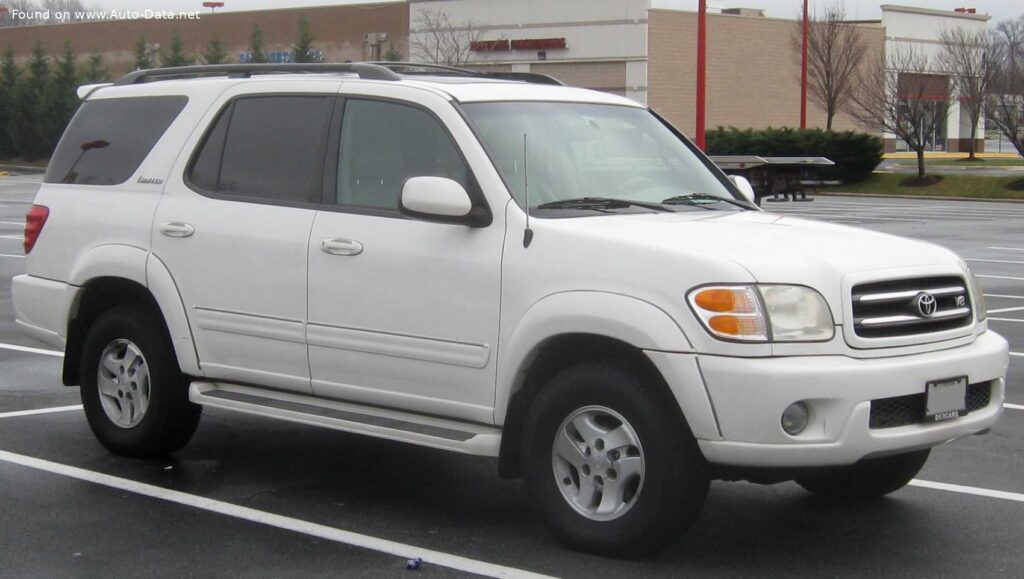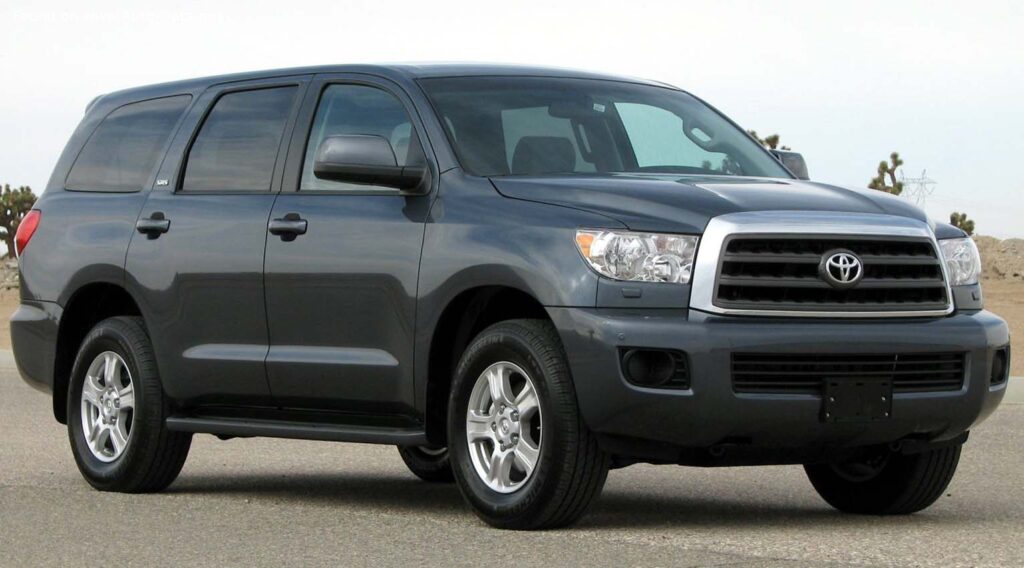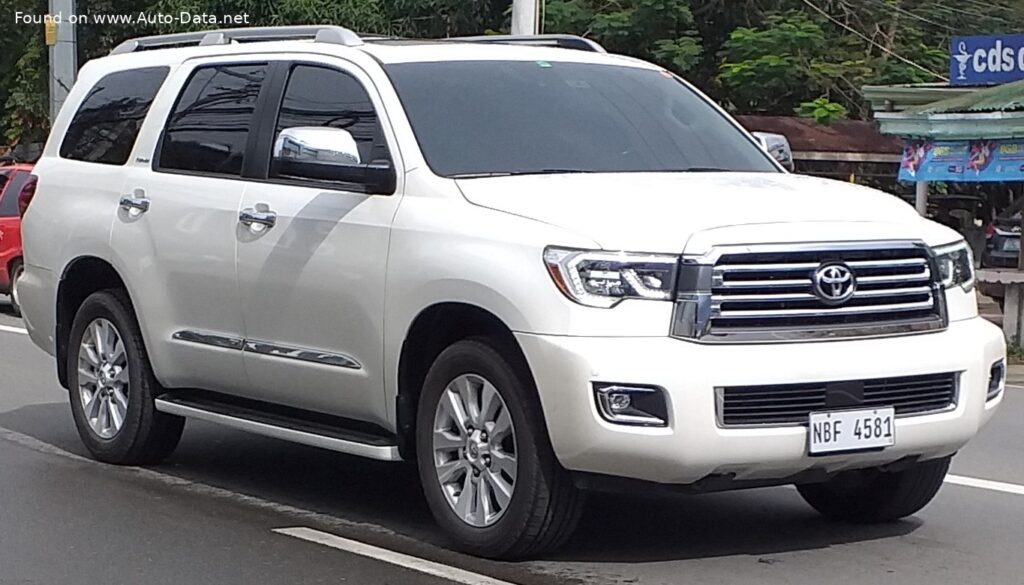
The Toyota Sequoia II, particularly the facelifted version introduced in February 2017, represents Toyota’s full-size SUV offering primarily for the North American market. Positioned above the 4Runner and Highlander in Toyota’s SUV lineup, the Sequoia competes with domestic rivals like the Chevrolet Tahoe, Ford Expedition, and GMC Yukon. The 2017 facelift brought styling updates and enhanced features, but retained the core mechanicals of the second-generation Sequoia, which ran from 2008 to 2022. This generation aimed to provide a blend of spaciousness, towing capability, and Toyota’s reputation for reliability, appealing to families and those needing a robust vehicle for work and recreation.
Toyota Sequoia II (2017 Facelift): Overview
The Sequoia II facelift, produced from 2017 through June 2022, continued the second generation’s focus on providing a large, comfortable, and capable SUV. While not a revolutionary redesign, the 2017 updates included a more prominent grille, revised headlights, and updated interior trim. The powertrain remained largely unchanged, centered around a powerful 5.7-liter V8 engine. The Sequoia’s primary market was the United States and Canada, where full-size SUVs remain popular due to their practicality and towing capacity. It was not widely sold in other global markets.
Engine & Performance
The heart of the 2017-2022 Toyota Sequoia is the 3UR-FE 5.7-liter V8 engine. This naturally aspirated engine produces 381 horsepower at 5600 rpm and 401.23 lb-ft of torque at 3600 rpm. The engine utilizes Toyota’s VVT-i (Variable Valve Timing-intelligent) technology to optimize performance and efficiency across the rev range. Power is delivered through a six-speed automatic transmission (ECT-i – Electronically Controlled Transmission with intelligence) to a standard four-wheel-drive system. The drivetrain employs a permanent rear-wheel-drive configuration with an electronically or mechanically operated clutch to engage the front wheels when needed. This setup provides enhanced traction in various conditions. The weight-to-power ratio stands at 7.1 kg/Hp, and the weight-to-torque ratio is 5 kg/Nm, indicating a robust power delivery for its size. Fuel economy is rated at 14 US mpg combined (16.8 l/100km), with 13 US mpg in urban settings and 17 US mpg on the highway.
Design & Features
The Toyota Sequoia II is a traditional body-on-frame SUV, offering a robust and durable construction. It’s a five-door vehicle with seating for seven or eight passengers, depending on the configuration. The 2017 facelift brought a bolder front fascia, with a larger grille and redesigned headlights. Inside, the Sequoia offers a spacious cabin with three rows of seating. Standard features typically included a touchscreen infotainment system, Bluetooth connectivity, and a rearview camera. Higher trims offered features like leather upholstery, navigation, and a premium sound system. Safety features, crucial for a vehicle of this size, included ABS (Anti-lock Braking System) and multiple airbags. The Sequoia’s large size provides substantial cargo space, ranging from 18.89 cubic feet with all seats in place to 120.11 cubic feet with the second and third rows folded down. Its substantial towing capacity, up to 7,101.09 lbs (3221 kg) with brakes, makes it suitable for hauling boats, trailers, and other recreational equipment.
Technical Specifications
| Brand | Toyota |
| Model | Sequoia |
| Generation | Sequoia II (facelift 2017) |
| Type (Engine) | 5.7 V8 VVT-i (381 Hp) 4WD ECT-i |
| Start of production | February, 2017 |
| End of production | June, 2022 |
| Powertrain Architecture | Internal Combustion engine |
| Body type | SUV |
| Seats | 7-8 |
| Doors | 5 |
| Fuel consumption (urban) | 18.1 l/100 km (13 US mpg, 15.6 UK mpg, 5.5 km/l) |
| Fuel consumption (extra urban) | 13.8 l/100 km (17 US mpg, 20.5 UK mpg, 7.2 km/l) |
| Fuel consumption (combined) | 16.8 l/100 km (14 US mpg, 16.8 UK mpg, 6 km/l) |
| Fuel Type | Petrol (Gasoline) |
| Emission standard | ULEV-II |
| Weight-to-power ratio | 7.1 kg/Hp |
| Weight-to-torque ratio | 5 kg/Nm |
| Power | 381 Hp @ 5600 rpm |
| Power per litre | 67.3 Hp/l |
| Torque | 544 Nm @ 3600 rpm (401.23 lb.-ft. @ 3600 rpm) |
| Engine layout | Front, Longitudinal |
| Engine Model/Code | 3UR-FE |
| Engine displacement | 5663 cm3 (345.58 cu. in.) |
| Number of cylinders | 8 |
| Engine configuration | V-engine |
| Cylinder Bore | 94 mm (3.7 in.) |
| Piston Stroke | 102 mm (4.02 in.) |
| Number of valves per cylinder | 4 |
| Fuel injection system | Direct injection |
| Engine aspiration | Naturally aspirated engine |
| Valvetrain | DOHC, VVT-i |
| Engine oil capacity | 7.5 l (7.93 US qt | 6.6 UK qt) |
| Coolant | 12.4 l (13.1 US qt | 10.91 UK qt) |
| Kerb Weight | 2715-2722 kg (5985.55 – 6000.98 lbs.) |
| Max. weight | 3311 kg (7299.51 lbs.) |
| Max load | 589-596 kg (1298.52 – 1313.96 lbs.) |
| Trunk (boot) space – minimum | 535 l (18.89 cu. ft.) |
| Trunk (boot) space – maximum | 3401 l (120.11 cu. ft.) |
| Fuel tank capacity | 100 l (26.42 US gal | 22 UK gal) |
| Permitted trailer load with brakes (12%) | 3221 kg (7101.09 lbs.) |
| Length | 5210 mm (205.12 in.) |
| Width | 2029 mm (79.88 in.) |
| Height | 1956 mm (77.01 in.) |
| Wheelbase | 3099 mm (122.01 in.) |
| Front track | 1725 mm (67.91 in.) |
| Rear (Back) track | 1755 mm (69.09 in.) |
| Ride height (ground clearance) | 254 mm (10 in.) |
| Minimum turning circle (turning diameter) | 11.6 m (38.06 ft.) |
| Approach angle | 27° |
| Departure angle | 21° |
| Drivetrain Architecture | ICE drives rear wheels, front wheels engaged via clutch |
| Drive wheel | All wheel drive (4×4) |
| Number of gears and type of gearbox | 6 gears, automatic transmission ECT-i |
| Front suspension | Coil spring, Double wishbone, Transverse stabilizer |
| Rear suspension | Double wishbone, Transverse stabilizer, Coil spring |
| Assisting systems | ABS (Anti-lock braking system) |
| Steering type | Steering rack and pinion |
| Power steering | Hydraulic Steering |
| Tires size | 275/65 R18; 275/55 R20 |
| Wheel rims size | 8J x 18; 8J x 20 |