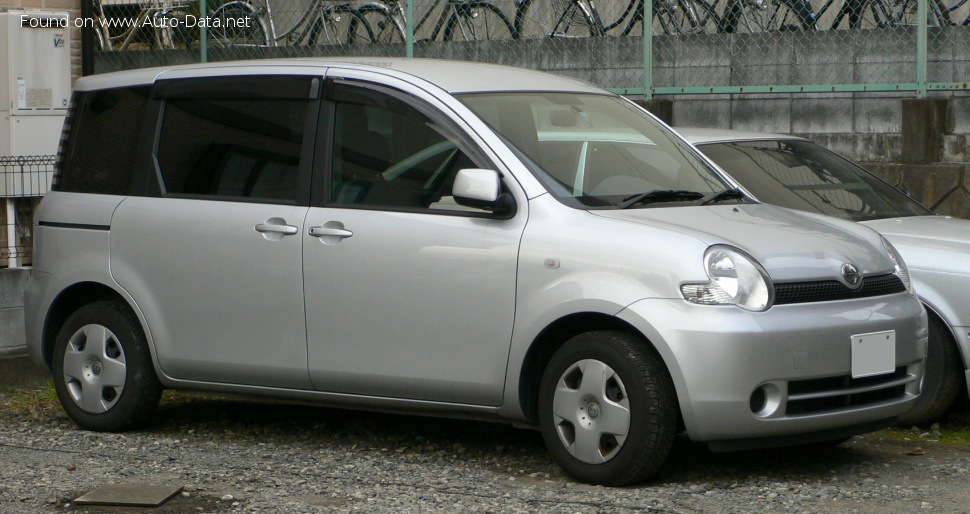
The Toyota Sienta I 1.5 i, produced between 2003 and 2006, represents a unique entry in Toyota’s lineup, primarily targeted at the Japanese domestic market (JDM). This compact minivan, notable for its seven-seat configuration within a relatively small footprint, aimed to provide practical transportation for families in densely populated urban environments. While not officially sold in the United States, the Sienta I exemplifies Toyota’s commitment to innovative space utilization and efficient engineering. It filled a niche between smaller kei cars and larger, more conventional minivans, offering a versatile and economical option for Japanese consumers. The Sienta’s design prioritized interior space and ease of access, features highly valued in its target market.
Toyota Sienta I: A Compact People Carrier
The Sienta I was conceived as a response to the growing demand for multi-purpose vehicles in Japan. Its compact dimensions made it easy to maneuver in crowded city streets, while its seven-seat capacity provided ample room for families. The vehicle’s design was unconventional for its time, featuring a boxy silhouette and a high roofline to maximize interior volume. This first generation Sienta established the model as a practical and affordable choice for those needing flexible passenger and cargo space. The Sienta’s success in Japan paved the way for subsequent generations, each building upon the original’s core strengths.
Engine & Performance
Powering the Toyota Sienta I 1.5 i is the 1NZ-FE 1.5-liter inline-four cylinder gasoline engine. This naturally aspirated engine produces 110 horsepower at 6000 rpm and 143 Nm (105.47 lb.-ft.) of torque at 4200 rpm. While not designed for outright performance, the 1NZ-FE provides adequate power for everyday driving and efficient fuel consumption. The engine’s power-to-weight ratio is 73.5 hp per liter, reflecting its focus on efficiency. The engine utilizes a multi-port fuel injection system and a double overhead camshaft (DOHC) valvetrain, contributing to its smooth operation and reasonable power output. The front-engine, front-wheel-drive configuration further enhances fuel economy and simplifies the drivetrain. The engine’s transverse mounting optimizes space utilization within the compact engine bay.
Design & Features
The Toyota Sienta I is a five-door minivan designed to accommodate up to seven passengers. Its boxy shape is a defining characteristic, maximizing interior space. The high roofline allows for comfortable headroom for all occupants, even in the third row. The Sienta’s sliding rear doors, a common feature on Japanese minivans, provide easy access to the rear seats, particularly in tight parking spaces. The interior is designed with practicality in mind, featuring durable materials and a functional layout. While not lavishly equipped, the Sienta I offered essential features such as air conditioning, power steering, and basic audio systems. Safety features for the time included ventilated disc brakes on the front wheels and drum brakes on the rear. The vehicle’s tires are sized 175/70 R14, mounted on 5.5JJ x 14 inch wheel rims. The Sienta’s design prioritized functionality and space efficiency over aesthetic flourishes, reflecting its target market’s needs.
Technical Specifications
| Brand | Toyota |
| Model | Sienta |
| Generation | Sienta I |
| Type (Engine) | 1.5 i (110 Hp) |
| Start of production | 2003 |
| End of production | 2006 |
| Powertrain Architecture | Internal Combustion engine |
| Body type | Minivan |
| Seats | 7 |
| Doors | 5 |
| Fuel Type | Petrol (Gasoline) |
| Power | 110 Hp @ 6000 rpm |
| Power per litre | 73.5 Hp/l |
| Torque | 143 Nm @ 4200 rpm |
| Torque (lb.-ft.) | 105.47 lb.-ft. @ 4200 rpm |
| Engine layout | Front, Transverse |
| Engine Model/Code | 1NZ-FE |
| Engine displacement | 1496 cm3 |
| Engine displacement (cu. in.) | 91.29 cu. in. |
| Number of cylinders | 4 |
| Engine configuration | Inline |
| Cylinder Bore | 75 mm |
| Cylinder Bore (in.) | 2.95 in. |
| Piston Stroke | 84.7 mm |
| Piston Stroke (in.) | 3.33 in. |
| Compression ratio | 10.5:1 |
| Number of valves per cylinder | 4 |
| Fuel injection system | Multi-port manifold injection |
| Engine aspiration | Naturally aspirated engine |
| Valvetrain | DOHC |
| Engine oil capacity | 3.7 l |
| Engine oil capacity (US qt) | 3.91 US qt |
| Engine oil capacity (UK qt) | 3.26 UK qt |
| Coolant | 4.9 l |
| Coolant (US qt) | 5.18 US qt |
| Coolant (UK qt) | 4.31 UK qt |
| Fuel tank capacity | 42 l |
| Fuel tank capacity (US gal) | 11.1 US gal |
| Fuel tank capacity (UK gal) | 9.24 UK gal |
| Length | 4100 mm |
| Length (in.) | 161.42 in. |
| Width | 1695 mm |
| Width (in.) | 66.73 in. |
| Height | 1670 mm |
| Height (in.) | 65.75 in. |
| Wheelbase | 2700 mm |
| Wheelbase (in.) | 106.3 in. |
| Front track | 1465 mm |
| Front track (in.) | 57.68 in. |
| Rear track | 1485 mm |
| Rear track (in.) | 58.46 in. |
| Minimum turning circle | 10.4 m |
| Minimum turning circle (ft.) | 34.12 ft. |
| Drivetrain Architecture | Front wheel drive |
| Front brakes | Ventilated discs |
| Rear brakes | Drum |
| Tires size | 175/70 R14 |
| Wheel rims size | 5.5JJ x 14 |
The Toyota Sienta I 1.5 i, though not a vehicle commonly found in the United States, represents a significant example of Toyota’s engineering prowess and its ability to cater to specific market needs. Its compact dimensions, seven-seat capacity, and efficient engine made it a popular choice for families in Japan, and it laid the foundation for the Sienta’s continued success in subsequent generations. The vehicle’s focus on practicality and space utilization remains a hallmark of the Sienta model to this day.