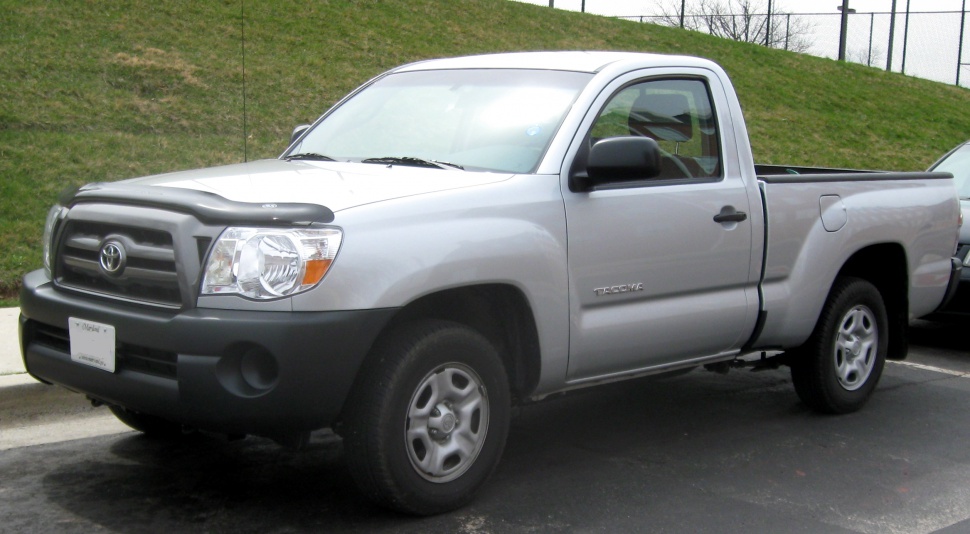
The Toyota Tacoma II Single Cab 2.7, produced from 2004 to 2012, represents the second generation of the popular Tacoma compact pickup truck. While the Tacoma enjoys widespread recognition and sales success in North America, it’s important to understand its position within Toyota’s global lineup. The Tacoma, unlike many of Toyota’s offerings, was primarily designed and marketed for the North American market, filling a niche for a smaller, more maneuverable pickup than the full-size Tundra. The Single Cab configuration, specifically, catered to buyers prioritizing utility and affordability over passenger space, often finding use in commercial applications or as a work truck. This generation saw significant improvements in refinement, capability, and safety compared to its predecessor, solidifying the Tacoma’s reputation as a reliable and durable vehicle.
Toyota Tacoma II Single Cab 2.7: A Detailed Overview
The Tacoma II generation marked a substantial departure from the first generation, offering a more modern design, increased interior space, and enhanced mechanical components. The Single Cab model, characterized by its two-door layout and three-seat capacity, remained a popular choice for those needing a practical and rugged work vehicle. It distinguished itself from the Double Cab (extended cab) and Access Cab (extra cab) versions by offering a shorter wheelbase and a more focused utilitarian approach. The 2.7-liter engine option provided a balance between fuel efficiency and adequate power for typical light-duty tasks.
Engine & Performance
Powering the Toyota Tacoma II Single Cab 2.7 is the 2TR-FE 2.7-liter inline-four cylinder gasoline engine. This naturally aspirated engine produces 159 horsepower at 5200 rpm and 244 Nm (179.97 lb.-ft.) of torque at 3800 rpm. The engine utilizes a multi-port fuel injection system and a Double Overhead Camshaft (DOHC) valvetrain with Variable Valve Timing-intelligent (D-VVT-i) technology. This combination helps optimize both power delivery and fuel efficiency. The engine’s longitudinal front-engine layout contributes to a balanced weight distribution. The Tacoma’s weight-to-power ratio is 9.1 kg/Hp, and its weight-to-torque ratio is 6 kg/Nm. A five-speed manual transmission is standard, delivering power to the rear wheels. While not a performance-oriented powertrain, the 2TR-FE provides sufficient power for everyday driving and light hauling duties. Fuel economy is rated at 10.2 l/100 km (23.1 US mpg) in urban conditions and 8.3 l/100 km (28.3 US mpg) on the extra-urban cycle.
Design & Features
The Tacoma II Single Cab is a traditional pickup truck in terms of body style, featuring a separate cab and bed configuration. The Single Cab’s two-door layout prioritizes cargo space and simplicity. The vehicle’s dimensions are 4836 mm (190.39 in.) in length, 1834 mm (72.2 in.) in width, and 1669 mm (65.71 in.) in height, with a wheelbase of 2779 mm (109.41 in.). The curb weight is 1452 kg (3201.11 lbs.), with a maximum weight capacity of 2064 kg (4550.34 lbs.) and a maximum load capacity of 612 kg (1349.23 lbs.).
Safety features for the 2004-2012 Tacoma included an Anti-lock Braking System (ABS) as standard equipment. The suspension system consists of an independent McPherson strut setup with coil springs and an anti-roll bar at the front, and independent coil springs at the rear. Braking is handled by ventilated discs at the front and drums at the rear. The Tacoma rides on 15-inch wheels with 215/70 R15 tires. The interior, while functional, is relatively basic in the Single Cab configuration, focusing on durability and ease of cleaning. The Tacoma’s 80-liter (21.13 US gal) fuel tank provides a respectable driving range.
Technical Specifications
| Brand | Toyota |
| Model | Tacoma |
| Generation | Tacoma II Single Cab |
| Type (Engine) | 2.7 (159 Hp) |
| Start of production | August, 2004 |
| End of production | 2012 |
| Powertrain Architecture | Internal Combustion engine |
| Body type | Pick-up |
| Seats | 3 |
| Doors | 2 |
| Fuel consumption (urban) | 10.2 l/100 km (23.1 US mpg) |
| Fuel consumption (extra urban) | 8.3 l/100 km (28.3 US mpg) |
| Fuel Type | Petrol (Gasoline) |
| Weight-to-power ratio | 9.1 kg/Hp |
| Weight-to-torque ratio | 6 kg/Nm |
| Power | 159 Hp @ 5200 rpm |
| Torque | 244 Nm @ 3800 rpm (179.97 lb.-ft. @ 3800 rpm) |
| Engine layout | Front, Longitudinal |
| Engine Model/Code | 2TR-FE |
| Engine displacement | 2694 cm3 (164.4 cu. in.) |
| Number of cylinders | 4 |
| Engine configuration | Inline |
| Number of valves per cylinder | 4 |
| Fuel injection system | Multi-port manifold injection |
| Engine aspiration | Naturally aspirated |
| Valvetrain | DOHC, D-VVT-i |
| Engine oil capacity | 5.8 l (6.13 US qt | 5.1 UK qt) |
| Coolant capacity | 8.7 l (9.19 US qt | 7.65 UK qt) |
| Kerb Weight | 1452 kg (3201.11 lbs.) |
| Max. weight | 2064 kg (4550.34 lbs.) |
| Max load | 612 kg (1349.23 lbs.) |
| Fuel tank capacity | 80 l (21.13 US gal | 17.6 UK gal) |
| Length | 4836 mm (190.39 in.) |
| Width | 1834 mm (72.2 in.) |
| Height | 1669 mm (65.71 in.) |
| Wheelbase | 2779 mm (109.41 in.) |
| Front track | 1549 mm (60.98 in.) |
| Rear track | 1549 mm (60.98 in.) |
| Ride height (ground clearance) | 206 mm (8.11 in.) |
| Drivetrain Architecture | Rear wheel drive |
| Number of gears | 5 |
| Gearbox type | Manual transmission |
| Front suspension | Independent, McPherson with coil spring and anti-roll bar |
| Rear suspension | Independent coil spring |
| Front brakes | Ventilated discs |
| Rear brakes | Drum |
| Assisting systems | ABS (Anti-lock braking system) |
| Steering type | Steering rack and pinion |
| Tires size | 215/70 R15 |
| Wheel rims size | 15 |