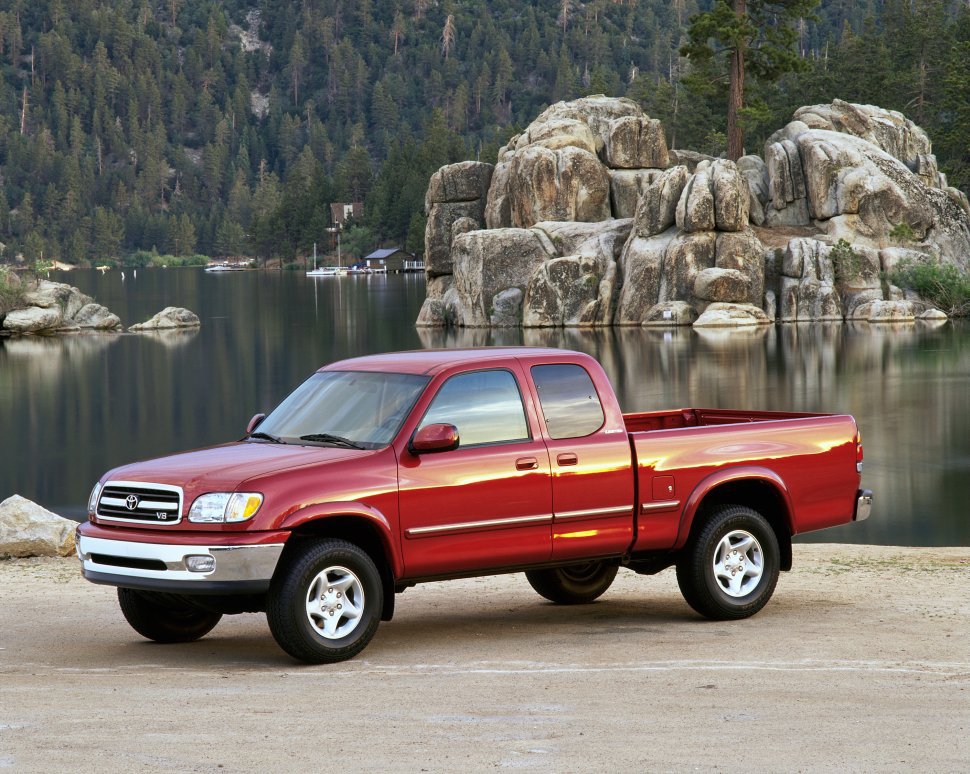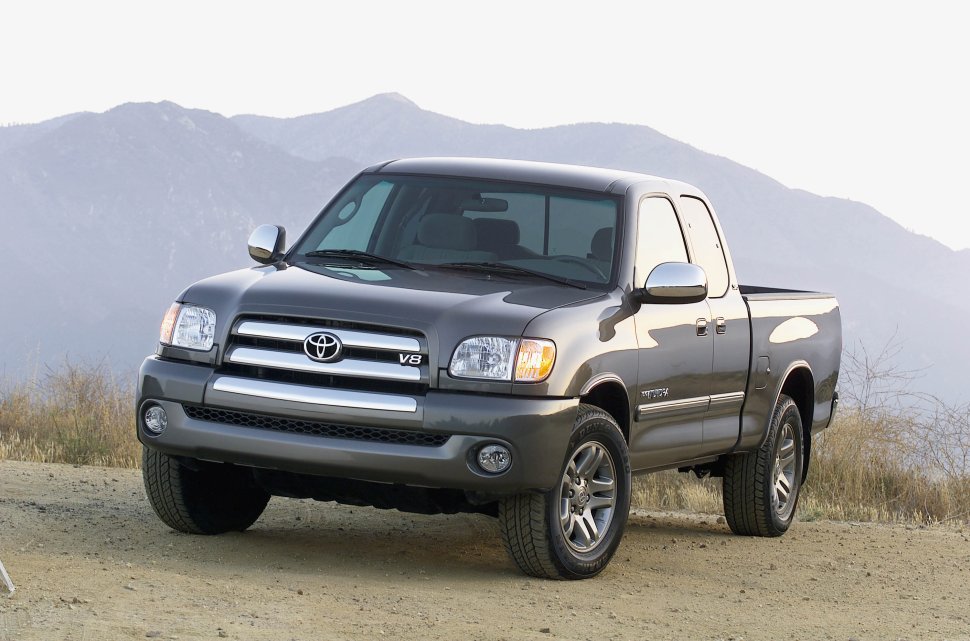
The Toyota Tundra I Access Cab (facelift 2002) 3.4i 4×4 represents Toyota’s initial foray into the full-size pickup truck market in North America. Introduced in 1999 and receiving a significant facelift in 2002, the Tundra was designed to appeal to American truck buyers seeking a reliable, capable, and well-equipped alternative to domestic offerings. The Access Cab configuration, featuring a smaller second set of doors, offered increased passenger space compared to standard cab models, while the 3.4-liter engine provided a balance of power and fuel efficiency. This generation Tundra aimed to establish Toyota as a serious contender in the highly competitive American pickup truck segment.
Toyota Tundra I Access Cab (facelift 2002): Overview
The Tundra I, specifically the 2002 facelifted model, was a pivotal vehicle for Toyota. Prior to its introduction, Toyota had limited success in the full-size truck market. The Tundra was engineered specifically for North American tastes, undergoing extensive testing and refinement to meet the demands of American truck owners. The Access Cab body style, with its four doors, provided a more practical option for families and those needing to transport passengers alongside cargo. The 3.4i designation refers to the 3.4-liter inline-six engine, which was the standard powerplant for this configuration. The 4×4 designation indicates a four-wheel-drive system, enhancing the truck’s off-road capability and all-weather performance.
Engine & Performance
Powering the 2002 Toyota Tundra I Access Cab 3.4i 4×4 is the 5VZ-FE 3.4-liter V6 engine. This naturally aspirated engine produces 190 horsepower at 4800 rpm and 298 Nm (219.79 lb.-ft.) of torque at 3600 rpm. The engine features a cast iron block and aluminum cylinder heads, incorporating multi-port fuel injection and a double overhead camshaft (DOHC) valvetrain with four valves per cylinder. This configuration delivers a power-to-weight ratio of 94.5 horsepower per tonne and a torque-to-weight ratio of 148.2 Nm per tonne. The engine’s longitudinal front-engine layout contributes to balanced handling. The 5-speed manual transmission allows for driver control and efficient power delivery. Fuel economy is rated at 14.7 l/100 km (16 US mpg) in urban driving and 12.3 l/100 km (19.1 US mpg) in extra-urban conditions. The engine has a displacement of 3378 cm3 (206.14 cu. in.) with a bore of 93.4 mm (3.68 in.) and a stroke of 82 mm (3.23 in.), operating with a compression ratio of 9.6:1.
Design & Features
The 2002 Toyota Tundra I Access Cab is a four-door pickup truck designed with practicality and durability in mind. The Access Cab configuration provides seating for up to five passengers, offering a more comfortable and versatile interior compared to standard cab models. The truck bed measures 2625 liters (92.7 cu. ft.) in volume, providing ample space for hauling cargo. The exterior design is characterized by a robust and functional aesthetic, typical of American pickup trucks of the era. Safety features for the time included ABS (Anti-lock Braking System) as standard equipment. The Tundra’s suspension system consists of double wishbones at the front and leaf springs at the rear, providing a balance of ride comfort and load-carrying capacity. The vehicle’s dimensions are substantial, with a length of 5545 mm (218.31 in.), a width of 1910 mm (75.2 in.), and a height of 1816 mm (71.5 in.). Ground clearance is a generous 289 mm (11.38 in.), enhancing its off-road capability. The turning circle is 13.6 meters (44.62 ft.).
Technical Specifications
| Brand | Toyota |
| Model | Tundra |
| Generation | Tundra I Access Cab (facelift 2002) |
| Type (Engine) | 3.4i (190 Hp) 4×4 |
| Start of production | 2002 |
| End of production | 2004 |
| Powertrain Architecture | Internal Combustion engine |
| Body type | Pick-up |
| Seats | 5 |
| Doors | 4 |
| Fuel consumption (urban) | 14.7 l/100 km (16 US mpg, 19.2 UK mpg) |
| Fuel consumption (extra urban) | 12.3 l/100 km (19.1 US mpg, 23 UK mpg) |
| Fuel Type | Petrol (Gasoline) |
| Weight-to-power ratio | 10.6 kg/Hp |
| Weight-to-torque ratio | 6.7 kg/Nm |
| Power | 190 Hp @ 4800 rpm |
| Torque | 298 Nm @ 3600 rpm (219.79 lb.-ft. @ 3600 rpm) |
| Engine layout | Front, Longitudinal |
| Engine Model/Code | 5VZ-FE |
| Engine displacement | 3378 cm3 (206.14 cu. in.) |
| Number of cylinders | 6 |
| Engine configuration | V-engine |
| Cylinder Bore | 93.4 mm (3.68 in.) |
| Piston Stroke | 82 mm (3.23 in.) |
| Compression ratio | 9.6:1 |
| Number of valves per cylinder | 4 |
| Fuel injection system | Multi-port manifold injection |
| Engine aspiration | Naturally aspirated |
| Valvetrain | DOHC |
| Engine oil capacity | 5.2 l (5.49 US qt | 4.58 UK qt) |
| Coolant capacity | 9.9 l (10.46 US qt | 8.71 UK qt) |
| Kerb Weight | 2011 kg (4433.5 lbs.) |
| Max. weight | 2721 kg (5998.78 lbs.) |
| Max load | 710 kg (1565.28 lbs.) |
| Trunk (boot) space – maximum | 2625 l (92.7 cu. ft.) |
| Fuel tank capacity | 100 l (26.42 US gal | 22 UK gal) |
| Permitted trailer load with brakes (12%) | 2177 kg (4799.46 lbs.) |
| Length | 5545 mm (218.31 in.) |
| Width | 1910 mm (75.2 in.) |
| Height | 1816 mm (71.5 in.) |
| Wheelbase | 3259 mm (128.31 in.) |
| Front track | 1673 mm (65.87 in.) |
| Rear track | 1648 mm (64.88 in.) |
| Ride height (ground clearance) | 289 mm (11.38 in.) |
| Minimum turning circle | 13.6 m (44.62 ft.) |
| Approach angle | 28° |
| Departure angle | 23° |
| Drive wheel | All wheel drive (4×4) |
| Number of gears | 5 |
| Gearbox type | Manual transmission |
| Front suspension | Double wishbone |
| Rear suspension | Leaf spring |
| Front brakes | Ventilated discs |
| Rear brakes | Drum |
| Assisting systems | ABS (Anti-lock braking system) |
| Steering type | Steering rack and pinion |
| Tires size | 245/70 R16 |
| Wheel rims size | 7.0J x 16 |