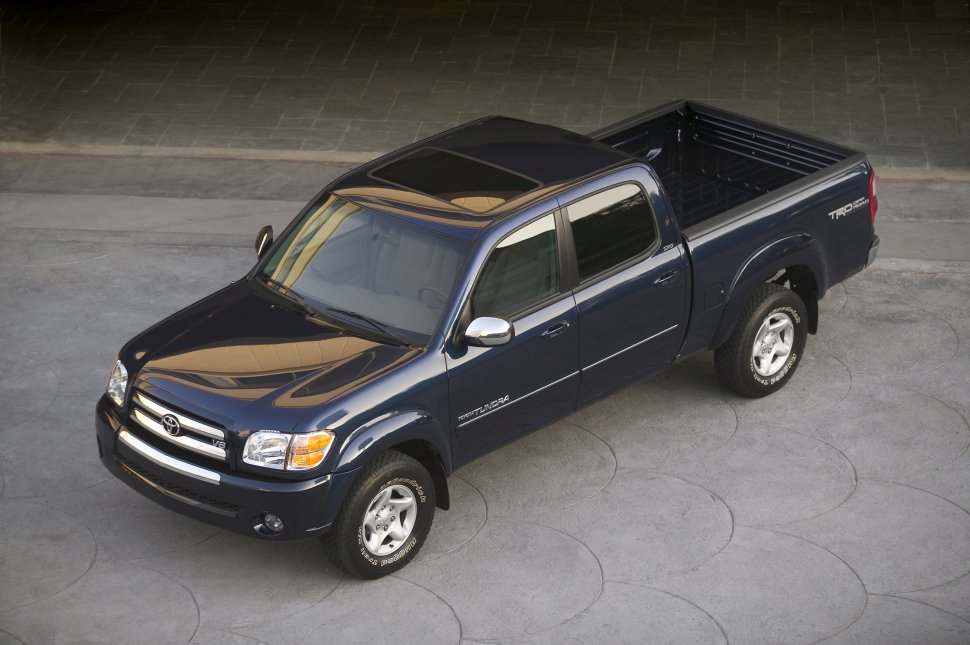
The Toyota Tundra, launched in 1999, represented Toyota’s initial full-size pickup truck offering, specifically designed to penetrate the highly competitive North American market. The first generation, designated the Tundra I, underwent a significant facelift in 2002, enhancing its styling and features. The 2002-2004 Tundra Double Cab SR5 4.7i V8, powered by the 2UZ-FE engine, was a key variant within this generation, offering a blend of power, space, and reliability aimed at families and those requiring substantial cargo capacity. This model aimed to challenge established domestic manufacturers like Ford, Chevrolet, and Dodge in the full-size truck segment.
Toyota Tundra I Double Cab (2002-2004)
The facelifted Tundra I Double Cab, produced from 2002 to 2004, built upon the foundation of the original model, addressing some early criticisms and refining the overall package. The Double Cab configuration, offering seating for five passengers, was particularly popular, providing a viable alternative to larger SUVs for families needing both passenger space and truck functionality. The SR5 trim level represented a step up in features and appointments, making it a well-rounded option for both work and personal use. The 4.7-liter V8 engine was the top engine choice, delivering substantial power for towing and hauling.
Engine & Performance
The heart of the 2002-2004 Toyota Tundra I Double Cab SR5 was the 2UZ-FE 4.7-liter V8 engine. This naturally aspirated powerplant produced 240 horsepower at 4800 rpm and 427 Nm (314.94 lb.-ft.) of torque at 3400 rpm. The engine featured a robust cast-iron block and aluminum cylinder heads, along with a double overhead camshaft (DOHC) valvetrain with four valves per cylinder. Fuel delivery was managed by a multi-port manifold injection system. This configuration provided a good balance of power and durability, making it suitable for demanding tasks. The engine’s power-to-weight ratio was 8.9 kg/Hp, or 112 Hp/tonne, and the torque-to-weight ratio was 5 kg/Nm, or 199.3 Nm/tonne. Power per liter was a respectable 51.5 Hp/l. The engine was paired with a 4-speed automatic transmission (ECT) driving the rear wheels, providing smooth and reliable shifting.
Design & Features
The 2002-2004 Tundra Double Cab was a traditional body-on-frame pickup truck, offering a rugged and durable construction. The Double Cab configuration extended the cab length to accommodate a second row of seats, significantly increasing passenger capacity compared to standard cab models. The SR5 trim included features such as upgraded interior materials, power windows and locks, and air conditioning. Safety features for the era included Anti-lock Braking System (ABS). The truck’s exterior styling was conservative but functional, with a focus on durability and practicality. The Tundra offered a substantial payload capacity of 851 kg (1876.13 lbs.) and a permitted trailer load with brakes of 2268 kg (5000.08 lbs.), making it a capable work vehicle. Ground clearance was a generous 277 mm (10.91 in.), enhancing its off-road capability. The approach and departure angles of 25° and 23° respectively, further aided in navigating challenging terrain.
Technical Specifications
| Brand | Toyota |
| Model | Tundra |
| Generation | Tundra I Double Cab (facelift 2002) |
| Type (Engine) | SR5 4.7i V8 (240 Hp) Automatic |
| Start of production | 2002 |
| End of production | 2004 |
| Powertrain Architecture | Internal Combustion engine |
| Body type | Pick-up |
| Seats | 5 |
| Doors | 4 |
| Fuel consumption (urban) | 16.8 l/100 km (14 US mpg / 16.8 UK mpg) |
| Fuel consumption (extra urban) | 13 l/100 km (18.1 US mpg / 21.7 UK mpg) |
| Fuel Type | Petrol (Gasoline) |
| Weight-to-power ratio | 8.9 kg/Hp |
| Weight-to-torque ratio | 5 kg/Nm |
| Power | 240 Hp @ 4800 rpm |
| Torque | 427 Nm @ 3400 rpm (314.94 lb.-ft. @ 3400 rpm) |
| Engine layout | Front, Longitudinal |
| Engine Model/Code | 2UZ-FE |
| Engine displacement | 4664 cm3 (284.61 cu. in.) |
| Number of cylinders | 8 |
| Engine configuration | V-engine |
| Cylinder Bore | 94 mm (3.7 in.) |
| Piston Stroke | 84 mm (3.31 in.) |
| Compression ratio | 9.6:1 |
| Number of valves per cylinder | 4 |
| Fuel injection system | Multi-port manifold injection |
| Engine aspiration | Naturally aspirated engine |
| Valvetrain | DOHC |
| Engine oil capacity | 6.2 l (6.55 US qt | 5.46 UK qt) |
| Coolant capacity | 11.7 l (12.36 US qt | 10.29 UK qt) |
| Kerb Weight | 2143 kg (4724.51 lbs.) |
| Max. weight | 2994 kg (6600.64 lbs.) |
| Max load | 851 kg (1876.13 lbs.) |
| Fuel tank capacity | 100 l (26.42 US gal | 22 UK gal) |
| Length | 5845 mm (230.12 in.) |
| Width | 2014 mm (79.29 in.) |
| Height | 1879 mm (73.98 in.) |
| Wheelbase | 3271 mm (128.78 in.) |
| Front track | 1673 mm (65.87 in.) |
| Rear track | 1709 mm (67.28 in.) |
| Ride height (ground clearance) | 277 mm (10.91 in.) |
| Minimum turning circle | 14.4 m (47.24 ft.) |
| Drivetrain Architecture | Rear wheel drive |
| Number of gears and type of gearbox | 4 gears, automatic transmission ECT |
| Front suspension | Double wishbone |
| Rear suspension | Leaf spring |
| Front brakes | Ventilated discs |
| Rear brakes | Drum |
| Assisting systems | ABS (Anti-lock braking system) |
| Steering type | Steering rack and pinion |
| Tires size | 245/70 R16 |
| Wheel rims size | 7.0J x 16 |
The 2002-2004 Toyota Tundra I Double Cab SR5 4.7i V8 represented a significant step for Toyota in the full-size pickup truck market. While it didn’t immediately displace the established domestic brands, it earned a reputation for reliability, durability, and a comfortable ride, laying the groundwork for the Tundra’s continued success in subsequent generations. Its blend of power, space, and features made it a compelling option for buyers seeking a capable and dependable full-size truck.