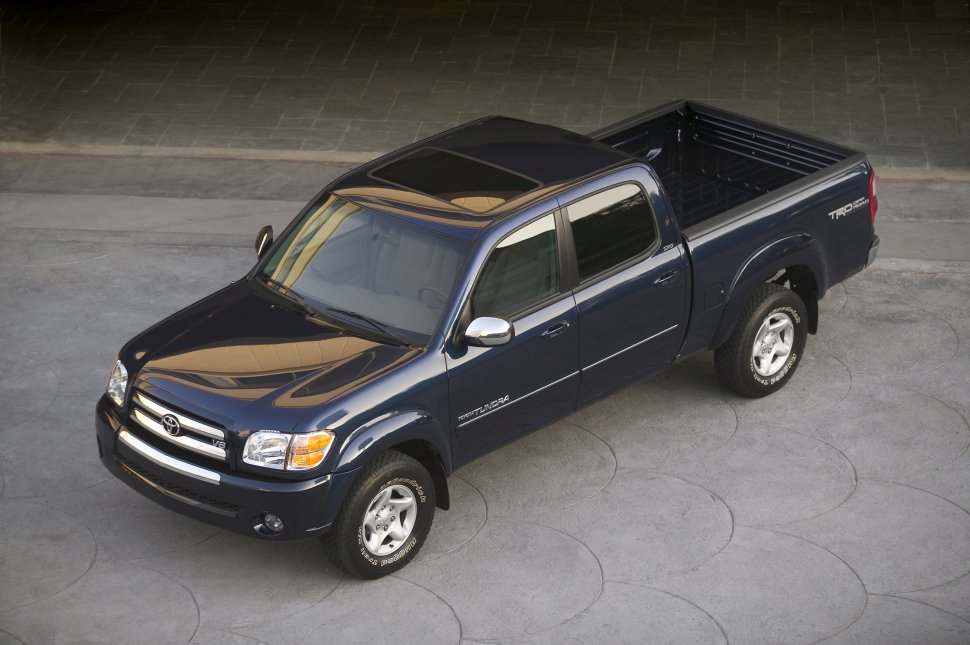
The Toyota Tundra, launched in 1999, represented Toyota’s initial full-size pickup truck offering, specifically designed to compete in the North American market dominated by domestic manufacturers like Ford, Chevrolet, and Dodge. The first generation Tundra (UCP/XP30 series) aimed to provide a more refined and reliable alternative, focusing on build quality and longevity. The 2005-2006 model years represent a significant facelift for the first generation, introducing updated styling, improved features, and enhanced performance. The Tundra I Double Cab (facelift 2002) SR5 4.7i V8 Automatic, as detailed here, was a key variant within this updated range, offering a spacious cabin and robust V8 power.
Toyota Tundra I Double Cab (Facelift 2002) SR5 4.7i V8
The Tundra Double Cab, particularly the SR5 trim with the 4.7-liter V8 engine, was positioned as a versatile option for families and those needing both passenger space and substantial hauling capacity. The “SR5” designation signified a step up in features and appointments compared to the base model, offering a balance of comfort and capability. This facelifted version, produced from 2005 to 2006, addressed some of the initial criticisms of the first-generation Tundra, improving its overall appeal and competitiveness in the full-size truck segment.
Engine & Performance
At the heart of the 2005-2006 Tundra SR5 Double Cab lay the 2UZ-FE 4.7-liter V8 engine. This naturally aspirated powerplant produced 282 horsepower at 5400 rpm and 441 Newton-meters (325.26 lb.-ft.) of torque at 3400 rpm. The engine featured a robust cast-iron block and aluminum cylinder heads, along with a double overhead camshaft (DOHC) valvetrain with four valves per cylinder. Fuel delivery was managed by a multi-port manifold injection system. This configuration provided a good balance of power and reliability, making it suitable for both everyday driving and demanding tasks like towing. The engine’s power-to-weight ratio was 7.7 kg/Hp, or 130.5 Hp/tonne, and the torque-to-weight ratio was 4.9 kg/Nm, or 204.1 Nm/tonne. Power per liter was a respectable 60.5 Hp/l. The engine was paired with a 5-speed automatic transmission (ECT – Electronically Controlled Transmission) driving the rear wheels. Fuel economy was rated at 14.7 l/100 km (16 US mpg, 19.2 UK mpg, 6.8 km/l) in urban conditions and 13 l/100 km (18.1 US mpg, 21.7 UK mpg, 7.7 km/l) on the extra-urban cycle.
Design & Features
The Tundra Double Cab was a four-door, five-seat pickup truck with a distinctively styled body. The 2005-2006 facelift brought revised front-end styling, including a new grille, headlights, and bumper. The interior was designed with practicality and comfort in mind, offering ample space for passengers and cargo. The Double Cab configuration provided significantly more rear-seat legroom than the standard cab models. The SR5 trim level included features such as air conditioning, power windows and locks, and an upgraded audio system. Safety features, while not as comprehensive as modern standards, included Anti-lock Braking System (ABS). The truck’s dimensions were substantial, measuring 5845 mm (230.12 in.) in length, 2014 mm (79.29 in.) in width, and 1879 mm (73.98 in.) in height. Ground clearance was a generous 277 mm (10.91 in.), enhancing its off-road capability. The Tundra’s suspension utilized a double wishbone setup at the front and a traditional leaf spring arrangement at the rear, optimized for both ride comfort and load-carrying capacity.
Technical Specifications
| Brand | Toyota |
| Model | Tundra |
| Generation | Tundra I Double Cab (facelift 2002) |
| Type (Engine) | SR5 4.7i V8 (282 Hp) Automatic |
| Start of production | 2005 |
| End of production | 2006 |
| Powertrain Architecture | Internal Combustion engine |
| Body type | Pick-up |
| Seats | 5 |
| Doors | 4 |
| Fuel consumption (urban) | 14.7 l/100 km (16 US mpg, 19.2 UK mpg) |
| Fuel consumption (extra urban) | 13 l/100 km (18.1 US mpg, 21.7 UK mpg) |
| Fuel Type | Petrol (Gasoline) |
| Weight-to-power ratio | 7.7 kg/Hp |
| Weight-to-torque ratio | 4.9 kg/Nm |
| Power | 282 Hp @ 5400 rpm |
| Torque | 441 Nm @ 3400 rpm (325.26 lb.-ft. @ 3400 rpm) |
| Engine layout | Front, Longitudinal |
| Engine Model/Code | 2UZ-FE |
| Engine displacement | 4664 cm3 (284.61 cu. in.) |
| Number of cylinders | 8 |
| Engine configuration | V-engine |
| Cylinder Bore | 94 mm (3.7 in.) |
| Piston Stroke | 84 mm (3.31 in.) |
| Compression ratio | 9.6:1 |
| Number of valves per cylinder | 4 |
| Fuel injection system | Multi-port manifold injection |
| Engine aspiration | Naturally aspirated |
| Valvetrain | DOHC |
| Engine oil capacity | 6.2 l (6.55 US qt | 5.46 UK qt) |
| Coolant capacity | 11.7 l (12.36 US qt | 10.29 UK qt) |
| Kerb Weight | 2161 kg (4764.19 lbs.) |
| Max. weight | 2994 kg (6600.64 lbs.) |
| Max load | 833 kg (1836.45 lbs.) |
| Fuel tank capacity | 100 l (26.42 US gal | 22 UK gal) |
| Permitted trailer load with brakes (12%) | 3084 kg (6799.06 lbs.) |
| Length | 5845 mm (230.12 in.) |
| Width | 2014 mm (79.29 in.) |
| Height | 1879 mm (73.98 in.) |
| Wheelbase | 3271 mm (128.78 in.) |
| Front track | 1673 mm (65.87 in.) |
| Rear track | 1709 mm (67.28 in.) |
| Ride height (ground clearance) | 277 mm (10.91 in.) |
| Minimum turning circle | 14.4 m (47.24 ft.) |
| Approach angle | 25° |
| Departure angle | 23° |
| Drivetrain | Rear wheel drive |
| Number of gears | 5 |
| Gearbox type | Automatic transmission ECT |
| Front suspension | Double wishbone |
| Rear suspension | Leaf spring |
| Front brakes | Ventilated discs |
| Rear brakes | Drum |
| Assisting systems | ABS (Anti-lock braking system) |
| Steering type | Steering rack and pinion |
| Tires size | 265/65 R17 |
| Wheel rims size | 7.5J x 17 |
The Toyota Tundra I Double Cab (facelift 2002) SR5 4.7i V8 Automatic, while superseded by later generations, remains a significant vehicle in Toyota’s history. It demonstrated the company’s commitment to entering and competing in the highly competitive North American full-size truck market, establishing a foundation for the Tundra’s continued success and reputation for reliability.