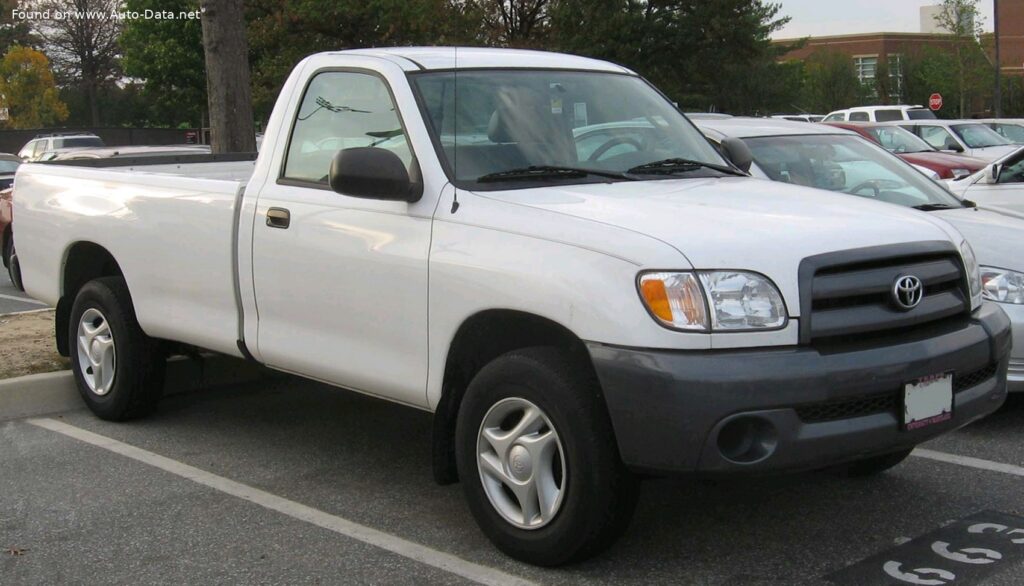
The Toyota Tundra I Regular Cab (facelift 2002) represents Toyota’s initial foray into the full-size pickup truck market in North America. Introduced to challenge established domestic manufacturers like Ford, Chevrolet, and Dodge, the Tundra aimed to offer a blend of reliability, durability, and value. The 2002 facelift brought refinements to the original Tundra design, enhancing its appeal and competitiveness. This generation Tundra, specifically the 4.0i V6 model, was positioned as a workhorse vehicle, catering to buyers needing a robust and capable truck for both personal and commercial use. While not as widely recognized as later Tundra iterations, the first-generation model laid the foundation for Toyota’s success in the full-size truck segment.
Toyota Tundra I Regular Cab (2002-2004)
The Tundra I, produced from 1999 to 2006, underwent a significant facelift in 2002. This refresh included styling updates, interior enhancements, and mechanical improvements. The Regular Cab configuration, with its two doors and seating for up to four passengers, was a popular choice for those prioritizing practicality and affordability. The 4.0i V6 engine option provided a balance of power and fuel efficiency, making it suitable for a wide range of tasks. The Tundra was designed with a focus on longevity and ease of maintenance, aligning with Toyota’s reputation for building reliable vehicles.
Engine & Performance
The 2002-2004 Toyota Tundra I Regular Cab 4.0i V6 is powered by the 1GR-FE engine, a 3.956-liter (241.41 cubic inches) naturally aspirated V6. This engine produces 245 horsepower at 5200 rpm and 382 Nm (281.75 lb-ft) of torque at 3800 rpm. The engine features a double overhead camshaft (DOHC) valvetrain with four valves per cylinder and utilizes a multi-port fuel injection system. The engine’s power-to-weight ratio is 7.3 kg/Hp, or 136.3 Hp/tonne, and the torque-to-weight ratio is 4.7 kg/Nm, or 212.5 Nm/tonne. Power is delivered to the rear wheels via a six-speed manual transmission. The longitudinal engine layout contributes to a balanced weight distribution. Fuel economy is rated at 13 liters per 100 kilometers (18.1 US mpg, 21.7 UK mpg, 7.7 km/l) in urban driving and 10.6 liters per 100 kilometers (22.2 US mpg, 26.6 UK mpg, 9.4 km/l) in extra-urban conditions.
Design & Features
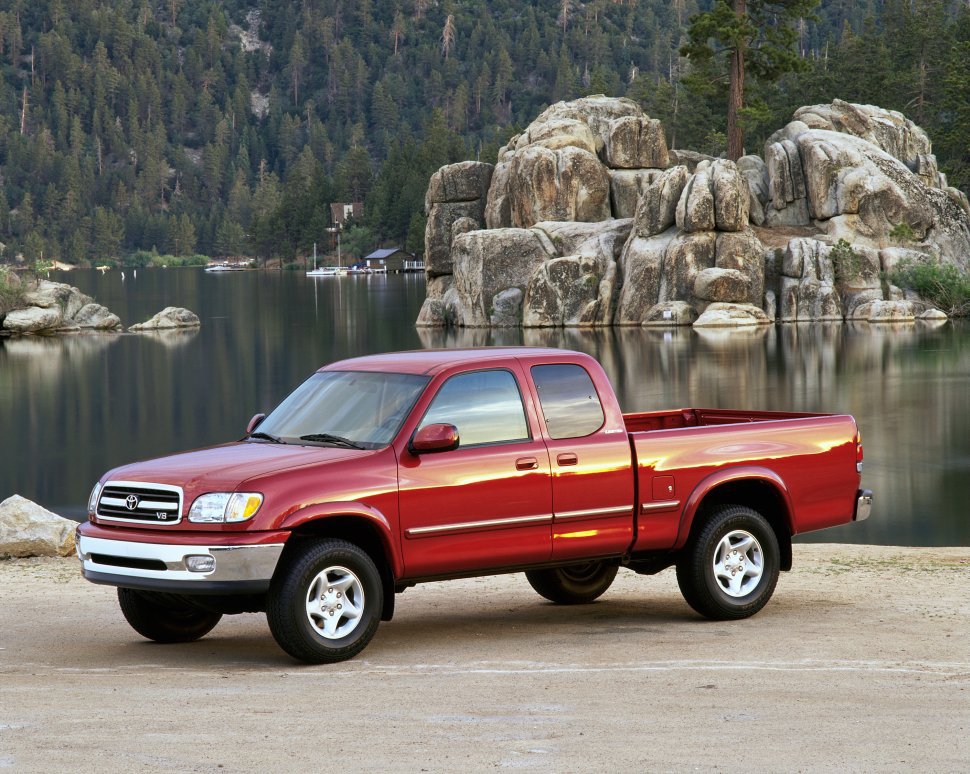
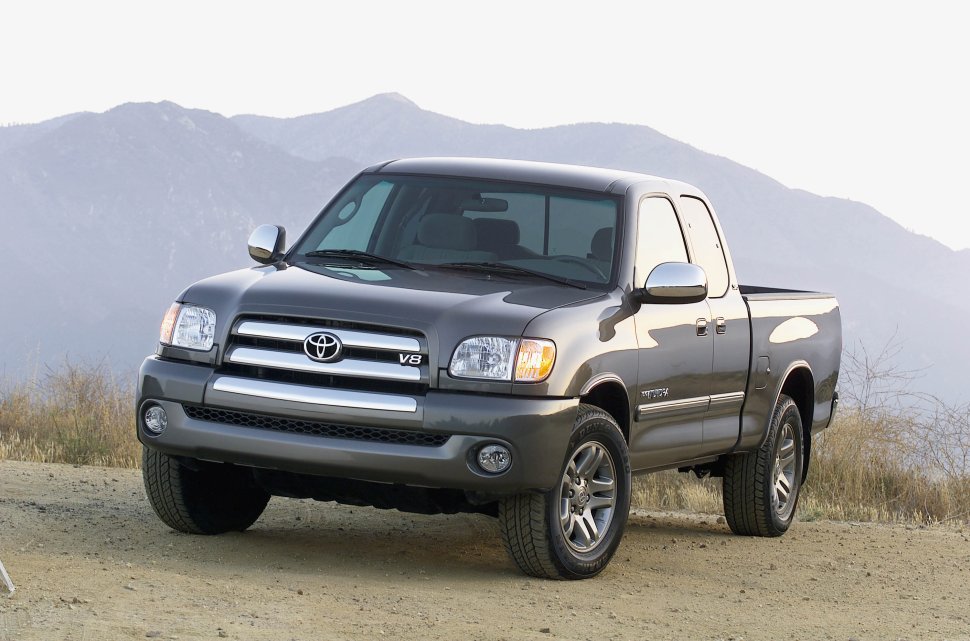
The Tundra I Regular Cab is a traditional pick-up truck with a separate body-on-frame construction. The 2002 facelift brought subtle styling changes to the front fascia, including a revised grille and headlights. The interior was updated with improved materials and a more ergonomic layout. The truck bed offers a generous 2625 liters (92.7 cubic feet) of cargo space. Safety features for the era included an Anti-lock Braking System (ABS). The Tundra’s ride height provides 264 mm (10.39 inches) of ground clearance, enhancing its off-road capability. Approach and departure angles are 26° and 23° respectively. The vehicle’s dimensions are 5545 mm (218.31 inches) in length, 1910 mm (75.2 inches) in width, and 1796 mm (70.71 inches) in height, with a wheelbase of 3259 mm (128.31 inches). The Tundra’s design prioritized functionality and durability, making it a practical choice for work and recreational use.
Technical Specifications
| Brand | Toyota |
| Model | Tundra |
| Generation | Tundra I Regular Cab (facelift 2002) |
| Type (Engine) | 4.0i V6 (245 Hp) |
| Start of production | 2002 |
| End of production | 2004 |
| Powertrain Architecture | Internal Combustion engine |
| Body type | Pick-up |
| Seats | 4 |
| Doors | 2 |
| Fuel consumption (urban) | 13 l/100 km (18.1 US mpg, 21.7 UK mpg) |
| Fuel consumption (extra urban) | 10.6 l/100 km (22.2 US mpg, 26.6 UK mpg) |
| Fuel Type | Petrol (Gasoline) |
| Weight-to-power ratio | 7.3 kg/Hp |
| Weight-to-torque ratio | 4.7 kg/Nm |
| Power | 245 Hp @ 5200 rpm |
| Torque | 382 Nm @ 3800 rpm (281.75 lb.-ft. @ 3800 rpm) |
| Engine layout | Front, Longitudinal |
| Engine Model/Code | 1GR-FE |
| Engine displacement | 3956 cm3 (241.41 cu. in.) |
| Number of cylinders | 6 |
| Engine configuration | V-engine |
| Cylinder Bore | 94 mm (3.7 in.) |
| Piston Stroke | 95 mm (3.74 in.) |
| Compression ratio | 10:1 |
| Number of valves per cylinder | 4 |
| Fuel injection system | Multi-port manifold injection |
| Engine aspiration | Naturally aspirated |
| Valvetrain | DOHC |
| Engine oil capacity | 6.2 l (6.55 US qt | 5.46 UK qt) |
| Coolant capacity | 11.7 l (12.36 US qt | 10.29 UK qt) |
| Kerb Weight | 1798 kg (3963.91 lbs.) |
| Max. weight | 2494 kg (5498.33 lbs.) |
| Max load | 696 kg (1534.42 lbs.) |
| Trunk (boot) space – maximum | 2625 l (92.7 cu. ft.) |
| Fuel tank capacity | 100 l (26.42 US gal | 22 UK gal) |
| Permitted trailer load with brakes (12%) | 2268 kg (5000.08 lbs.) |
| Length | 5545 mm (218.31 in.) |
| Width | 1910 mm (75.2 in.) |
| Height | 1796 mm (70.71 in.) |
| Wheelbase | 3259 mm (128.31 in.) |
| Front track | 1681 mm (66.18 in.) |
| Rear track | 1648 mm (64.88 in.) |
| Ride height (ground clearance) | 264 mm (10.39 in.) |
| Minimum turning circle | 13.6 m (44.62 ft.) |
| Front suspension | Double wishbone |
| Rear suspension | Leaf spring |
| Front brakes | Ventilated discs |
| Rear brakes | Drum |
| Assisting systems | ABS (Anti-lock braking system) |
| Steering type | Steering rack and pinion |
| Tires size | 245/70 R16; 265/70 R16; 265/65 R17 |
| Wheel rims size | 7.0J x 16; 7.5J x 17 |
| Drive wheel | Rear wheel drive |
| Number of gears | 6 gears, manual transmission |