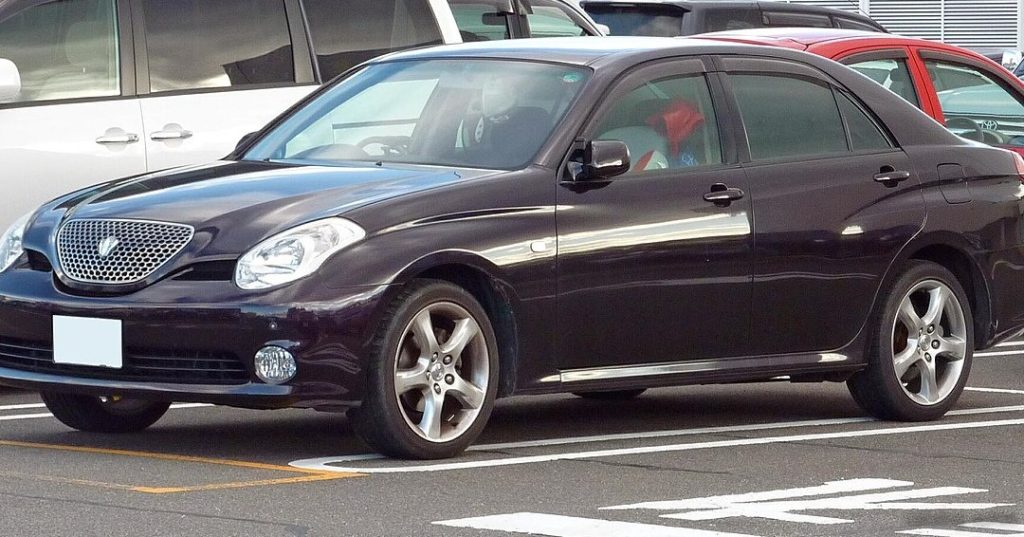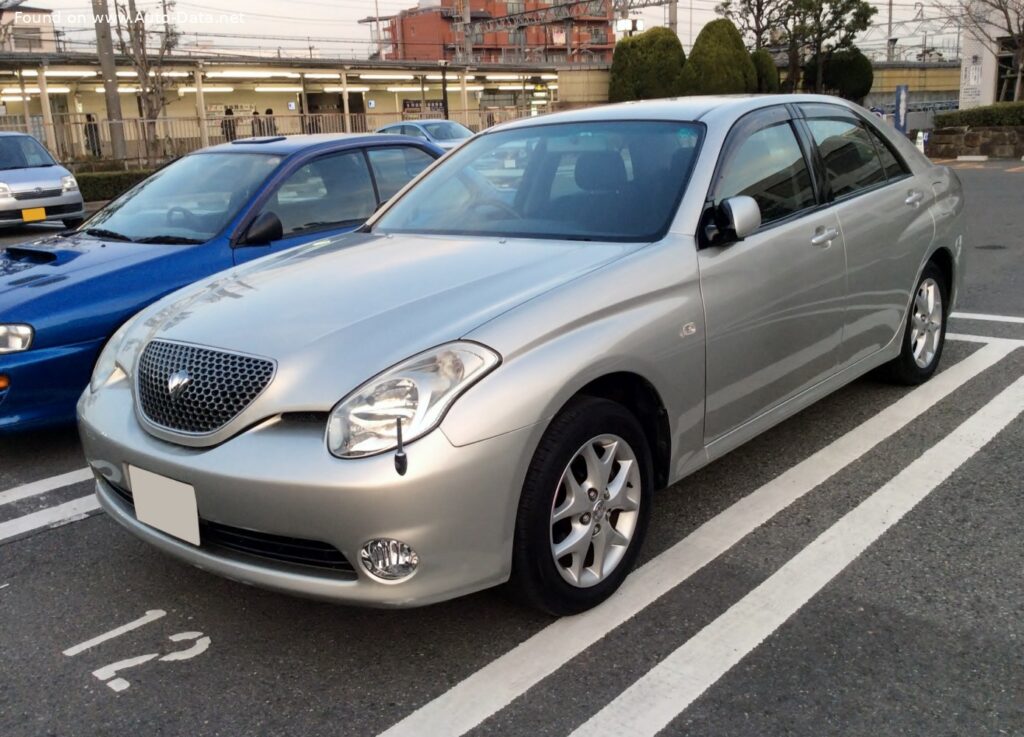
The Toyota Verossa 2.5 i 24V VVT-i (200 Hp) represents a distinctive chapter in Toyota’s history, particularly within the Japanese Domestic Market (JDM). Launched in 2001, the Verossa was positioned as a sport-luxury sedan, intended to succeed the long-running Chaser and Cresta models, which had garnered a strong following for their blend of performance and comfort. Sharing its platform with the more conservative Mark II and the upscale Brevis, the Verossa distinguished itself with a bold, somewhat polarizing design language that marked a significant departure from Toyota’s traditionally restrained styling cues. Its production run was relatively brief, concluding in 2003, making it a unique and somewhat rare sight even in its home market. This specific variant, powered by the advanced 2.5-liter 1JZ-FSE engine, offered a compelling combination of refined inline-six performance, modern technology, and rear-wheel-drive dynamics, catering to drivers seeking a sophisticated yet engaging driving experience.
Engine and Performance of the Toyota Verossa
At the heart of the Toyota Verossa 2.5 i 24V VVT-i (200 Hp) lies the revered 1JZ-FSE engine, a 2.5-liter (2492 cm3 or 152.07 cu. in.) naturally aspirated inline-six powerplant. This engine is a cornerstone of Toyota’s engineering prowess, known for its inherent balance and smoothness. Producing a robust 200 horsepower at 6000 revolutions per minute (rpm), it delivers impressive acceleration and highway cruising capability. The power output translates to a healthy 80.3 horsepower per liter, indicating efficient design for a naturally aspirated engine of its era. Torque figures stand at 250 Newton-meters, which converts to 184.39 lb.-ft. available at a relatively low 3800 rpm. This broad torque band ensures responsive performance across the rev range, making the Verossa feel eager whether navigating city streets or tackling winding roads.
A key technological highlight of the 1JZ-FSE engine is its Variable Valve Timing with intelligence (VVT-i) system. This sophisticated mechanism continuously adjusts the timing of the intake and exhaust valves, optimizing engine breathing for maximum efficiency and power delivery across varying engine speeds. This not only contributes to the engine’s impressive power output but also enhances fuel economy and reduces emissions. Furthermore, the “FSE” designation signifies that this engine employs a direct injection fuel system. Direct injection precisely sprays fuel directly into the combustion chambers, rather than into the intake manifold, allowing for more accurate fuel metering and a higher compression ratio of 11:1. This results in more complete combustion, yielding greater power, improved fuel efficiency, and lower emissions compared to conventional port injection systems.
The engine’s layout is front, longitudinal, a classic configuration for rear-wheel-drive performance sedans, contributing to balanced weight distribution and superior handling characteristics. With six cylinders arranged in an inline configuration and a DOHC (Double Overhead Camshaft) valvetrain with four valves per cylinder, the engine is designed for optimal airflow and high-rpm capability. The bore and stroke measurements of 86 mm (3.39 in.) and 71.5 mm (2.81 in.), respectively, indicate an oversquare design, typically favoring higher revs and power delivery. Power is channeled through a precise 5-speed manual transmission, offering the driver direct control over the engine’s output and reinforcing the Verossa’s sporty credentials. This combination of a powerful, refined inline-six engine and a manual gearbox provides an engaging and rewarding driving experience, especially for enthusiasts.
In terms of dynamic metrics, the Verossa boasts a weight-to-power ratio of 7.5 kg/Hp (134.2 Hp/tonne) and a weight-to-torque ratio of 6 kg/Nm (167.8 Nm/tonne). These figures suggest a nimble and responsive vehicle for its class and era. With a kerb weight of 3284.89 lbs. (1490 kg), the Verossa strikes a good balance between structural rigidity and overall mass, contributing to its agile handling and comfortable ride. The fuel tank capacity of 18.49 US gallons (70 liters) ensures a respectable cruising range, making it suitable for longer journeys.
Design and Features of the Toyota Verossa
The Toyota Verossa’s design was arguably its most defining characteristic, setting it apart with a bold and somewhat controversial aesthetic. As a four-door sedan with seating for five, it maintained the practicalities expected of its segment, but its exterior styling was anything but conventional. Departing from the more conservative lines of its platform-mates, the Verossa featured a distinctive front fascia with unique headlamps and a prominent grille that gave it a highly individualistic look. Its sculpted body lines and flowing profile aimed to evoke a sense of dynamism and luxury, though its visual impact was a subject of much debate among enthusiasts and the general public alike.
Dimensionally, the Verossa is a substantial vehicle, measuring 187.99 inches (4775 mm) in length, 69.29 inches (1760 mm) in width, and 57.09 inches (1450 mm) in height. Its generous wheelbase of 109.45 inches (2780 mm) contributes significantly to both interior passenger comfort and ride stability. The front track of 58.86 inches (1495 mm) and a rear track of 58.07 inches (1475 mm) provide a wide stance, enhancing handling stability and road presence. These dimensions, combined with its rear-wheel-drive architecture, underscore its positioning as a sport-luxury sedan designed for both spirited driving and comfortable cruising.
Underpinning the Verossa’s dynamic capabilities is a sophisticated suspension system. Both the front and rear axles utilize a double wishbone setup. This type of independent suspension is highly regarded for its ability to maintain optimal tire contact with the road surface, even during aggressive cornering or over uneven terrain. This translates to superior handling precision, enhanced grip, and a remarkably comfortable ride, effectively absorbing road imperfections while minimizing body roll. The Verossa’s braking system comprises ventilated discs at the front and solid discs at the rear, providing strong and consistent stopping power. The inclusion of an Anti-lock Braking System (ABS) as standard further enhances safety by preventing wheel lock-up during hard braking, allowing the driver to maintain steering control.
Steering is managed by a rack and pinion system, renowned for its directness and responsiveness. Coupled with hydraulic power steering, the system provides excellent tactile feedback to the driver, enhancing the sense of connection with the road. The Verossa rides on 215/45 R17 tires, a size indicative of its sporty aspirations, offering a good balance of grip, ride comfort, and aesthetic appeal. The overall drivetrain architecture, where the internal combustion engine drives the rear wheels, is a hallmark of performance-oriented vehicles, offering a purer steering feel unburdened by drive forces and the ability to transfer power effectively to the road during acceleration. The interior, while not explicitly detailed in the specifications, would have undoubtedly offered a high level of refinement, comfort, and technological amenities befitting its luxury sedan status in the Japanese market, focusing on a driver-centric cockpit and spacious passenger accommodations.
Technical Specifications: Toyota Verossa 2.5 i 24V VVT-i (200 Hp)
| Brand | Toyota |
| Model | Verossa |
| Generation | Verossa |
| Type (Engine) | 2.5 i 24V VVT-i (200 Hp) |
| Start of production | 2001 year |
| End of production | 2003 year |
| Powertrain Architecture | Internal Combustion engine |
| Body type | Sedan |
| Seats | 5 |
| Doors | 4 |
| Fuel Type | Petrol (Gasoline) |
| Weight-to-power ratio | 7.5 kg/Hp, 134.2 Hp/tonne |
| Weight-to-torque ratio | 6 kg/Nm, 167.8 Nm/tonne |
| Power | 200 Hp @ 6000 rpm. |
| Power per litre | 80.3 Hp/l |
| Torque | 250 Nm @ 3800 rpm. (184.39 lb.-ft. @ 3800 rpm.) |
| Engine layout | Front, Longitudinal |
| Engine Model/Code | 1JZ-FSE |
| Engine displacement | 2492 cm3 (2.5 l, 152.07 cu. in.) |
| Number of cylinders | 6 |
| Engine configuration | V-engine |
| Cylinder Bore | 86 mm (3.39 in.) |
| Piston Stroke | 71.5 mm (2.81 in.) |
| Compression ratio | 11:1 |
| Number of valves per cylinder | 4 |
| Fuel injection system | Direct injection |
| Engine aspiration | Naturally aspirated engine |
| Valvetrain | DOHC |
| Engine oil capacity | 5.4 l (5.71 US qt | 4.75 UK qt) |
| Coolant | 6.9 l (7.29 US qt | 6.07 UK qt) |
| Kerb Weight | 1490 kg (3284.89 lbs.) |
| Max. weight | 1765 kg (3891.16 lbs.) |
| Max load | 275 kg (606.27 lbs.) |
| Fuel tank capacity | 70 l (18.49 US gal | 15.4 UK gal) |
| Length | 4775 mm (187.99 in.) |
| Width | 1760 mm (69.29 in.) |
| Height | 1450 mm (57.09 in.) |
| Wheelbase | 2780 mm (109.45 in.) |
| Front track | 1495 mm (58.86 in.) |
| Rear (Back) track | 1475 mm (58.07 in.) |
| Drivetrain Architecture | The Internal combustion engine (ICE) drives the rear wheels of the vehicle. |
| Drive wheel | Rear wheel drive |
| Number of gears and type of gearbox | 5 gears, manual transmission |
| Front suspension | Double wishbone |
| Rear suspension | Double wishbone |
| Front brakes | Ventilated discs |
| Rear brakes | Disc |
| Assisting systems | ABS (Anti-lock braking system) |
| Steering type | Steering rack and pinion |
| Power steering | Hydraulic Steering |
| Tires size | 215/45 R17 |