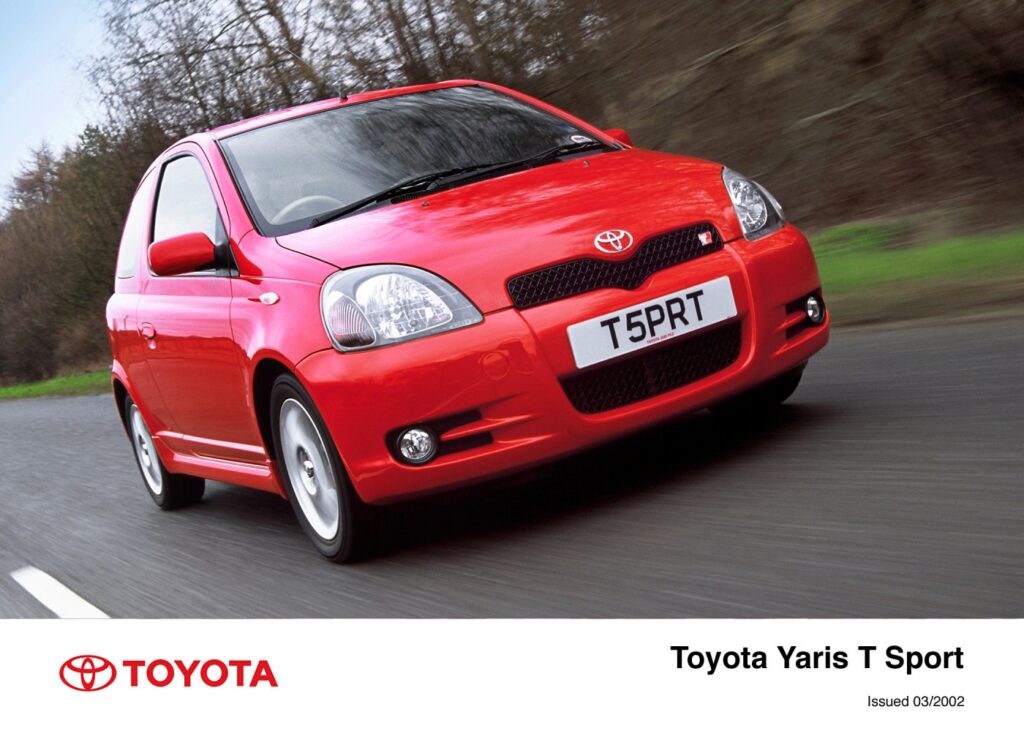
The Toyota Yaris, known in Japan as the Toyota Vitz, is a subcompact hatchback produced by Toyota since 1999. Representing Toyota’s entry into the burgeoning supermini segment, the Yaris was designed to be a thoroughly modern, space-efficient vehicle. The first generation, known as the Yaris I (XP10/NLP10 chassis codes), was particularly significant as it marked Toyota’s first attempt at a truly global small car. While the Yaris was sold extensively throughout Europe and Asia, it wasn’t initially offered in the North American market. This article details the 3-door version of the Yaris I, specifically the 1.0i 16V model with an automatic transmission, produced between 1999 and 2003.
Toyota Yaris I: A European Supermini
The Yaris I was conceived as a replacement for the Toyota Starlet, offering a more contemporary design and a focus on maximizing interior space within a small footprint. Its design prioritized practicality and fuel efficiency, appealing to urban drivers and those seeking an economical vehicle. The 3-door body style, while less common in the North American market, was popular in Europe where smaller cars are favored due to tighter city streets and higher fuel costs. The Yaris I quickly gained a reputation for reliability and affordability, establishing a strong foothold for Toyota in the competitive supermini class.
Engine & Performance
The 1.0i 16V variant of the Yaris I is powered by the 1SZ-FE engine, a 998 cc (60.9 cubic inches) inline-4 cylinder gasoline engine. This naturally aspirated engine produces 68 horsepower at 6000 rpm and 90 Nm (66.38 lb-ft) of torque at 4000 rpm. While not a performance-oriented engine, it was designed for efficiency and smooth operation. The engine features a multi-port fuel injection system and a double overhead camshaft (DOHC) valvetrain, contributing to its relatively refined performance for its size. Power is delivered to the front wheels via a 5-speed automatic transmission. Acceleration from 0 to 100 km/h (0-62 mph) takes 13.8 seconds, and the vehicle has a top speed of 155 km/h (96.31 mph). The 0-60 mph time is calculated at 13.1 seconds. The weight-to-power ratio is 12.2 kg/Hp, and the weight-to-torque ratio is 9.2 kg/Nm.
Design & Features
The Yaris I 3-door is a classic example of late-1990s/early-2000s hatchback design. Its compact dimensions (3615 mm/142.32 inches long, 1660 mm/65.35 inches wide, and 1500 mm/59.06 inches high) make it easy to maneuver in urban environments. The 3-door configuration emphasizes a sporty aesthetic, although it does compromise rear passenger access somewhat. The interior is designed to maximize space, offering seating for five passengers. The rear seats can be folded down to increase cargo capacity from a minimum of 305 liters (10.77 cubic feet) to a maximum of 950 liters (33.55 cubic feet). Safety features for the time included an Anti-lock Braking System (ABS). The Yaris I prioritized functionality and practicality over luxurious appointments, offering a simple and durable interior. The steering utilizes a hydraulic power steering rack and pinion system for ease of use.
Technical Specifications
| Brand | Toyota |
| Model | Yaris |
| Generation | Yaris I (3-door) |
| Type (Engine) | 1.0i 16V (68 Hp) Automatic |
| Start of production | 1999 |
| End of production | 2003 |
| Powertrain Architecture | Internal Combustion engine |
| Body type | Hatchback |
| Seats | 5 |
| Doors | 3 |
| Fuel consumption (urban) | 6.4 l/100 km (36.8 US mpg, 44.1 UK mpg, 15.6 km/l) |
| Fuel consumption (extra urban) | 4.9 l/100 km (48 US mpg, 57.6 UK mpg, 20.4 km/l) |
| Fuel consumption (combined) | 5.7 l/100 km (41.3 US mpg, 49.6 UK mpg, 17.5 km/l) |
| Fuel Type | Petrol (Gasoline) |
| Acceleration 0 – 100 km/h | 13.8 sec |
| Acceleration 0 – 62 mph | 13.8 sec |
| Acceleration 0 – 60 mph | 13.1 sec |
| Maximum speed | 155 km/h (96.31 mph) |
| Weight-to-power ratio | 12.2 kg/Hp |
| Weight-to-torque ratio | 9.2 kg/Nm |
| Power | 68 Hp @ 6000 rpm |
| Power per litre | 68.1 Hp/l |
| Torque | 90 Nm @ 4000 rpm (66.38 lb.-ft. @ 4000 rpm) |
| Engine layout | Front, Transverse |
| Engine Model/Code | 1SZ-FE |
| Engine displacement | 998 cm3 (60.9 cu. in.) |
| Number of cylinders | 4 |
| Engine configuration | Inline |
| Cylinder Bore | 69 mm (2.72 in.) |
| Piston Stroke | 66.7 mm (2.63 in.) |
| Compression ratio | 10:1 |
| Number of valves per cylinder | 4 |
| Fuel injection system | Multi-port manifold injection |
| Engine aspiration | Naturally aspirated engine |
| Valvetrain | DOHC |
| Engine oil capacity | 3.2 l (3.38 US qt | 2.82 UK qt) |
| Coolant | 4.6 l (4.86 US qt | 4.05 UK qt) |
| Kerb Weight | 830 kg (1829.84 lbs.) |
| Max. weight | 1320 kg (2910.1 lbs.) |
| Max load | 490 kg (1080.27 lbs.) |
| Trunk (boot) space – minimum | 305 l (10.77 cu. ft.) |
| Trunk (boot) space – maximum | 950 l (33.55 cu. ft.) |
| Fuel tank capacity | 45 l (11.89 US gal | 9.9 UK gal) |
| Length | 3615 mm (142.32 in.) |
| Width | 1660 mm (65.35 in.) |
| Height | 1500 mm (59.06 in.) |
| Wheelbase | 2370 mm (93.31 in.) |
| Front track | 1450 mm (57.09 in.) |
| Rear (Back) track | 1430 mm (56.3 in.) |
| Drivetrain Architecture | Front wheel drive |
| Number of gears and type of gearbox | 5 gears, automatic transmission |
| Front suspension | Spring Strut |
| Rear suspension | Coil spring |
| Front brakes | Ventilated discs |
| Rear brakes | Drum |
| Assisting systems | ABS (Anti-lock braking system) |
| Steering type | Steering rack and pinion |
| Power steering | Hydraulic Steering |
| Tires size | 155/80 R13 T |
| Wheel rims size | 13 |
The Toyota Yaris I, particularly the 1.0i 16V automatic, represents a significant step forward in small car design. Its focus on efficiency, practicality, and reliability cemented its position as a popular choice in Europe and Asia, and laid the groundwork for the continued success of the Yaris nameplate.