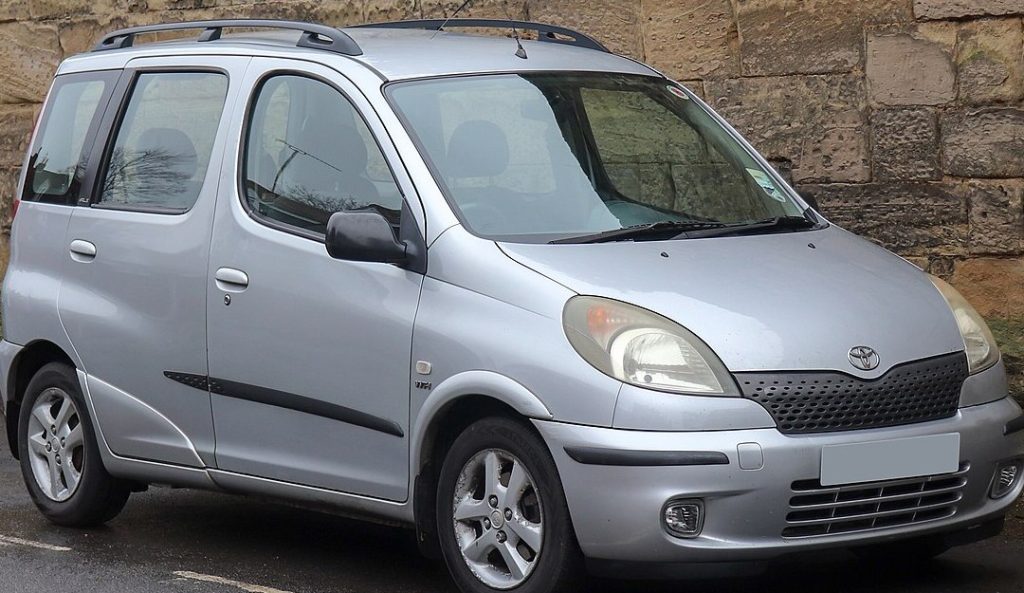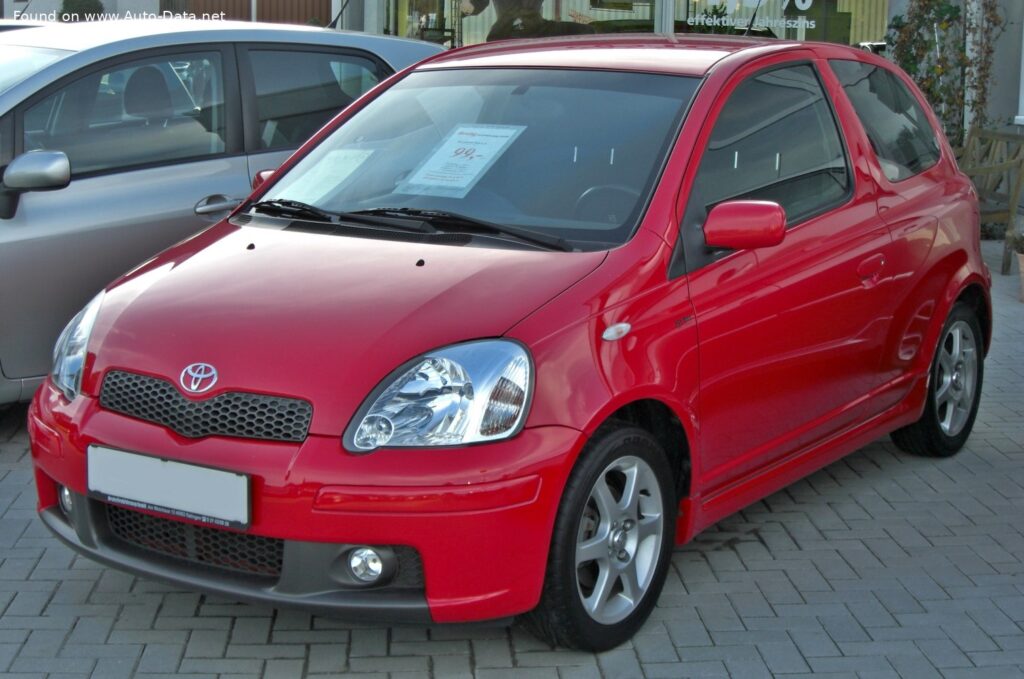
The Toyota Yaris, known in Japan as the Vitz, is a subcompact hatchback produced by Toyota since 1999. The first generation, known as the Yaris I, was a significant departure for Toyota, representing a move towards more contemporary styling and a focus on maximizing interior space within a small footprint. This article details the facelifted version of the Yaris I, produced from 2003 to 2005, specifically the 3-door model equipped with the 1.3-liter VVT-i engine producing 87 horsepower. While not initially a major seller in the United States, the Yaris gained popularity as a fuel-efficient and reliable option, particularly among urban drivers. The Yaris I established the model as a key player in the European and Asian subcompact market, competing with vehicles like the Volkswagen Polo and Honda Jazz.
Toyota Yaris I (Facelift 2003): An Overview
The 2003 facelift of the Yaris I brought subtle but important changes to the original design, including revised front and rear styling, interior refinements, and improvements to the engine for better efficiency and reduced emissions. The 3-door configuration offered a sportier aesthetic and appealed to buyers prioritizing maneuverability and ease of parking. This generation of Yaris was designed with a strong emphasis on practicality, offering a surprisingly spacious interior for its size and a versatile cargo area. The 1.3 VVT-i engine was a mainstay of the Yaris lineup, providing a balance of performance and fuel economy suitable for everyday driving.
Engine & Performance
The heart of the 2003 Toyota Yaris 1.3 VVT-i is the 2SZ-FE 1.3-liter inline-four cylinder engine. This naturally aspirated engine produces 87 horsepower at 6000 rpm and 122 Nm (89.98 lb.-ft.) of torque at 4200 rpm. The Variable Valve Timing-intelligent (VVT-i) system optimizes valve timing for improved performance and fuel efficiency across a wider range of engine speeds. Power is delivered to the front wheels via a 5-speed manual transmission. Acceleration from 0 to 100 km/h (0-62 mph) takes 12.1 seconds, while 0 to 60 mph is achieved in approximately 11.5 seconds. The Yaris 1.3 VVT-i has a top speed of 175 km/h (108.74 mph). The engine’s relatively low weight-to-power ratio of 10.3 kg/Hp contributes to its responsive feel, and the engine delivers 67 horsepower per liter of displacement.
Design & Features
The 2003 Yaris I facelift retained the high-roof, cab-forward design of the original, maximizing interior space. The 3-door hatchback body style provides a more dynamic appearance than the 5-door version. The interior is designed for practicality, with a focus on ergonomics and ease of use. The Yaris comfortably seats five passengers, although rear legroom is limited. The rear seats can be folded down to increase cargo capacity from a minimum of 205 liters (7.24 cu. ft.) to a maximum of 950 liters (33.55 cu. ft.). Safety features for this era included an Anti-lock Braking System (ABS) as standard equipment. The Yaris’s compact dimensions and electric power steering contribute to its excellent maneuverability, making it ideal for navigating congested city streets. The drag coefficient of 0.30 aids in fuel efficiency and reduces wind noise at higher speeds.
Technical Specifications
| Brand | Toyota |
| Model | Yaris |
| Generation | Yaris I (facelift 2003) 3-door |
| Type (Engine) | 1.3 VVT-i (87 Hp) |
| Start of production | 2003 |
| End of production | 2005 |
| Powertrain Architecture | Internal Combustion engine |
| Body type | Hatchback |
| Seats | 5 |
| Doors | 3 |
| Fuel consumption (urban) | 6.8 l/100 km (34.6 US mpg, 41.5 UK mpg, 14.7 km/l) |
| Fuel consumption (extra urban) | 4.9 l/100 km (48 US mpg, 57.6 UK mpg, 20.4 km/l) |
| Fuel consumption (combined) | 5.6 l/100 km (42 US mpg, 50.4 UK mpg, 17.9 km/l) |
| CO2 emissions | 133 g/km |
| Fuel Type | Petrol (Gasoline) |
| Acceleration 0 – 100 km/h | 12.1 sec |
| Acceleration 0 – 62 mph | 12.1 sec |
| Acceleration 0 – 60 mph | 11.5 sec |
| Maximum speed | 175 km/h (108.74 mph) |
| Emission standard | Euro 4 |
| Weight-to-power ratio | 10.3 kg/Hp |
| Weight-to-torque ratio | 7.3 kg/Nm |
| Power | 87 Hp @ 6000 rpm |
| Power per litre | 67 Hp/l |
| Torque | 122 Nm @ 4200 rpm (89.98 lb.-ft. @ 4200 rpm) |
| Engine layout | Front, Transverse |
| Engine Model/Code | 2SZ-FE |
| Engine displacement | 1298 cm3 (79.21 cu. in.) |
| Number of cylinders | 4 |
| Engine configuration | Inline |
| Cylinder Bore | 72 mm (2.83 in.) |
| Piston Stroke | 79.7 mm (3.14 in.) |
| Compression ratio | 10:1 |
| Number of valves per cylinder | 4 |
| Fuel injection system | Multi-port manifold injection |
| Engine aspiration | Naturally aspirated engine |
| Valvetrain | DOHC, VVT-i |
| Engine oil capacity | 3.2 l (3.38 US qt | 2.82 UK qt) |
| Coolant | 4.7 l (4.97 US qt | 4.14 UK qt) |
| Kerb Weight | 895-980 kg (1973.14 – 2160.53 lbs.) |
| Max. weight | 1385 kg (3053.4 lbs.) |
| Max load | 405-490 kg (892.87 – 1080.27 lbs.) |
| Trunk (boot) space – minimum | 205 l (7.24 cu. ft.) |
| Trunk (boot) space – maximum | 950 l (33.55 cu. ft.) |
| Fuel tank capacity | 45 l (11.89 US gal | 9.9 UK gal) |
| Permitted trailer load with brakes (12%) | 900 kg (1984.16 lbs.) |
| Permitted trailer load without brakes | 400 kg (881.85 lbs.) |
| Length | 3640 mm (143.31 in.) |
| Width | 1660 mm (65.35 in.) |
| Height | 1500 mm (59.06 in.) |
| Wheelbase | 2370 mm (93.31 in.) |
| Front track | 1440 mm (56.69 in.) |
| Rear (Back) track | 1420 mm (55.91 in.) |
| Drag coefficient (Cd) | 0.30 |
| Minimum turning circle (turning diameter) | 10.4 m (34.12 ft.) |
| Drivetrain Architecture | Front wheel drive |
| Number of gears and type of gearbox | 5 gears, manual transmission |
| Front suspension | Independent, type McPherson with coil spring and anti-roll bar |
| Rear suspension | Trailing arm, Coil spring, Torsion |
| Front brakes | Ventilated discs, 235 mm |
| Rear brakes | Drum |
| Assisting systems | ABS (Anti-lock braking system) |
| Steering type | Steering rack and pinion |
| Power steering | Electric Steering |
| Tires size | 175/65 R14 |
| Wheel rims size | 5.5J x 14 |