
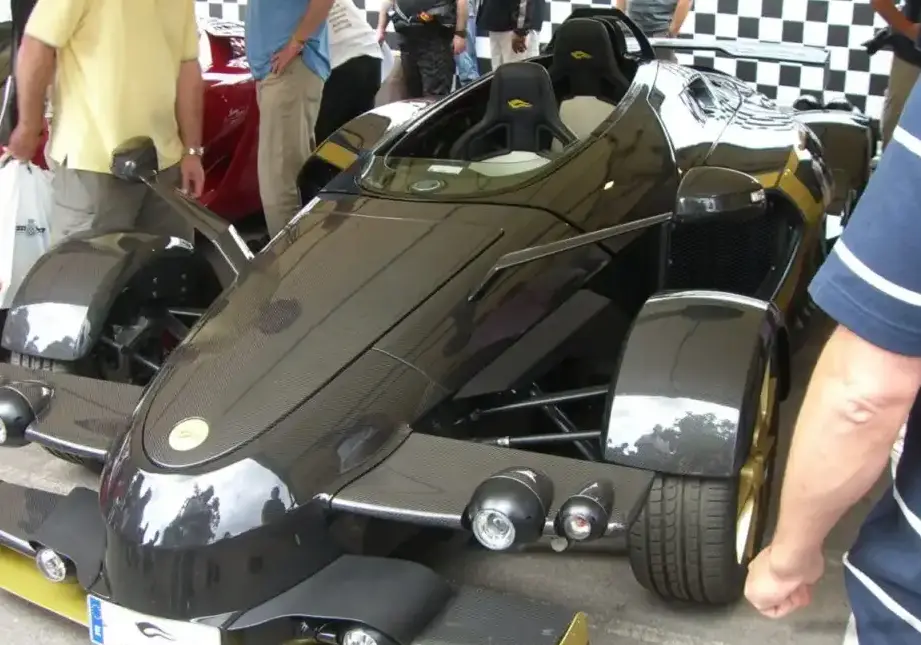
The Tramontana XTR 5.5 V12, launched in 2015, represents a highly exclusive and performance-focused offering in the world of bespoke sports cars. Built by the Spanish manufacturer Tramontana, the XTR is a two-seat roadster characterized by its striking design and potent powertrain. It’s positioned as a limited-production vehicle aimed at enthusiasts seeking a unique and exhilarating driving experience. The XTR doesn’t fit neatly into traditional market segments; it’s a low-volume, hand-built machine intended to compete with ultra-high-end sports cars and offer a level of personalization rarely seen in mass-produced vehicles.
Technical Specifications
| Brand | Tramontana |
| Model | XTR |
| Generation | XTR |
| Type (Engine) | 5.5 V12 (720 Hp) |
| Start of production | 2015 |
| Powertrain Architecture | Internal Combustion engine |
| Body type | Roadster |
| Seats | 2 |
| Doors | 1 |
| Fuel Type | Petrol (Gasoline) |
| Acceleration 0 – 100 km/h | 3.5 sec |
| Acceleration 0 – 62 mph | 3.5 sec |
| Acceleration 0 – 60 mph | 3.3 sec |
| Maximum speed | 300 km/h (186.41 mph) |
| Weight-to-power ratio | 1.9 kg/Hp, 529.4 Hp/tonne |
| Weight-to-torque ratio | 1.5 kg/Nm, 676.5 Nm/tonne |
| Power | 720 Hp @ 5850 rpm |
| Power per litre | 130.6 Hp/l |
| Torque | 920 Nm @ 4000 rpm (678.56 lb.-ft. @ 4000 rpm) |
| Engine layout | Middle, Longitudinal |
| Engine Model/Code | M 285 |
| Engine displacement | 5513 cm3 (336.42 cu. in.) |
| Number of cylinders | 12 |
| Engine configuration | V-engine |
| Cylinder Bore | 82 mm (3.23 in.) |
| Piston Stroke | 87 mm (3.43 in.) |
| Compression ratio | 9:1 |
| Number of valves per cylinder | 3 |
| Fuel injection system | Direct injection |
| Engine aspiration | Twin-Turbo, Intercooler |
| Valvetrain | SOHC |
| Engine oil capacity | 10 l (10.57 US qt | 8.8 UK qt) |
| Kerb Weight | 1360 kg (2998.29 lbs.) |
| Fuel tank capacity | 90 l (23.78 US gal | 19.8 UK gal) |
| Length | 4900 mm (192.91 in.) |
| Width | 2080 mm (81.89 in.) |
| Height | 1220-1275 mm (48.03 – 50.2 in.) |
| Wheelbase | 3050 mm (120.08 in.) |
| Front track | 1900 mm (74.8 in.) |
| Rear track | 1810 mm (71.26 in.) |
| Front overhang | 997 mm (39.25 in.) |
| Rear overhang | 780 mm (30.71 in.) |
| Approach angle | 6° |
| Departure angle | 12° |
| Drivetrain Architecture | The Internal combustion engine (ICE) drives the rear wheels of the vehicle. |
| Drive wheel | Rear wheel drive |
| Number of gears and type of gearbox | 6 gears, manual transmission |
| Front suspension | Double wishbone |
| Rear suspension | Double wishbone |
| Front brakes | Ventilated discs |
| Rear brakes | Ventilated discs |
| Assisting systems | ABS (Anti-lock braking system) |
| Steering type | Steering rack and pinion |
| Power steering | Hydraulic Steering |
Powertrain & Engine Architecture
The heart of the Tramontana XTR 5.5 V12 is its mid-mounted, longitudinally positioned 5.5-liter V12 engine, designated the M 285. This engine is notable for its twin-turbocharged configuration and direct fuel injection system, allowing it to produce a substantial 720 horsepower at 5850 rpm and 920 Nm (678.56 lb.-ft.) of torque at 4000 rpm. The engine utilizes a single overhead camshaft (SOHC) valvetrain with three valves per cylinder. The use of direct injection contributes to both power output and improved fuel efficiency compared to traditional port fuel injection systems. The engine requires a 10-liter (10.57 US qt) oil capacity and utilizes a specific oil specification determined by Tramontana.
Power is delivered to the rear wheels via a six-speed manual transmission. This choice emphasizes driver engagement and control, aligning with the car’s overall performance-oriented philosophy. The manual transmission is a key element in delivering the raw power of the V12 engine to the road.
Driving Characteristics
The Tramontana XTR 5.5 V12 delivers exceptionally quick acceleration, achieving 0-60 mph in approximately 3.3 seconds and a top speed of 300 km/h (186.41 mph). The combination of the powerful V12 engine and the relatively lightweight construction (1360 kg / 2998.29 lbs) results in a high power-to-weight ratio of 1.9 kg/Hp. The manual transmission requires skilled operation to fully exploit the engine’s potential. The car’s handling is expected to be precise and responsive, thanks to its mid-engine layout and double wishbone suspension on both the front and rear axles. The XTR is not designed for everyday commuting; it’s a focused performance machine intended for track days and spirited driving on open roads.
Equipment & Trim Levels
Given the XTR’s bespoke nature, trim levels are less defined than in mass-produced vehicles. The interior is characterized by a minimalist design, focusing on functionality and driver experience. Standard features include high-quality leather upholstery, a performance-oriented steering wheel, and a basic instrument cluster. However, a significant aspect of the XTR is the extensive customization options available to buyers. Customers can specify unique interior materials, colors, and finishes, as well as personalized exterior paint schemes. Optional extras can include advanced audio systems, navigation, and bespoke aerodynamic enhancements.
Chassis & Braking
The Tramontana XTR utilizes a lightweight chassis construction, contributing to its impressive power-to-weight ratio. The suspension system employs double wishbones at both the front and rear, designed to provide precise handling and control. Braking is handled by ventilated discs on all four wheels, coupled with an Anti-lock Braking System (ABS) for enhanced safety. The steering system is a rack and pinion type with hydraulic power assistance, offering responsive and direct steering feel.
Market Reception & Comparison
The Tramontana XTR 5.5 V12 occupies a niche market segment, and as such, has received limited mainstream press coverage. Reviews have generally praised its exceptional performance, striking design, and the level of customization available. However, its high price point and limited production run restrict its appeal to a very select clientele. Compared to other high-performance roadsters, such as the Porsche 911 or McLaren 570S, the XTR offers a more exclusive and personalized experience, but at a significantly higher cost. Reliability data is limited due to the low production volume, but the use of proven V12 engine technology suggests a reasonable level of durability.
Legacy
The Tramontana XTR 5.5 V12 represents a unique chapter in the history of Spanish automotive engineering. Its limited production run and bespoke nature ensure its status as a collector’s item. The long-term reliability of the powertrain remains to be fully assessed, but the robust design of the V12 engine suggests it should prove durable with proper maintenance. In the used car market, the XTR is likely to command a premium price due to its exclusivity and performance potential. It stands as a testament to the possibilities of low-volume, hand-built sports car manufacturing, offering a level of personalization and driving experience rarely found in mainstream vehicles.
