
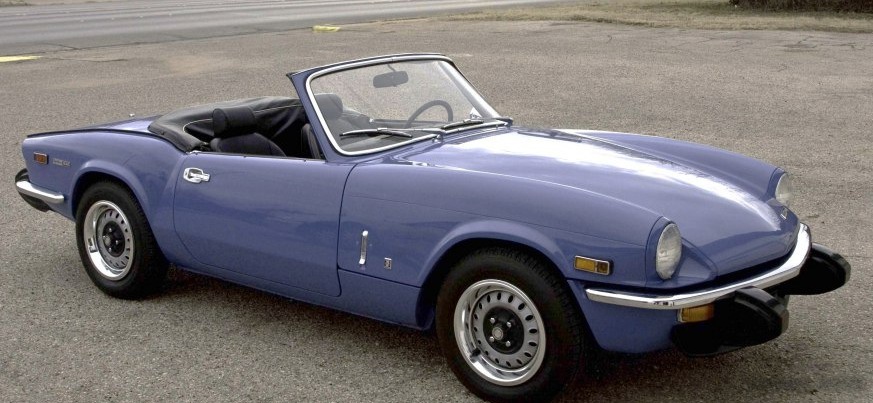
The Triumph Spitfire 1500, produced between 1975 and 1980, represented a significant update to the long-running Spitfire line. Falling within the Mark IV generation (often referred to simply as the 1500), it aimed to address criticisms of the earlier 1300 model’s lack of outright performance, particularly in the North American market where larger displacement engines were favored. The 1500 was positioned as the mainstream offering in the Spitfire range during its production run, bridging the gap between the earlier, smaller-engined models and the later, more performance-oriented variants. It continued the Spitfire’s tradition as an affordable, British sports car, appealing to enthusiasts seeking open-top motoring.
Technical Specifications
| Brand | Triumph |
| Model | Spitfire |
| Generation | Spitfire (Mark IV/1500) |
| Type (Engine) | 1500 (69 Hp) |
| Start of Production | 1975 |
| End of Production | 1980 |
| Powertrain Architecture | Internal Combustion Engine |
| Body Type | Cabriolet |
| Seats | 2 |
| Doors | 2 |
| Fuel Type | Petrol (Gasoline) |
| Acceleration 0 – 100 km/h | 15.4 sec |
| Acceleration 0 – 62 mph | 15.4 sec |
| Acceleration 0 – 60 mph | 14.6 sec |
| Maximum Speed | 153 km/h (95.07 mph) |
| Power | 69 Hp |
| Engine Aspiration | Naturally Aspirated |
| Fuel Tank Capacity | 33 l (8.72 US gal | 7.26 UK gal) |
Powertrain & Engine Architecture
The heart of the Spitfire 1500 was the Triumph 1493cc four-cylinder engine, internally designated as the engine code SAH. This engine represented a substantial increase in displacement over the previous 1300cc unit. It featured a cast iron block and cylinder head, with a single overhead camshaft operating inclined valves. The engine utilized a Zenith-Stromberg 150CD carburetor for fuel delivery, a relatively simple system for the time. While not particularly sophisticated, it proved reliable and relatively easy to maintain. The engine’s 8.8:1 compression ratio contributed to its modest power output of 69 horsepower at 5500 rpm, and 82 lb-ft of torque at 3500 rpm. The Spitfire 1500 was exclusively offered with a four-speed manual transmission, a departure from the automatic options sometimes found in other Spitfire models. The transmission was a fully synchronized unit, providing a reasonably smooth shift action, though not particularly sporty by modern standards.
Driving Characteristics
The Spitfire 1500’s driving experience was characterized by its light weight and nimble handling. The increased displacement of the 1500 engine provided a noticeable improvement in performance compared to the earlier 1300, making it more tractable for highway driving and overtaking. However, it was still not a particularly fast car by contemporary standards. Acceleration from 0-60 mph took around 14.6 seconds, and top speed was approximately 95 mph. The four-speed manual transmission’s gear ratios were spaced to prioritize acceleration in the lower gears, but the engine lacked the high-end power to fully exploit the higher gears. The Spitfire’s suspension, consisting of independent front suspension with double wishbones and a live axle rear suspension with trailing arms, provided a comfortable ride on smooth roads, but could become unsettled on rough surfaces. Steering was rack and pinion, offering precise control, but requiring a fair amount of effort, particularly at low speeds.
Equipment & Trim Levels
The Spitfire 1500 was generally offered in a relatively basic trim level, reflecting its position as an affordable sports car. Standard features included reclining bucket seats, a wood-rimmed steering wheel, and a heater. Instrumentation was limited to a speedometer, tachometer, fuel gauge, and temperature gauge. The interior trim was typically vinyl, with optional cloth seat inserts available. Exterior features included chrome bumpers, steel wheels, and a folding black vinyl soft top. Optional extras included wire wheels, a limited-slip differential, and a more comprehensive instrument panel. The color palette offered a range of vibrant hues typical of the 1970s, including British Racing Green, Carnival Red, and Pageant Blue.
Chassis & Braking
The Spitfire 1500 utilized a monocoque steel chassis, providing a relatively lightweight and rigid platform. Front suspension consisted of independent double wishbones with coil springs and telescopic shock absorbers. The rear suspension employed a live axle with trailing arms, coil springs, and telescopic shock absorbers. Braking was provided by disc brakes on the front wheels and drum brakes on the rear wheels. The braking system was adequate for the car’s performance, but lacked the stopping power of more modern vehicles. Steering was rack and pinion, providing precise control, but requiring a fair amount of physical effort. The car’s relatively short wheelbase and narrow track contributed to its nimble handling characteristics.
Market Reception & Comparison
The Spitfire 1500 was generally well-received by automotive critics, who praised its improved performance and handling compared to the earlier 1300 model. However, some critics noted that the engine lacked refinement and that the interior was somewhat spartan. Compared to other British sports cars of the era, such as the MG B, the Spitfire 1500 offered a more affordable and nimble driving experience. Fuel economy was reasonable for the time, averaging around 28-32 mpg. Reliability was generally good, although the Spitfire was prone to rust, particularly in areas exposed to salt. Compared to the later Spitfire 1500 TC (Triumph Competition) model, the standard 1500 offered less performance and fewer features, but was also more affordable.
Legacy
The Triumph Spitfire 1500 remains a popular choice among classic car enthusiasts today. Its affordability, simple mechanicals, and charming British character make it an appealing entry point into the world of classic sports cars. The 1500 engine is generally considered to be reliable, although regular maintenance is essential to prevent issues such as oil leaks and carburetor problems. Rust remains a significant concern, and prospective buyers should carefully inspect the car for corrosion, particularly in the chassis and body panels. Parts availability is generally good, with a thriving aftermarket supporting the Spitfire community. The Spitfire 1500 represents a significant chapter in the history of British sports cars, and continues to provide affordable open-top motoring enjoyment for enthusiasts around the world.
