
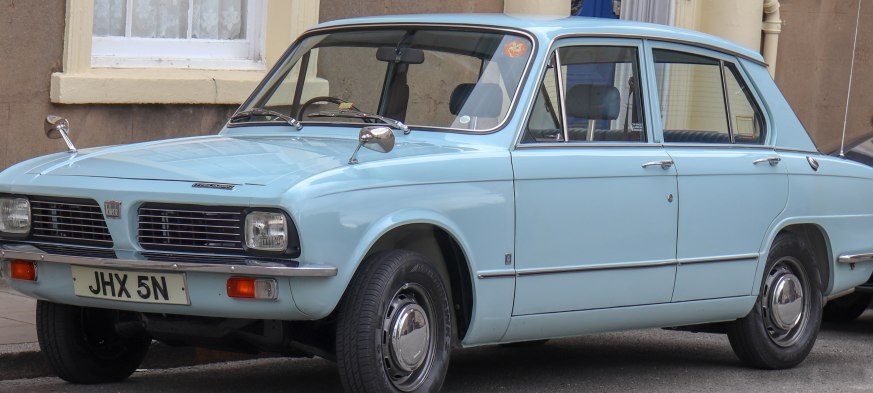
The Triumph Toledo 1300, produced between 1970 and 1977, was a compact saloon car offered by the British manufacturer Triumph. Positioned as an entry-level model within the Triumph range, it aimed to provide affordable and practical transportation. The Toledo occupied a niche between the larger Triumph saloons and the sporty Spitfire roadster, appealing to buyers seeking a no-frills, reliable vehicle. It was part of the broader effort by British Leyland to rationalize and modernize the Triumph lineup during a period of significant industry change. The 1300 variant, powered by a 1.3-liter engine producing 58 horsepower, represented the base model of the Toledo range.
Technical Specifications
| Brand | Triumph |
| Model | Toledo |
| Generation | Toledo |
| Type (Engine) | 1300 (58 Hp) |
| Start of production | 1970 |
| End of production | 1977 |
| Powertrain Architecture | Internal Combustion engine |
| Body type | Sedan |
| Seats | 5 |
| Doors | 4 |
| Fuel Type | Petrol (Gasoline) |
| Acceleration 0 – 60 mph | 18.5 sec |
| Maximum speed | 137 km/h (85.13 mph) |
| Power | 58 Hp @ 5500 rpm |
| Power per litre | 44.8 Hp/l |
| Torque | 92 Nm @ 3300 rpm (67.86 lb.-ft. @ 3300 rpm) |
| Engine layout | Front, Longitudinal |
| Engine displacement | 1296 cm3 (79.09 cu. in.) |
| Number of cylinders | 4 |
| Engine configuration | Inline |
| Cylinder Bore | 73.7 mm (2.9 in.) |
| Piston Stroke | 76 mm (2.99 in.) |
| Compression ratio | 8.5:1 |
| Number of valves per cylinder | 2 |
| Fuel injection system | Carburettor |
| Engine aspiration | Naturally aspirated engine |
| Valvetrain | OHV |
| Engine oil capacity | 3.7 l (3.91 US qt | 3.26 UK qt) |
| Coolant | 4.8 l (5.07 US qt | 4.22 UK qt) |
| Max. weight | 1240 kg (2733.73 lbs.) |
| Trunk (boot) space – minimum | 303 l (10.7 cu. ft.) |
| Fuel tank capacity | 48 l (12.68 US gal | 10.56 UK gal) |
| Length | 3965 mm (156.1 in.) |
| Width | 1568 mm (61.73 in.) |
| Height | 1372 mm (54.02 in.) |
| Wheelbase | 2454 mm (96.61 in.) |
| Front track | 1348 mm (53.07 in.) |
| Rear (Back) track | 1270 mm (50 in.) |
| Minimum turning circle (turning diameter) | 7.55 m (24.77 ft.) |
| Drivetrain Architecture | The Internal combustion engine (ICE) drives the rear wheels of the vehicle. |
| Drive wheel | Rear wheel drive |
| Number of gears and type of gearbox | 4 gears, manual transmission |
| Front suspension | Wishbone |
| Rear suspension | Independent multi-link suspension |
| Front brakes | Disc, 209.55 mm |
| Rear brakes | Drum, 203.2×31.75 mm |
| Steering type | Steering rack and pinion |
| Wheel rims size | Front wheel rims: 4J x 13 Rear wheel rims: 4J x 13 |
Powertrain & Engine Architecture
The heart of the Toledo 1300 was the Triumph 1296 cc inline-four cylinder engine. This engine, designated as the 13TC, was a relatively simple design featuring an overhead valve (OHV) valvetrain and a single Zenith 34WE carburetor. The engine’s longitudinal front-engine layout was a common configuration for British cars of the era. The 8.5:1 compression ratio was typical for the time, balancing performance and fuel economy. The engine produced 58 horsepower at 5500 rpm and 92 Nm (68 lb-ft) of torque at 3300 rpm. The engine was mated to a four-speed manual gearbox, which was the standard transmission for the 1300 model. While an automatic transmission was offered on some Toledo variants, it wasn’t available with the base 1300 engine.
Driving Characteristics
The Toledo 1300’s performance was modest by modern standards. Acceleration from 0 to 60 mph took approximately 18.5 seconds, and the top speed was around 85 mph. The four-speed manual gearbox offered a reasonable spread of ratios, but the engine’s limited torque meant that frequent gear changes were necessary, especially when tackling hills or overtaking. Compared to the more powerful 1600cc and 2000cc versions of the Toledo, the 1300 felt noticeably slower and less refined. However, the lighter weight of the 1300, compared to its larger siblings, did contribute to slightly better fuel economy and handling. The rear-wheel-drive configuration provided a traditional driving experience, but also meant that the car could be prone to oversteer if pushed hard.
Equipment & Trim Levels
The Toledo 1300 was offered with a fairly basic level of equipment. Standard features included cloth upholstery, a heater, and basic instrumentation. The interior was functional rather than luxurious, with a focus on durability. Optional extras included a radio, upgraded upholstery, and a sunroof. The exterior trim was relatively simple, with minimal chrome detailing. The Toledo 1300 was positioned as a practical and affordable family saloon, and its equipment level reflected this.
Chassis & Braking
The Toledo 1300 featured a separate chassis construction, with a robust ladder frame. Front suspension was independent, utilizing wishbones and coil springs, while the rear suspension employed an independent multi-link setup. This suspension arrangement provided a reasonably comfortable ride, although it wasn’t particularly sophisticated. Braking was provided by disc brakes at the front and drum brakes at the rear. The braking system was adequate for the car’s performance, but lacked the stopping power of more modern vehicles. Steering was via a rack and pinion system, which provided precise and responsive handling.
Market Reception & Comparison
The Triumph Toledo 1300 was generally well-received by the motoring press as a practical and affordable family car. Critics praised its comfortable ride, decent handling, and relatively low price. However, the engine’s lack of power was a common criticism. Compared to rivals such as the Ford Cortina and Vauxhall Victor, the Toledo 1300 offered a more refined driving experience, but lacked the performance and spaciousness of some competitors. Fuel economy was reasonable for the time, but not exceptional. Reliability was generally good, although the car’s age and construction meant that regular maintenance was essential.
Legacy
The Triumph Toledo 1300, while not a groundbreaking vehicle, played an important role in the British automotive landscape of the 1970s. It provided affordable transportation for many families and helped to maintain Triumph’s presence in the compact saloon market. Today, the Toledo 1300 is a popular choice among classic car enthusiasts, particularly those seeking a simple and reliable British saloon. Parts availability can be a challenge, but a dedicated network of Triumph owners and specialists ensures that the car can be kept on the road. The 1300’s relatively low price and straightforward mechanicals make it an accessible entry point into the world of classic car ownership. While not a high-performance machine, the Toledo 1300 offers a charming and nostalgic driving experience.
