
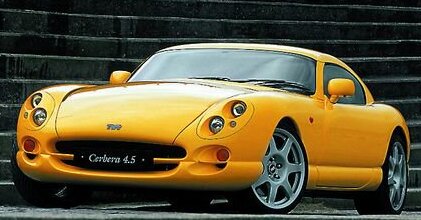
The TVR Cerbera 4.2 i V8, produced between 1995 and 1997, represents a high-performance iteration of TVR’s flagship grand tourer. Positioned as the top-of-the-line model within the Cerbera range, it offered a significant performance upgrade over the earlier 4.0-liter and subsequent 4.5-liter variants. The Cerbera, as a whole, was TVR’s attempt to create a true four-seater sports car, aiming to blend exhilarating performance with a degree of practicality. It was built on a bespoke chassis, utilizing a space frame construction, and represented a departure from TVR’s traditionally smaller, more focused sports cars. The 4.2 i V8 was a relatively short-lived version, bridging the gap between the initial launch models and the later, more refined 4.5-liter cars.
Technical Specifications
| Brand | TVR |
| Model | Cerbera |
| Generation | Cerbera |
| Type (Engine) | 4.2 i V8 (350 Hp) |
| Start of production | 1995 |
| End of production | 1997 |
| Powertrain Architecture | Internal Combustion engine |
| Body type | Coupe |
| Seats | 4 |
| Doors | 2 |
| Fuel Type | Petrol (Gasoline) |
| Acceleration 0 – 100 km/h | 4.5 sec |
| Acceleration 0 – 62 mph | 4.5 sec |
| Acceleration 0 – 60 mph | 4.3 sec |
| Maximum speed | 258 km/h (160.31 mph) |
| Weight-to-power ratio | 3.2 kg/Hp, 315.3 Hp/tonne |
| Weight-to-torque ratio | 2.7 kg/Nm, 369.4 Nm/tonne |
| Power | 350 Hp @ 6500 rpm |
| Power per litre | 83.6 Hp/l |
| Torque | 410 Nm @ 4500 rpm (302.4 lb.-ft. @ 4500 rpm) |
| Engine layout | Front, Longitudinal |
| Engine displacement | 4185 cm3 (255.38 cu. in.) |
| Number of cylinders | 8 |
| Engine configuration | V-engine |
| Cylinder Bore | 94 mm (3.7 in.) |
| Piston Stroke | 75.3 mm (2.96 in.) |
| Compression ratio | 9.8:1 |
| Number of valves per cylinder | 2 |
| Fuel injection system | Multi-port manifold injection |
| Engine aspiration | Naturally aspirated engine |
| Engine oil capacity | 6 l (6.34 US qt | 5.28 UK qt) |
| Coolant | 12 l (12.68 US qt | 10.56 UK qt) |
| Kerb Weight | 1110 kg (2447.13 lbs.) |
| Trunk (boot) space – minimum | 390 l (13.77 cu. ft.) |
| Fuel tank capacity | 65 l (17.17 US gal | 14.3 UK gal) |
| Length | 4280 mm (168.5 in.) |
| Width | 1865 mm (73.43 in.) |
| Height | 1220 mm (48.03 in.) |
| Wheelbase | 2566 mm (101.02 in.) |
| Front track | 1464 mm (57.64 in.) |
| Rear (Back) track | 1470 mm (57.87 in.) |
| Drivetrain Architecture | Rear wheel drive |
| Number of gears and type of gearbox | 5 gears, manual transmission |
| Front suspension | Spring Strut |
| Rear suspension | Spring Strut |
| Front brakes | Ventilated discs |
| Rear brakes | Disc |
| Assisting systems | ABS (Anti-lock braking system) |
| Steering type | Steering rack and pinion |
| Tires size | 225/45 ZR16; 235/50 ZR16 |
Powertrain & Engine Architecture
The heart of the Cerbera 4.2 i V8 is its 4.2-liter V8 engine, a naturally aspirated powerplant derived from TVR’s earlier designs. While often referred to as a ‘TVR V8’, the engine’s roots trace back to a Ford Essex V6 block, heavily modified and enlarged over the years by TVR’s engineers. The 4.2-liter version featured a larger bore and stroke compared to the 4.0-liter, contributing to the increased power output. It utilized a multi-port fuel injection system, delivering fuel directly into the intake ports, and featured two valves per cylinder. The engine produced 350 horsepower at 6,500 rpm and 410 Nm (302.4 lb-ft) of torque at 4,500 rpm. The engine was mounted longitudinally in the front of the car, driving the rear wheels. The standard transmission was a five-speed manual gearbox, providing a direct and engaging driving experience. An automatic transmission was not offered with this specific engine configuration.
Driving Characteristics
The Cerbera 4.2 i V8 delivered a raw and visceral driving experience. The 350 horsepower, combined with the relatively lightweight chassis (around 2,447 lbs), resulted in impressive acceleration – 0 to 60 mph in approximately 4.3 seconds and a top speed of 160 mph. The five-speed manual gearbox allowed for precise control over the engine’s power, although the gear ratios were relatively widely spaced, requiring the driver to work the engine to maintain momentum. Compared to the later 4.5-liter models, the 4.2 i V8 felt more responsive at lower revs, offering a broader torque curve. However, it lacked the outright top-end power of the 4.5. The Cerbera’s handling was characterized by its direct steering and well-balanced chassis, but it demanded respect due to its lack of electronic driver aids.
Equipment & Trim Levels
The Cerbera 4.2 i V8 was generally well-equipped for its time, although luxury wasn’t the primary focus. Standard features included leather upholstery, power windows, and central locking. The interior design was minimalist and driver-focused, with a simple dashboard layout and supportive sports seats. Optional extras included air conditioning, a sunroof, and upgraded audio systems. Trim levels were relatively limited, with most customization occurring through individual options. The interior typically featured a combination of leather and Alcantara, with a focus on creating a sporty and functional environment.
Chassis & Braking
The Cerbera utilized a bespoke space frame chassis constructed from steel tubes, providing a rigid and lightweight platform. Suspension consisted of independent double wishbones at the front and a live axle with trailing arms at the rear. The braking system featured ventilated discs at the front and solid discs at the rear, with ABS (Anti-lock Braking System) as standard. The suspension setup was tuned for performance, offering a firm ride but providing good control and stability. The relatively low weight of the car helped to compensate for the lack of advanced suspension technology.
Market Reception & Comparison
The TVR Cerbera 4.2 i V8 was generally well-received by automotive critics, who praised its performance, handling, and distinctive styling. However, it was also criticized for its lack of refinement and practicality. Compared to the 4.0-liter model, the 4.2 i V8 offered a noticeable performance improvement. Compared to the later 4.5-liter versions, it provided a more balanced driving experience, with better low-end torque but less outright power. Fuel economy was predictably poor, reflecting the car’s high-performance nature. Reliability was also a concern, as with many TVRs of this era, due to the use of bespoke components and a relatively small production volume.
Legacy
The TVR Cerbera 4.2 i V8 remains a sought-after model among TVR enthusiasts. Its combination of performance, styling, and relative rarity has made it a collectible car. The 4.2-liter V8 engine, while not the most powerful in the Cerbera range, is considered by many to be the most reliable and enjoyable to drive. However, maintaining a Cerbera requires a dedicated owner, as parts availability can be limited and specialist knowledge is often required. Today, well-maintained examples command a premium in the used car market, representing a unique and exciting piece of British automotive history.
