
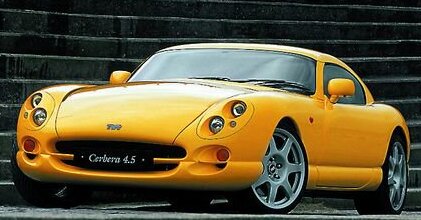
The TVR Cerbera 4.3 i V8, produced between 1995 and 2000, represents a pivotal point in the history of TVR, the independent British sports car manufacturer. Positioned as the flagship model within the Cerbera range, it aimed to deliver a raw, visceral driving experience combined with a relatively luxurious interior. The Cerbera, named after the three-headed dog guarding the gates of the Underworld in Greek mythology, was TVR’s attempt to create a grand tourer capable of challenging established marques like Porsche and Aston Martin. It was built on a bespoke chassis and featured a distinctive, often polarizing, design penned by Richard Prosser. The 4.3 i V8 variant, with its naturally aspirated engine, became the most recognizable and sought-after version of the Cerbera.
Technical Specifications
| Brand | TVR |
| Model | Cerbera |
| Generation | Cerbera |
| Type (Engine) | 4.3 i V8 (280 Hp) |
| Start of production | 1995 |
| End of production | 2000 |
| Powertrain Architecture | Internal Combustion engine |
| Body type | Coupe |
| Seats | 4 |
| Doors | 2 |
| Fuel Type | Petrol (Gasoline) |
| Weight-to-power ratio | 3.9 kg/Hp, 254.5 Hp/tonne |
| Weight-to-torque ratio | 2.8 kg/Nm, 361.8 Nm/tonne |
| Power | 280 Hp @ 5500 rpm |
| Power per litre | 65.4 Hp/l |
| Torque | 398 Nm @ 4000 rpm (293.55 lb.-ft. @ 4000 rpm) |
| Engine layout | Front, Longitudinal |
| Engine displacement | 4280 cm3 (261.18 cu. in.) |
| Number of cylinders | 8 |
| Engine configuration | V-engine |
| Cylinder Bore | 94 mm (3.7 in.) |
| Piston Stroke | 77 mm (3.03 in.) |
| Compression ratio | 10:1 |
| Number of valves per cylinder | 2 |
| Fuel injection system | Single-point injection |
| Engine aspiration | Naturally aspirated engine |
| Engine oil capacity | 5 l (5.28 US qt | 4.4 UK qt) |
| Coolant | 12 l (12.68 US qt | 10.56 UK qt) |
| Kerb Weight | 1100 kg (2425.08 lbs) |
| Fuel tank capacity | 57 l (15.06 US gal | 12.54 UK gal) |
| Length | 4146 mm (163.23 in) |
| Width | 1943 mm (76.5 in) |
| Height | 1205 mm (47.44 in) |
| Wheelbase | 2485 mm (97.83 in) |
| Front track | 1460 mm (57.48 in) |
| Rear track | 1460 mm (57.48 in) |
| Drivetrain Architecture | The Internal combustion engine (ICE) drives the rear wheels of the vehicle. |
| Drive wheel | Rear wheel drive |
| Number of gears and type of gearbox | 5 gears, manual transmission |
| Front suspension | Double wishbone |
| Rear suspension | Double wishbone |
| Front brakes | Ventilated discs |
| Rear brakes | Ventilated discs |
| Assisting systems | ABS (Anti-lock braking system) |
| Steering type | Steering rack and pinion |
| Tires size | 225/70 ZR16 |
Powertrain & Engine Architecture
The heart of the Cerbera 4.3 i V8 is its 4.3-liter (4280cc) naturally aspirated V8 engine. This engine, designated as the AJP8, was designed and built in-house by TVR. It featured a 90-degree V-angle, providing inherent balance and smoothness. The engine utilized a single-point fuel injection system, a relatively archaic setup for the mid-1990s, but one that TVR maintained for simplicity and perceived reliability. Each cylinder had two valves, and the compression ratio was set at 10:1. The AJP8 was known for its robust construction and willingness to rev, producing 280 horsepower at 5500 rpm and 398 Nm (293.55 lb-ft) of torque at 4000 rpm. The engine was mounted longitudinally in the front of the chassis, driving the rear wheels. The standard transmission was a five-speed manual gearbox, providing a direct and engaging driving experience. While an automatic transmission was offered in other Cerbera variants, it was not available with the 4.3 i V8.
Driving Characteristics
The Cerbera 4.3 i V8 offered a distinctly raw and engaging driving experience. The combination of the lightweight chassis (approximately 1100 kg or 2425 lbs) and the potent V8 engine resulted in brisk acceleration and impressive performance. The manual gearbox, while not particularly refined, allowed for precise control and maximized the engine’s power output. The car’s handling was characterized by its direct steering and responsive chassis, although it could be challenging to control at the limit due to its relatively short wheelbase and lack of electronic stability aids. Compared to the smaller-engined Cerberas (like the 2.0L or 1.9L versions), the 4.3 i V8 provided significantly more power and torque, resulting in a much more exhilarating driving experience. It also offered a more refined exhaust note and a greater sense of overall performance. The 4.3 i V8 was not focused on fuel economy; owners typically experienced fuel consumption in the range of 15-20 mpg.
Equipment & Trim Levels
The Cerbera 4.3 i V8 was generally well-equipped for a British sports car of its era, but the emphasis remained on driving experience rather than outright luxury. Standard features included leather upholstery, power windows, central locking, and an aftermarket stereo system. The interior design was relatively minimalist, with a focus on functionality. Optional extras included air conditioning, heated seats, and upgraded audio systems. The dashboard layout was straightforward, with clearly marked gauges for speed, rpm, coolant temperature, and fuel level. The interior trim was available in a variety of colors, allowing customers to personalize their vehicles. The Cerbera’s interior, while comfortable, was not as lavishly appointed as those found in some of its competitors.
Chassis & Braking
The Cerbera utilized a tubular steel spaceframe chassis, providing a high degree of rigidity and strength. The suspension system consisted of double wishbones at both the front and rear, with coil springs and adjustable dampers. This setup provided a good balance between ride comfort and handling performance. Braking duties were handled by ventilated discs at all four corners, assisted by an anti-lock braking system (ABS). The braking system was generally effective, but could suffer from fade under sustained hard use. The car rode on 16-inch wheels, typically fitted with 225/70 ZR16 tires.
Market Reception & Comparison
The TVR Cerbera 4.3 i V8 received mixed reviews from automotive critics. While praised for its performance, handling, and distinctive styling, it was also criticized for its build quality, reliability, and lack of refinement. Compared to other Cerbera variants, the 4.3 i V8 was seen as the most desirable and capable model. It offered a significant performance advantage over the smaller-engined versions, but at a higher price point. Its fuel economy was also considerably worse. The Cerbera competed with cars like the Porsche 968 and the Aston Martin DB7, but it offered a different driving experience – one that was more raw, visceral, and uncompromising.
Legacy
The TVR Cerbera 4.3 i V8 remains a highly sought-after vehicle among enthusiasts. The AJP8 engine, while not without its quirks, is generally considered to be a robust and reliable unit, provided it is properly maintained. However, TVR’s limited production numbers and the company’s financial difficulties mean that parts availability can be a challenge. The Cerbera’s distinctive styling and engaging driving experience have ensured its place in automotive history as a unique and memorable British sports car. Today, well-maintained examples command significant prices in the used car market, reflecting their rarity and desirability. The Cerbera 4.3 i V8 represents a high point in TVR’s engineering and design capabilities, and it continues to be celebrated by enthusiasts around the world.
