
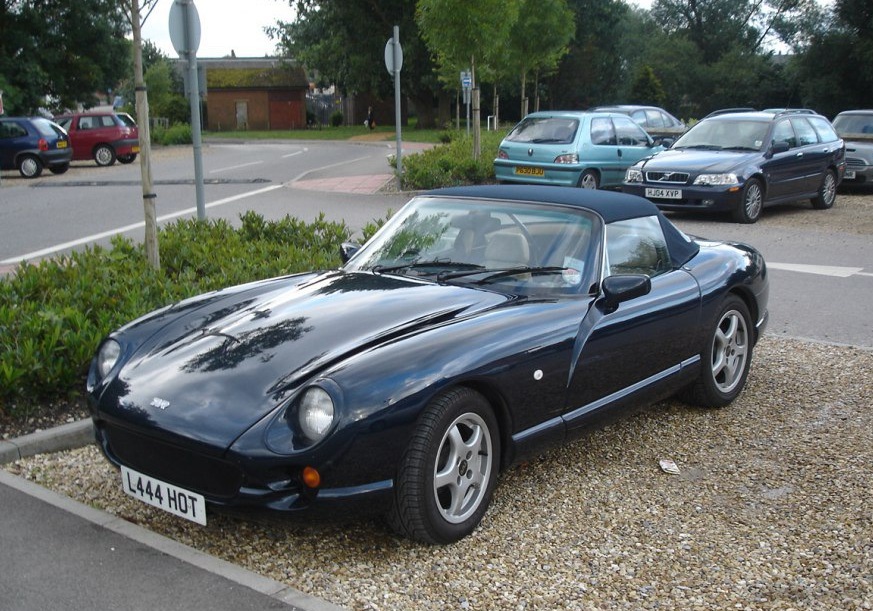
The TVR Chimaera 4.3, produced from 1992 to 2003, represents a pivotal point in the British sports car manufacturer’s history. Positioned as the more powerful and luxurious sibling to the Griffith, the Chimaera aimed to offer a grand touring experience with a distinctly British flair. It was built upon TVR’s steel tubular space frame chassis, a design philosophy that prioritized lightweight construction and dynamic handling. The 4.3-liter variant, producing 280 horsepower, was the flagship model of the Chimaera range, offering a significant performance upgrade over the earlier 4.0-liter versions. The Chimaera, along with the Griffith, helped solidify TVR’s reputation for building raw, visceral sports cars that appealed to enthusiasts seeking an alternative to more mainstream offerings.
Technical Specifications
| Brand | TVR |
| Model | Chimaera |
| Generation | Chimaera |
| Type (Engine) | 4.3 (280 Hp) |
| Start of production | 1992 |
| End of production | 2003 |
| Powertrain Architecture | Internal Combustion engine |
| Body type | Cabriolet |
| Seats | 2 |
| Doors | 2 |
| Fuel consumption (economy) – urban | 18 l/100 km (13.1 US mpg, 15.7 UK mpg, 5.6 km/l) |
| Fuel consumption (economy) – extra urban | 10 l/100 km (23.5 US mpg, 28.2 UK mpg, 10 km/l) |
| Fuel Type | Petrol (Gasoline) |
| Acceleration 0 – 100 km/h | 4.4 sec |
| Acceleration 0 – 62 mph | 4.4 sec |
| Acceleration 0 – 60 mph | 4.2 sec |
| Maximum speed | 253 km/h (157.21 mph) |
| Weight-to-power ratio | 3.8 kg/Hp, 264.2 Hp/tonne |
| Weight-to-torque ratio | 2.7 kg/Nm, 375.5 Nm/tonne |
| Power | 280 Hp @ 5500 rpm |
| Power per litre | 65.5 Hp/l |
| Torque | 398 Nm @ 4000 rpm (293.55 lb.-ft. @ 4000 rpm) |
| Engine layout | Front, Longitudinal |
| Engine displacement | 4275 cm3 (260.88 cu. in.) |
| Number of cylinders | 8 |
| Engine configuration | V-engine |
| Cylinder Bore | 94 mm (3.7 in.) |
| Piston Stroke | 77 mm (3.03 in.) |
| Compression ratio | 8.9:1 |
| Number of valves per cylinder | 2 |
| Fuel injection system | Multi-port manifold injection |
| Engine aspiration | Naturally aspirated engine |
| Engine oil capacity | 5 l (5.28 US qt | 4.4 UK qt) |
| Coolant | 12 l (12.68 US qt | 10.56 UK qt) |
| Kerb Weight | 1060 kg (2336.9 lbs.) |
| Max. weight | 1300 kg (2866.01 lbs.) |
| Max load | 240 kg (529.11 lbs.) |
| Trunk (boot) space – minimum | 310 l (10.95 cu. ft.) |
| Fuel tank capacity | 57 l (15.06 US gal | 12.54 UK gal) |
| Length | 3965 mm (156.1 in.) |
| Width | 1730 mm (68.11 in.) |
| Height | 1223 mm (48.15 in.) |
| Wheelbase | 2282 mm (89.84 in.) |
| Front track | 1460 mm (57.48 in.) |
| Rear (Back) track | 1470 mm (57.87 in.) |
| Drivetrain Architecture | The Internal combustion engine (ICE) drives the rear wheels of the vehicle. |
| Drive wheel | Rear wheel drive |
| Number of gears and type of gearbox | 5 gears, manual transmission |
| Front suspension | Wishbone |
| Rear suspension | Wishbone |
| Front brakes | Ventilated discs |
| Rear brakes | Disc |
| Assisting systems | ABS (Anti-lock braking system) |
| Steering type | Steering rack and pinion |
| Tires size | 205/55 R16; 225/50 R16 |
| Wheel rims size | 7J x 16; 7.5J x 16 |
Powertrain & Engine Architecture
The heart of the Chimaera 4.3 is its 4.3-liter Rover V8 engine. This engine, derived from the Buick-Oldsmobile-Pontiac 3.5-liter V8, was extensively modified by TVR over the years. The 4.3-liter version featured a larger bore and stroke compared to earlier iterations, resulting in increased displacement and power output. It utilized a multi-port fuel injection system, managed by an early engine control unit (ECU), and a relatively conservative 8.9:1 compression ratio. The engine’s valvetrain employed two valves per cylinder, operated by a single overhead camshaft. The engine was mounted longitudinally in the front of the chassis, driving the rear wheels. The standard transmission for the 4.3 was a five-speed manual gearbox, providing a direct and engaging driving experience. While an automatic transmission was offered on some Chimaera models, it was less common with the 4.3-liter engine due to its focus on performance.
Driving Characteristics
The Chimaera 4.3 delivered a thrilling driving experience characterized by its raw power and responsive handling. The 280 horsepower engine provided brisk acceleration, with 0-60 mph times consistently in the low 4-second range. The manual gearbox allowed for precise control over the engine’s power band, while the rear-wheel-drive configuration contributed to a lively and engaging chassis. The relatively lightweight construction of the car, tipping the scales at around 2337 pounds, further enhanced its agility. Compared to the earlier 4.0-liter Chimaeras, the 4.3 offered a noticeable increase in torque, making it more tractable in everyday driving situations. However, it still retained the TVR’s reputation for being a demanding car to drive, requiring a skilled driver to fully exploit its potential. The 4.3 was significantly faster than the lower-spec models, and offered a more refined experience than the smaller engine options.
Equipment & Trim Levels
The Chimaera 4.3 was generally well-equipped for a British sports car of its era, though luxury wasn’t its primary focus. Standard features included leather upholstery, power windows, and central locking. The interior design was relatively simple and functional, with a focus on providing the driver with essential information. Optional extras included air conditioning, a premium sound system, and upgraded interior trim materials. The dashboard layout was straightforward, with clearly marked gauges for speed, RPM, oil pressure, and coolant temperature. The Chimaera’s interior was designed to be a comfortable and inviting space, but it lacked the sophisticated features found in some of its more modern competitors.
Chassis & Braking
The Chimaera’s chassis was a key element of its dynamic performance. It utilized a steel tubular space frame construction, providing a rigid and lightweight platform. The suspension system employed independent wishbones at both the front and rear, offering a good balance between ride comfort and handling precision. Braking duties were handled by ventilated discs at the front and solid discs at the rear, assisted by an anti-lock braking system (ABS). The ABS system helped to improve braking stability, particularly in wet or slippery conditions. The Chimaera’s suspension was tuned to provide a firm but compliant ride, allowing it to handle both spirited driving on winding roads and comfortable cruising on the highway.
Market Reception & Comparison
The TVR Chimaera 4.3 was generally well-received by automotive critics, who praised its performance, handling, and distinctive styling. However, it was also criticized for its build quality and reliability, which were often inconsistent. Compared to other sports cars in its price range, such as the Porsche 968 and the BMW Z3, the Chimaera offered a more raw and visceral driving experience. Its fuel economy was relatively poor, averaging around 18 l/100 km (13.1 US mpg) in urban driving and 10 l/100 km (23.5 US mpg) on the highway. However, its performance and exclusivity appealed to a niche market of enthusiasts who were willing to overlook its shortcomings.
Legacy
The TVR Chimaera 4.3 remains a highly sought-after sports car among collectors and enthusiasts. Its distinctive styling, powerful engine, and engaging driving experience have cemented its place in automotive history. While its reliability can be a concern, the Chimaera’s relatively simple mechanical design makes it relatively easy to maintain and repair. Today, well-maintained examples of the Chimaera 4.3 command premium prices in the used car market, reflecting their rarity and desirability. The Chimaera, and particularly the 4.3 variant, represents a high point in TVR’s engineering and design, and continues to be celebrated as a true British sports car icon.
