
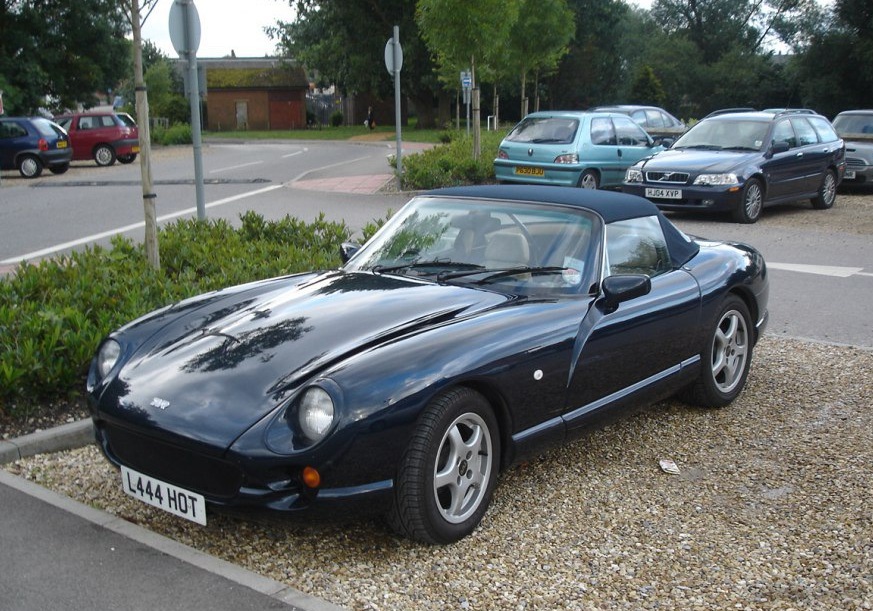
The TVR Chimaera 5.0, produced between 1992 and 1997, represents a pivotal point in the British sports car manufacturer’s history. Positioned as the more powerful sibling to the Griffith, the Chimaera offered a grand touring experience with a focus on raw performance and distinctive styling. It was built upon TVR’s steel spaceframe chassis, a design philosophy that prioritized lightweight construction and driver engagement. The 5.0-liter variant, producing 340 horsepower, was the top-of-the-line offering, solidifying the Chimaera’s reputation as a serious performance machine within the UK and select export markets. It’s important to note that TVR, being a low-volume manufacturer, offered a high degree of customization, meaning specifications could vary slightly between individual vehicles.
Technical Specifications
| Brand | TVR |
| Model | Chimaera |
| Generation | Chimaera |
| Type (Engine) | 5.0 (340 Hp) |
| Start of production | 1992 |
| End of production | 1997 |
| Powertrain Architecture | Internal Combustion engine |
| Body type | Cabriolet |
| Seats | 2 |
| Doors | 2 |
| Fuel Type | Petrol (Gasoline) |
| Acceleration 0 – 100 km/h | 5.5 sec |
| Acceleration 0 – 62 mph | 5.5 sec |
| Acceleration 0 – 60 mph | 5.2 sec |
| Maximum speed | 271 km/h (168.39 mph) |
| Weight-to-power ratio | 3.1 kg/Hp, 320.8 Hp/tonne |
| Weight-to-torque ratio | 2.2 kg/Nm, 453.8 Nm/tonne |
| Power | 340 Hp @ 5250 rpm |
| Power per litre | 68 Hp/l |
| Torque | 481 Nm @ 3750 rpm (354.77 lb.-ft. @ 3750 rpm) |
| Engine layout | Front, Longitudinal |
| Engine displacement | 4997 cm3 (304.94 cu. in.) |
| Number of cylinders | 8 |
| Engine configuration | V-engine |
| Cylinder Bore | 94 mm (3.7 in.) |
| Piston Stroke | 90 mm (3.54 in.) |
| Compression ratio | 9.5:1 |
| Number of valves per cylinder | 2 |
| Fuel injection system | Multi-port manifold injection |
| Engine aspiration | Naturally aspirated engine |
| Engine oil capacity | 5 l (5.28 US qt | 4.4 UK qt) |
| Coolant | 12 l (12.68 US qt | 10.56 UK qt) |
| Kerb Weight | 1060 kg (2336.9 lbs.) |
| Max. weight | 1280 kg (2821.92 lbs.) |
| Max load | 220 kg (485.02 lbs.) |
| Trunk (boot) space – minimum | 310 l (10.95 cu. ft.) |
| Fuel tank capacity | 57 l (15.06 US gal | 12.54 UK gal) |
| Length | 3965 mm (156.1 in.) |
| Width | 1730 mm (68.11 in.) |
| Height | 1223 mm (48.15 in.) |
| Wheelbase | 2282 mm (89.84 in.) |
| Front track | 1460 mm (57.48 in.) |
| Rear (Back) track | 1470 mm (57.87 in.) |
| Drivetrain Architecture | The Internal combustion engine (ICE) drives the rear wheels of the vehicle. |
| Drive wheel | Rear wheel drive |
| Number of gears and type of gearbox | 5 gears, manual transmission |
| Front suspension | Wishbone |
| Rear suspension | Wishbone |
| Front brakes | Ventilated discs |
| Rear brakes | Disc |
| Assisting systems | ABS (Anti-lock braking system) |
| Steering type | Steering rack and pinion |
| Tires size | 235/50 R16 |
Powertrain & Engine Architecture
The heart of the Chimaera 5.0 is its Rover-sourced V8 engine, specifically the 4.997-liter (305 cubic inch) unit. While originating from Rover, TVR extensively modified the engine, including the addition of fuel injection and a revised cylinder head design to enhance performance. The engine utilizes a multi-port fuel injection system, contributing to its responsive throttle characteristics. The engine’s 9.5:1 compression ratio and two valves per cylinder contribute to a broad torque curve. The 340 horsepower peak arrives at 5250 rpm, while the substantial 481 Nm (355 lb-ft) of torque is available at 3750 rpm. This engine was mated exclusively to a five-speed manual transmission, providing a direct connection between the driver and the rear wheels. The longitudinal engine layout and rear-wheel drive configuration were fundamental to the Chimaera’s handling balance.
Driving Characteristics
The Chimaera 5.0 delivers a visceral driving experience. The combination of the lightweight chassis and the potent V8 engine results in exhilarating acceleration. The 0-60 mph sprint takes approximately 5.2 seconds, and it can achieve a top speed of 168 mph. The five-speed manual transmission offers precise shifts, allowing the driver to fully exploit the engine’s powerband. The car feels nimble and responsive, particularly on winding roads. However, it’s not a refined grand tourer in the modern sense. The ride can be firm, and the lack of significant driver aids means that it demands respect and attention. Compared to the smaller-engined Chimaeras, the 5.0 offers a significant performance upgrade, but it also requires more skill and confidence to drive at its limit.
Equipment & Trim Levels
The Chimaera, even in its 5.0 guise, was relatively spartan in terms of standard equipment. TVR focused on delivering a pure driving experience rather than luxury features. Standard features typically included leather upholstery, power windows, and central locking. However, air conditioning, heated seats, and upgraded audio systems were often optional extras. Interior trim options were limited, with a focus on durable materials and a functional design. The dashboard layout was simple and driver-focused, with clearly visible gauges. The level of customization offered by TVR meant that individual cars could vary significantly in terms of their specification.
Chassis & Braking
The Chimaera’s chassis is a steel spaceframe, a design TVR had perfected over years of production. This construction method provides a high degree of rigidity while keeping weight to a minimum. Suspension consists of independent double wishbones at both the front and rear, providing a good balance between handling and ride comfort. Braking is handled by ventilated discs at the front and solid discs at the rear, assisted by an anti-lock braking system (ABS). The ABS system was a relatively basic setup by modern standards, but it provided a valuable safety net. The car’s relatively low weight (around 2337 lbs) contributes to its impressive braking performance.
Market Reception & Comparison
The TVR Chimaera 5.0 was generally well-received by automotive journalists and enthusiasts. It was praised for its performance, handling, and distinctive styling. Critics noted its raw, unfiltered driving experience and its lack of refinement compared to more mainstream sports cars. Compared to the 4.0-liter Chimaera, the 5.0 offered a substantial power increase, but it also came with a higher price tag. The 5.0 was positioned as a direct competitor to cars like the Porsche 968 and the Lotus Esprit, offering a similar level of performance at a lower price point. However, TVR’s reputation for build quality and reliability was often questioned.
Legacy
The TVR Chimaera 5.0 remains a highly sought-after sports car among enthusiasts. Its combination of performance, styling, and relative rarity has made it a collectible vehicle. The Rover V8 engine, while known for its potential reliability issues if not properly maintained, is relatively straightforward to work on, and parts availability is generally good. Today, well-maintained Chimaera 5.0s command strong prices in the used car market. The car represents a unique chapter in British automotive history, embodying a spirit of independent engineering and a commitment to delivering a pure, engaging driving experience. Its legacy continues to inspire and captivate sports car enthusiasts around the world.
