
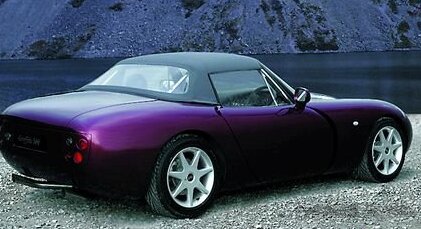
The TVR Griffith 5.0, produced between 1990 and 2002, represents a pivotal model in the history of TVR Engineering, a British manufacturer renowned for its hand-built, high-performance sports cars. The Griffith, named after the Welsh industrialist Richard Griffith who invested in the company, was designed to be a more accessible and internationally competitive sports car than previous TVR offerings. It was built on a steel spaceframe chassis and featured a fiberglass body, a formula TVR had perfected over decades. The 5.0-liter variant, producing 326 horsepower, was the flagship of the Griffith range, offering a compelling blend of raw power, lightweight construction, and distinctive styling. It aimed to capture a segment of the market seeking a thrilling, driver-focused experience, competing with cars like the Porsche 911 and Lotus Esprit, but at a significantly lower price point.
Technical Specifications
| Brand | TVR |
| Model | Griffith |
| Generation | Griffith |
| Type (Engine) | 5.0 (326 Hp) |
| Start of production | 1990 |
| End of production | 2002 |
| Powertrain Architecture | Internal Combustion engine |
| Body type | Cabriolet |
| Seats | 2 |
| Doors | 2 |
| Fuel consumption (urban) | 19 l/100 km (12.4 US mpg) |
| Fuel consumption (extra urban) | 12 l/100 km (19.6 US mpg) |
| Fuel Type | Petrol (Gasoline) |
| Acceleration 0 – 100 km/h | 4.4 sec |
| Acceleration 0 – 62 mph | 4.4 sec |
| Acceleration 0 – 60 mph | 4.2 sec |
| Maximum speed | 269 km/h (167.15 mph) |
| Weight-to-power ratio | 3.3 kg/Hp |
| Weight-to-torque ratio | 2.4 kg/Nm |
| Power | 326 Hp @ 5500 rpm |
| Power per litre | 65.2 Hp/l |
| Torque | 434 Nm @ 4000 rpm (320.1 lb.-ft. @ 4000 rpm) |
| Engine layout | Front, Longitudinal |
| Engine displacement | 4997 cm3 (304.94 cu. in.) |
| Number of cylinders | 8 |
| Engine configuration | V-engine |
| Cylinder Bore | 94 mm (3.7 in.) |
| Piston Stroke | 90 mm (3.54 in.) |
| Compression ratio | 10:1 |
| Number of valves per cylinder | 2 |
| Fuel injection system | Multi-port manifold injection |
| Engine aspiration | Naturally aspirated engine |
| Engine oil capacity | 5 l (5.28 US qt | 4.4 UK qt) |
| Coolant | 12 l (12.68 US qt | 10.56 UK qt) |
| Kerb Weight | 1060 kg (2336.9 lbs.) |
| Max. weight | 1300 kg (2866.01 lbs.) |
| Max load | 240 kg (529.11 lbs.) |
| Fuel tank capacity | 57 l (15.06 US gal | 12.54 UK gal) |
| Length | 3965 mm (156.1 in.) |
| Width | 1943 mm (76.5 in.) |
| Height | 1200 mm (47.24 in.) |
| Wheelbase | 2282 mm (89.84 in.) |
| Front track | 1460 mm (57.48 in.) |
| Rear track | 1460 mm (57.48 in.) |
| Drivetrain Architecture | Rear wheel drive |
| Number of gears | 5 gears, manual transmission |
| Front suspension | Double wishbone |
| Rear suspension | Double wishbone |
| Front brakes | Ventilated discs |
| Rear brakes | Ventilated discs |
| Assisting systems | ABS (Anti-lock braking system) |
| Steering type | Steering rack and pinion |
| Tires size | 235/50 R16 |
| Wheel rims size | 7.5 J x 16 |
Powertrain & Engine Architecture
The heart of the Griffith 5.0 is its Rover V8 engine, a 4.997-liter (304.94 cubic inch) naturally aspirated unit. This engine, derived from the Buick-Oldsmobile-Pontiac 3.5-liter V8, was extensively modified by TVR over the years. The 5.0-liter version featured a compression ratio of 10:1 and utilized multi-port fuel injection. The engine produced 326 horsepower at 5500 rpm and 434 Nm (320.1 lb-ft) of torque at 4000 rpm. The engine’s longitudinal front-mid layout contributed to a balanced weight distribution. The standard transmission was a five-speed manual gearbox, providing a direct connection between the driver and the engine’s power. While an automatic transmission was offered in some Griffith models, it was less common with the 5.0-liter engine due to its focus on performance.
Driving Characteristics
The Griffith 5.0 delivered a raw and visceral driving experience. The combination of a lightweight chassis, powerful V8 engine, and rear-wheel drive resulted in exhilarating acceleration and responsive handling. The 0-60 mph sprint was achievable in around 4.2 seconds, and the car could reach a top speed of 167.15 mph. The manual gearbox offered precise shifts, allowing drivers to fully exploit the engine’s powerband. Compared to lower-powered Griffith models, the 5.0 provided significantly more punch, particularly in mid-range acceleration. However, it also demanded more respect from the driver, as the power could easily overwhelm the rear tires if not managed carefully. The suspension, while providing a firm ride, was tuned to offer a good balance between handling and comfort.
Equipment & Trim Levels
The Griffith 5.0 was relatively spartan in terms of standard equipment, reflecting TVR’s focus on driving experience over luxury. Standard features typically included leather upholstery, power windows, and central locking. Air conditioning was often an optional extra. Interior trim options were limited, with a focus on durable materials and a functional design. The dashboard layout was simple and driver-focused, with clearly visible gauges. Optional extras included upgraded sound systems, alloy wheels, and various cosmetic enhancements. The Griffith wasn’t about lavish appointments; it was about the connection between driver and machine.
Chassis & Braking
The Griffith’s chassis was a steel spaceframe, providing a rigid and lightweight platform. Suspension consisted of double wishbones at both the front and rear, offering a good balance of handling and ride quality. Braking was handled by ventilated discs on all four wheels, assisted by an anti-lock braking system (ABS). The ABS system, while improving safety, was not as sophisticated as those found in contemporary German sports cars. The car’s relatively low weight (around 2337 lbs) contributed to its impressive braking performance. The steering was a rack and pinion system, providing precise and responsive control.
Market Reception & Comparison
The TVR Griffith 5.0 was generally well-received by automotive critics, who praised its performance, handling, and value for money. It was often lauded as a true driver’s car, offering a more engaging experience than many of its rivals. However, it also received criticism for its build quality, which was sometimes inconsistent due to the hand-built nature of the cars. Compared to the smaller-engined Griffiths, the 5.0 offered a significant performance upgrade, but at a higher price point. It also required more careful driving due to its increased power. Fuel economy was predictably poor, with figures of around 12.4 mpg in urban driving and 19.6 mpg on the highway.
Legacy
The TVR Griffith 5.0 remains a highly sought-after sports car among enthusiasts. Its combination of raw power, lightweight construction, and distinctive styling has made it a classic. The Rover V8 engine, while not known for its ultimate reliability, is relatively straightforward to maintain and rebuild. The Griffith’s simple construction and readily available parts make it a viable option for home mechanics. Today, well-maintained examples command strong prices in the used car market, reflecting their enduring appeal and the unique driving experience they offer. The Griffith 5.0 cemented TVR’s reputation as a manufacturer of exciting, unconventional sports cars, and its legacy continues to inspire automotive enthusiasts today.
