
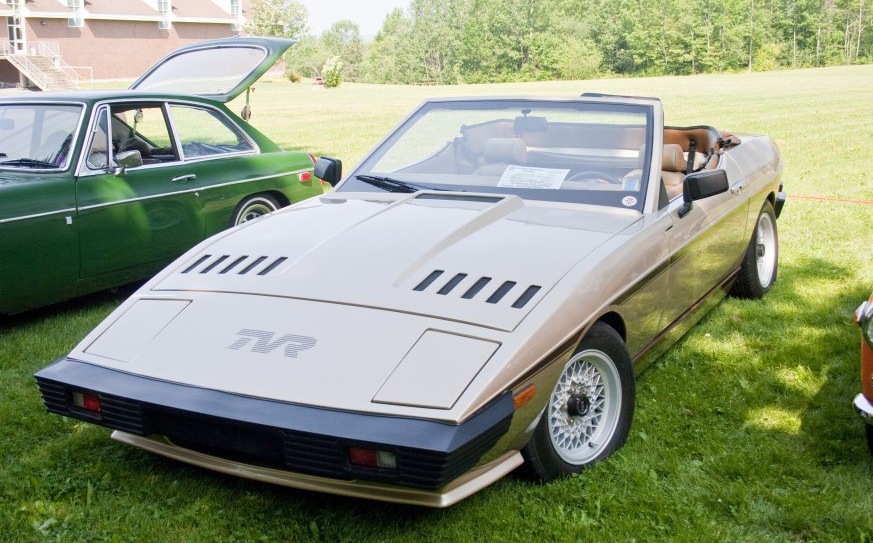
The TVR Tasmin 2.8, produced between 1980 and 1983, represents a pivotal moment in the British sports car manufacturer’s history. It was TVR’s first attempt at a mass-produced, mid-engined sports car, aiming to broaden the brand’s appeal beyond its traditionally niche, hand-built offerings. The Tasmin, named after a character in a science fiction novel, utilized a backbone chassis – a TVR hallmark – but incorporated a fiberglass body designed for easier and more consistent manufacturing. The 2.8-liter variant, producing 160 horsepower, occupied the top end of the Tasmin range during its production run, offering a performance-focused experience within the relatively affordable sports car market of the early 1980s. It was intended to compete with cars like the Porsche 924 and Lotus Esprit, though at a significantly lower price point.
Technical Specifications
| Brand | TVR |
| Model | Tasmin |
| Generation | Tasmin |
| Type (Engine) | 2.8 (160 Hp) |
| Start of production | 1980 |
| End of production | 1983 |
| Powertrain Architecture | Internal Combustion Engine |
| Body type | Cabriolet |
| Fuel Type | Petrol (Gasoline) |
| Power | 160 Hp |
| Engine Aspiration | Naturally Aspirated |
Powertrain & Engine Architecture
The heart of the Tasmin 2.8 was the Ford Cologne V6 engine, specifically the 2.8-liter variant. This engine, a 60-degree V6, was chosen for its relatively compact size, robust construction, and readily available parts supply. While TVR did some minor tuning, the engine remained largely in Ford’s specification. It featured a single overhead camshaft (SOHC) design, two valves per cylinder, and a cast iron block with aluminum cylinder heads. Fuel delivery was handled by a Weber 32/36 DGV carburetor, a common setup for the era. The engine produced 160 horsepower at approximately 5,500 rpm and 175 lb-ft of torque at 3,500 rpm.
The transmission was a Ford Type 9 five-speed manual gearbox, chosen for its durability and relatively short gear ratios, complementing the engine’s power band. The gearbox was mounted directly behind the engine, contributing to the car’s mid-engine balance. The drivetrain then sent power to the rear wheels via a standard open differential. While an automatic transmission was offered in some Tasmin models (the 2.0-liter version), the 2.8-liter was exclusively available with the five-speed manual, reflecting its performance-oriented nature.
Driving Characteristics
The Tasmin 2.8 offered a distinctly raw and engaging driving experience. The combination of the lightweight fiberglass body (around 2,200 lbs) and the 160 hp V6 resulted in brisk acceleration. Zero to sixty mph was achievable in around 6.5 seconds, respectable for the early 1980s. The car’s mid-engine layout provided excellent balance and handling, although the suspension – consisting of independent double wishbones at all four corners – was relatively simple by modern standards. The steering, while unassisted, was direct and communicative, providing good feedback to the driver.
The five-speed gearbox allowed the driver to keep the engine in its sweet spot, maximizing performance. Gear ratios were relatively short, encouraging frequent shifting. However, the car’s lack of aerodynamic aids and relatively high center of gravity meant that high-speed stability wasn’t its strongest suit. The ride quality was firm, reflecting the car’s sporting intentions, and could be unforgiving on rough road surfaces. Compared to the 2.0-liter Tasmin, the 2.8 offered a significant performance boost, with noticeably stronger acceleration and a more responsive feel.
Equipment & Trim Levels
The Tasmin 2.8 was relatively sparsely equipped compared to contemporary sports cars from larger manufacturers. The interior was functional rather than luxurious, with simple, supportive bucket seats upholstered in cloth or leather (leather was an optional extra). The dashboard featured a straightforward layout with analog gauges for speed, rpm, water temperature, and fuel level. A three-spoke steering wheel was standard.
Standard features included a heater and demister, but air conditioning, power windows, and central locking were typically optional extras. The car’s convertible top was manually operated. Trim levels were limited, with most customization options revolving around interior upholstery colors and the addition of optional equipment. The focus was on providing a pure driving experience, rather than a lavishly equipped one.
Chassis & Braking
The Tasmin’s chassis was based on TVR’s traditional backbone construction, consisting of a steel spine running the length of the car, to which the suspension and body panels were attached. This design provided a rigid and lightweight platform. The suspension utilized independent double wishbones at all four corners, with coil springs and telescopic shock absorbers. Anti-roll bars were fitted to both the front and rear axles to reduce body roll during cornering.
Braking was provided by disc brakes on all four wheels, although the rear discs were smaller in diameter than the front. The braking system was unassisted, requiring a firm pedal effort. Wheels were typically 15-inch alloy wheels, shod with performance tires. The combination of the lightweight chassis, well-tuned suspension, and effective brakes contributed to the Tasmin’s agile handling characteristics.
Market Reception & Comparison
The TVR Tasmin 2.8 received mixed reviews from automotive critics. It was praised for its performance, handling, and distinctive styling, but criticized for its build quality, sparse interior, and lack of refinement. Compared to the 2.0-liter Tasmin, the 2.8 was widely regarded as the more desirable model, offering a significant performance upgrade. However, it was more expensive, limiting its appeal to a smaller segment of the market.
Fuel economy was relatively poor, averaging around 20 mpg in mixed driving. Reliability was also a concern, as with many British sports cars of the era. The Ford Cologne V6 engine was generally reliable, but the Tasmin’s fiberglass body and relatively complex electrical system could be prone to issues. Compared to rivals like the Porsche 924, the Tasmin offered more performance for the money, but lacked the Porsche’s build quality and reliability.
Legacy
The TVR Tasmin, while short-lived, was a significant car for the company. It represented TVR’s first serious attempt at mass production and helped to broaden the brand’s appeal. The 2.8-liter variant remains the most sought-after version of the Tasmin by enthusiasts.
Today, the Tasmin 2.8 is a relatively rare and collectible sports car. Well-maintained examples command a premium price. The Ford Cologne V6 engine is relatively easy to maintain, thanks to the availability of parts. However, finding qualified mechanics familiar with TVR’s unique construction techniques can be challenging. The Tasmin 2.8 is remembered as a raw, exciting, and uniquely British sports car that offered a compelling alternative to more mainstream rivals.
