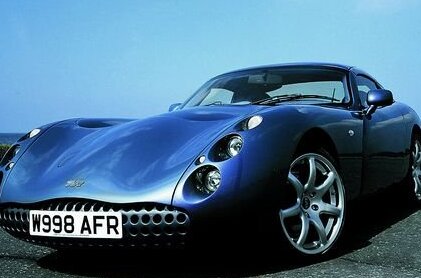
The TVR Tuscan Challenge Speed Eight 3.9i V8, produced between 1989 and 1993, represents a pivotal moment in the history of TVR, a British manufacturer renowned for its hand-built, high-performance sports cars. This model, a two-seat cabriolet, was a direct descendant of the earlier Tuscan series, but distinguished by its potent 3.9-liter V8 engine. The Tuscan Challenge was aimed at enthusiasts seeking a raw, visceral driving experience, embodying TVR’s commitment to performance over outright luxury. It occupied a unique position within the TVR lineup, offering a significant step up in power and sophistication compared to the four-cylinder models, while remaining more focused and less compromised than later, more comfort-oriented TVRs.
Technical Specifications
| Brand | TVR |
| Model | Tuscan Challenge |
| Generation | Tuscan Challenge |
| Type (Engine) | Speed Eight 3.9i V8 (243 Hp) |
| Start of production | 1989 |
| End of production | 1993 |
| Powertrain Architecture | Internal Combustion engine |
| Body type | Cabriolet |
| Seats | 2 |
| Doors | 2 |
| Fuel consumption (urban) | 16 l/100 km (14.7 US mpg, 17.7 UK mpg, 6.3 km/l) |
| Fuel consumption (extra urban) | 10 l/100 km (23.5 US mpg, 28.2 UK mpg, 10 km/l) |
| Fuel Type | Petrol (Gasoline) |
| Acceleration 0 – 100 km/h | 7 sec |
| Acceleration 0 – 62 mph | 7 sec |
| Acceleration 0 – 60 mph | 6.7 sec |
| Maximum speed | 230 km/h (142.92 mph) |
| Weight-to-power ratio | 4.6 kg/Hp, 217 Hp/tonne |
| Weight-to-torque ratio | 3.1 kg/Nm, 326.8 Nm/tonne |
| Power | 243 Hp @ 5300 rpm |
| Power per litre | 61.6 Hp/l |
| Torque | 366 Nm @ 3500 rpm (269.95 lb.-ft. @ 3500 rpm) |
| Engine displacement | 3947 cm3 (240.86 cu. in.) |
| Number of cylinders | 8 |
| Engine configuration | V-engine |
| Cylinder Bore | 94 mm (3.7 in.) |
| Piston Stroke | 71.1 mm (2.8 in.) |
| Compression ratio | 10.5:1 |
| Number of valves per cylinder | 2 |
| Fuel injection system | Multi-port manifold injection |
| Engine aspiration | Naturally aspirated engine |
| Kerb Weight | 1120 kg (2469.18 lbs.) |
| Max. weight | 1425 kg (3141.59 lbs.) |
| Max load | 305 kg (672.41 lbs.) |
| Trunk (boot) space – minimum | 225 l (7.95 cu. ft.) |
| Fuel tank capacity | 61 l (16.11 US gal | 13.42 UK gal) |
| Length | 4100 mm (161.42 in.) |
| Width | 1760 mm (69.29 in.) |
| Height | 1210 mm (47.64 in.) |
| Wheelbase | 2460 mm (96.85 in.) |
| Front track | 1500 mm (59.06 in.) |
| Rear (Back) track | 1530 mm (60.24 in.) |
| Drivetrain Architecture | Rear wheel drive |
| Number of gears and type of gearbox | 5 gears, manual transmission |
| Front suspension | Coil spring |
| Rear suspension | Coil spring |
| Front brakes | Ventilated discs |
| Rear brakes | Ventilated discs |
| Assisting systems | ABS (Anti-lock braking system), Hydraulic Steering |
| Tires size | 225/50 R15 |
Powertrain & Engine Architecture
The heart of the Tuscan Challenge is its 3.9-liter V8 engine, internally designated as the ‘Speed Eight’. This engine was a significant departure for TVR, representing their first in-house designed and built V8. It featured a 90-degree V-angle, providing inherent balance and smoothness. The engine utilized a cast iron block with aluminum cylinder heads, and employed a multi-port fuel injection system for precise fuel delivery. The valvetrain consisted of two valves per cylinder, operated by a single overhead camshaft per bank. The 5-speed manual transmission was sourced from a variety of suppliers over the production run, but generally provided a direct and engaging shift feel. The engine’s 243 horsepower and 366 Nm (270 lb-ft) of torque were substantial for a relatively lightweight sports car of this era.
Driving Characteristics
The Tuscan Challenge, with its 243 hp and relatively low weight of around 2470 pounds, offered exhilarating performance. Acceleration to 60 mph was achieved in approximately 6.7 seconds, and it could reach a top speed of 143 mph. The manual transmission, while not known for its precision, contributed to the raw and engaging driving experience. The power delivery was linear, with a strong mid-range punch thanks to the V8 configuration. Compared to the later, more refined TVR models, the Tuscan Challenge felt more direct and visceral. The lack of electronic driver aids meant that the driver was fully engaged in the process of controlling the car, demanding respect and skill.
Equipment & Trim Levels
The Tuscan Challenge was not a car focused on lavish luxury. It was designed for driving, and the interior reflected that. Standard features included leather seats, a wood-rimmed steering wheel, and basic instrumentation. The interior was relatively spartan, but functional. Options included upgraded audio systems, and various trim materials. The dashboard layout was simple and driver-focused, with clearly visible gauges. The convertible top was manually operated, adding to the car’s raw and engaging character.
Chassis & Braking
The Tuscan Challenge utilized a steel tube chassis, a hallmark of TVR construction. This provided a strong and lightweight platform for the suspension and bodywork. Suspension consisted of independent coil springs all around, offering a firm but compliant ride. Braking was provided by ventilated discs on all four wheels, assisted by an anti-lock braking system (ABS). While the braking performance was adequate for the car’s performance, it wasn’t a standout feature. The steering was hydraulic, providing reasonable assistance without feeling overly isolated.
Market Reception & Comparison
The TVR Tuscan Challenge was well-received by automotive enthusiasts who appreciated its raw performance and unique character. Critics praised the V8 engine’s power and sound, but also noted the car’s lack of refinement compared to its European rivals. Compared to other TVR models, such as the four-cylinder Tuscans, the Challenge offered a significant performance upgrade. However, it was more expensive and less fuel-efficient. Against competitors like the Porsche 944 or Lotus Elan, the Tuscan Challenge offered a more visceral and arguably more exciting driving experience, but lacked the build quality and reliability of those established marques.
Legacy
The TVR Tuscan Challenge Speed Eight 3.9i V8 holds a special place in TVR history as the first model to showcase the company’s in-house V8 engine. The ‘Speed Eight’ engine would go on to power many subsequent TVR models, becoming a defining feature of the brand. Today, the Tuscan Challenge is a sought-after classic car, appreciated by collectors and enthusiasts for its rarity, performance, and unique character. While maintenance can be challenging due to the car’s age and the specialized nature of its components, the Tuscan Challenge remains a rewarding and engaging sports car to own and drive. Reliability, as with many TVRs of this era, can be variable, and requires diligent maintenance and a knowledgeable owner. The car’s value has steadily increased in recent years, reflecting its growing desirability within the classic car market.