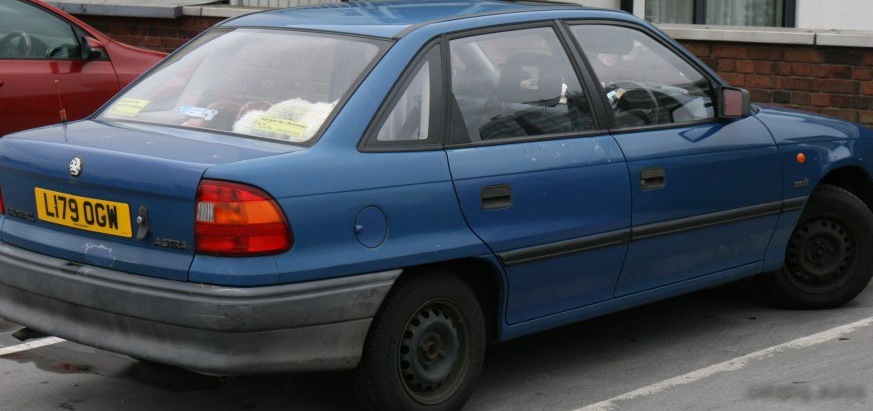
The Vauxhall Astra Mk III, produced between 1991 and 1994, represented a significant step forward for the British manufacturer, building upon the success of its predecessors. Within the Mk III range, the 1.4i variant, producing 60 horsepower, served as the entry point to the model line. Manufactured from 1992-1994, this version was aimed at budget-conscious buyers and those prioritizing fuel economy over outright performance. It occupied the lowest rung of the Astra Mk III ladder, sitting below the 1.6i, 1.8i, and diesel models. The Mk III Astra was a crucial model for Vauxhall, solidifying its position in the competitive European compact car segment.
Technical Specifications
| Brand | Vauxhall |
| Model | Astra |
| Generation | Astra Mk III |
| Type (Engine) | 1.4i (60 Hp) |
| Start of production | 1992 |
| End of production | 1994 |
| Powertrain Architecture | Internal Combustion engine |
| Body type | Sedan |
| Seats | 5 |
| Doors | 4 |
| Fuel consumption (combined) | 6.8 l/100 km |
| Fuel consumption (US mpg) | 34.6 |
| Fuel consumption (UK mpg) | 41.5 |
| Fuel consumption (km/l) | 14.7 |
| Fuel Type | Petrol (Gasoline) |
| Acceleration 0 – 100 km/h | 16 sec |
| Acceleration 0 – 62 mph | 16 sec |
| Acceleration 0 – 60 mph | 15.2 sec |
| Maximum speed | 159 km/h |
| Maximum speed (mph) | 98.8 |
| Weight-to-power ratio | 15.8 kg/Hp |
| Weight-to-torque ratio | 9.2 kg/Nm |
| Power | 60 Hp @ 5200 rpm |
| Power per litre | 43.2 Hp/l |
| Torque | 103 Nm @ 2800 rpm |
| Torque (lb.-ft.) | 75.97 @ 2800 rpm |
| Engine layout | Front, Transverse |
| Engine Model/Code | C14NZ |
| Engine displacement | 1388 cm3 |
| Engine displacement (cu. in.) | 84.7 |
| Number of cylinders | 4 |
| Engine configuration | Inline |
| Fuel injection system | Single-point injection |
| Engine aspiration | Naturally aspirated |
| Engine oil capacity | 3.5 l |
| Engine oil capacity (US qt) | 3.7 |
| Engine oil capacity (UK qt) | 3.08 |
| Coolant capacity | 5.7 l |
| Coolant capacity (US qt) | 6.02 |
| Coolant capacity (UK qt) | 5.02 |
| Kerb Weight | 950 kg |
| Kerb Weight (lbs) | 2094.39 |
| Max. weight | 1475 kg |
| Max. weight (lbs) | 3251.82 |
| Max load | 525 kg |
| Max load (lbs) | 1157.43 |
| Trunk (boot) space – minimum | 501 l |
| Trunk (boot) space – minimum (cu. ft.) | 17.69 |
| Trunk (boot) space – maximum | 1200 l |
| Trunk (boot) space – maximum (cu. ft.) | 42.38 |
| Fuel tank capacity | 52 l |
| Fuel tank capacity (US gal) | 13.74 |
| Fuel tank capacity (UK gal) | 11.44 |
| Length | 4239 mm |
| Length (in.) | 166.89 |
| Width | 1689 mm |
| Width (in.) | 66.5 |
| Height | 1410 mm |
| Height (in.) | 55.51 |
| Wheelbase | 2520 mm |
| Wheelbase (in.) | 99.21 |
| Front track | 1420 mm |
| Front track (in.) | 55.91 |
| Rear track | 1420 mm |
| Rear track (in.) | 55.91 |
| Ride height (ground clearance) | 135 mm |
| Ride height (in.) | 5.31 |
| Drag coefficient (Cd) | 0.31 |
| Drivetrain Architecture | ICE, Front wheel drive |
| Drive wheel | Front wheel drive |
| Number of gears | 5 |
| Gearbox type | Manual transmission |
| Front brakes | Ventilated discs |
| Rear brakes | Drum |
| Tires size | 175/70 R13 |
| Wheel rims size | 13 |
Powertrain & Engine Architecture
The heart of the Astra Mk III 1.4i was the C14NZ engine, a 1.4-liter (1388cc) inline-four cylinder unit. This engine utilized a single-point fuel injection system, a relatively basic setup for the early 1990s, but one that contributed to its affordability and reasonable fuel efficiency. The engine produced 60 horsepower at 5200 rpm and 103 Nm (76 lb-ft) of torque at 2800 rpm. The engine’s valvetrain featured a single overhead camshaft (SOHC) operating two valves per cylinder. The engine was transversely mounted, driving the front wheels. The standard transmission was a five-speed manual gearbox, optimized for economy rather than performance. The C14NZ was known for its simplicity and relative reliability, though it lacked the refinement and power of larger engines in the Astra range.
Driving Characteristics
The 1.4i Astra Mk III offered modest performance. Acceleration from 0-60 mph took around 15.2 seconds, and the top speed was approximately 99 mph. The five-speed manual transmission featured relatively long gear ratios, prioritizing fuel economy over spirited driving. Power delivery was smooth but lacked the punch of the 1.6 or 1.8-liter variants. The car felt best suited to urban driving and relaxed cruising on motorways. Compared to the more powerful Astras, the 1.4i felt noticeably slower, particularly when fully loaded or tackling hills. However, its lighter weight compared to some of its siblings did offer a degree of agility in corners.
Equipment & Trim Levels
The 1.4i Astra Mk III typically came with a basic level of equipment. Standard features included central locking, power steering, and a basic stereo system. Interior upholstery was typically cloth, and the dashboard featured a simple, functional design. Optional extras included electric windows, a sunroof, and upgraded stereo systems. The trim level was generally considered the base model, aimed at buyers seeking affordable transportation. It lacked the more luxurious appointments found in the higher-spec Astra variants.
Chassis & Braking
The Astra Mk III 1.4i utilized a MacPherson strut front suspension and a torsion beam rear suspension. The front brakes were ventilated discs, providing adequate stopping power, while the rear brakes were drums. This configuration was typical for cars in this class at the time. The suspension setup prioritized ride comfort over sporty handling. The car’s relatively light weight helped to mitigate the limitations of the rear drum brakes. Stabilizer bars were fitted to both the front and rear axles, contributing to reduced body roll during cornering.
Market Reception & Comparison
The Astra Mk III 1.4i was generally well-received as an affordable and practical family car. Critics praised its fuel economy and reliability, but noted its lack of performance. Compared to the 1.6i and 1.8i models, the 1.4i offered significantly less power and a slower driving experience. However, it was considerably cheaper to buy and run. The 1.4i also offered better fuel economy than the diesel variants, making it a popular choice for drivers who covered moderate mileage. In the used car market, the 1.4i Astra Mk III remains a relatively affordable option, appealing to first-time drivers or those seeking a cheap and reliable runabout.
Legacy
The C14NZ engine, while not known for its performance, proved to be a durable and reliable unit. Many examples are still on the road today, testament to its robust construction. The Astra Mk III 1.4i remains a popular choice for classic car enthusiasts and those seeking a nostalgic driving experience. Its simplicity and affordability make it an attractive option for restoration projects. While it may not be the most exciting car in the Astra lineage, the 1.4i played a vital role in establishing the Mk III as a successful and popular model.