Technical Specifications
| Brand | Vauxhall |
| Model | Astra |
| Generation | Astra Mk III CC |
| Type (Engine) | 1.4i (60 Hp) |
| Start of production | 1991 |
| End of production | 1998 |
| Powertrain Architecture | Internal Combustion engine |
| Body type | Hatchback |
| Seats | 5 |
| Doors | 3-5 |
| Fuel consumption (urban) | 8.6-10.5 l/100 km (27.4 – 22.4 US mpg) |
| Fuel consumption (extra urban) | 5.1-6.1 l/100 km (46.1 – 38.6 US mpg) |
| Fuel consumption (combined) | 6.8-7.7 l/100 km (34.6 – 30.5 US mpg) |
| CO2 emissions | 162-183 g/km |
| Fuel Type | Petrol (Gasoline) |
| Acceleration 0 – 100 km/h | 16 sec |
| Acceleration 0 – 62 mph | 16 sec |
| Acceleration 0 – 60 mph | 15.2 sec |
| Maximum speed | 159 km/h (98.8 mph) |
| Weight-to-power ratio | 15.7 kg/Hp |
| Weight-to-torque ratio | 9.1 kg/Nm |
| Power | 60 Hp @ 5200 rpm |
| Torque | 103 Nm @ 2800 rpm (75.97 lb.-ft. @ 2800 rpm) |
| Engine layout | Front, Transverse |
| Engine Model/Code | C14NZ, X14NZ |
| Engine displacement | 1389 cm3 (84.76 cu. in.) |
| Number of cylinders | 4 |
| Engine configuration | Inline |
| Number of valves per cylinder | 4 |
| Fuel injection system | Single-point injection |
| Engine oil capacity | 3.5 l (3.7 US qt | 3.08 UK qt) |
| Coolant capacity | 5.7 l (6.02 US qt | 5.02 UK qt) |
| Kerb Weight | 940/970 kg (2072.35 lbs.) |
| Max. weight | 1475/1495 kg (3251.82 lbs.) |
| Max load | 525-535 kg (1157.43 – 1179.47 lbs.) |
| Trunk (boot) space – minimum | 360 l (12.71 cu. ft.) |
| Length | 4049 mm (159.41 in.) |
| Width | 1689 mm (66.5 in.) |
| Height | 1410 mm (55.51 in.) |
| Wheelbase | 2520 mm (99.21 in.) |
| Front track | 1420 mm (55.91 in.) |
| Rear track | 1420 mm (55.91 in.) |
| Ride height (ground clearance) | 135 mm (5.31 in.) |
| Drag coefficient (Cd) | 0.31 |
| Drivetrain Architecture | Front wheel drive |
| Number of gears | 5 |
| Gearbox type | Manual transmission |
| Front brakes | Ventilated discs |
| Rear brakes | Drum |
| Tires size | 175/70 R13 |
| Wheel rims size | 13 |
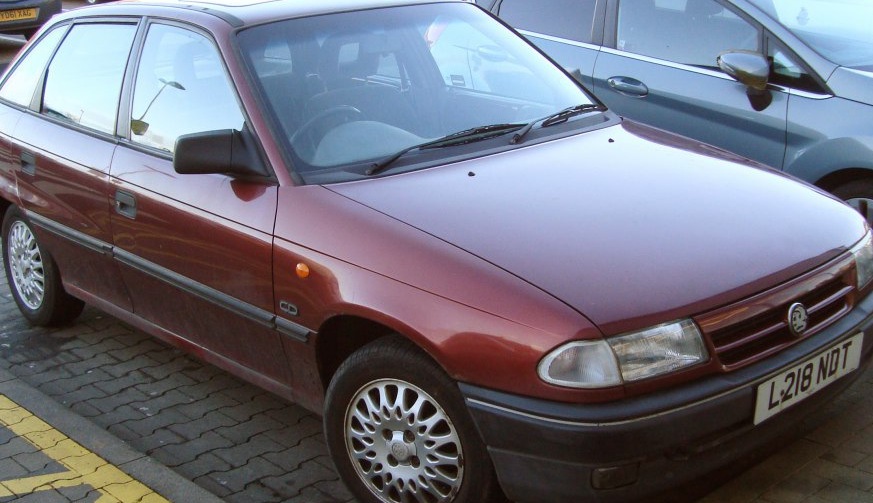
The Vauxhall Astra Mk III, manufactured between 1991 and 1998, marked a significant evolution for the British automaker, building on the foundations laid by its predecessors. Within the Mk III range, the 1.4i model, producing 60 horsepower, served as the entry-level option, proving particularly popular in the United Kingdom and throughout Europe. Available in both 3-door and 5-door hatchback body styles, this variant aimed to deliver affordable and practical transportation for budget-conscious consumers. Constructed on the GM T platform – shared with Opel and other Vauxhall models – the Astra Mk III played a vital role in solidifying the Astra’s position as a mainstream competitor in the compact family car segment.
Powertrain & Engine Architecture
At the heart of the Astra 1.4i lay the C14NZ (and subsequently the X14NZ) engine, a 1.4-liter inline-four cylinder powerplant. This engine was characterized by its relatively straightforward design, featuring a single overhead camshaft (SOHC) and two valves per cylinder. Fuel delivery was managed by a single-point fuel injection system, a cost-effective solution prevalent in entry-level vehicles of the period. The engine generated 60 horsepower at 5200 rpm and 103 Nm (76 lb-ft) of torque at 2800 rpm. A five-speed manual transmission was the standard configuration, offering a balance between fuel efficiency and usability. The engine’s design philosophy prioritized dependability and affordability over outright performance.
Driving Characteristics
The 1.4i Astra wasn’t engineered for exhilarating performance. Acceleration was modest, requiring approximately 16 seconds to reach 60 mph. The engine demonstrated strain at higher revolutions, and overtaking maneuvers demanded careful consideration. However, within urban settings, the 1.4i proved perfectly adequate. The five-speed gearbox provided reasonable control, and the vehicle’s relatively light weight helped to compensate for the limited power output. In comparison to the more potent 1.6L and 2.0L variants, the 1.4i offered a smoother, more forgiving driving experience, albeit at the cost of performance. The gear ratios were optimized for economy, prioritizing fuel efficiency over rapid acceleration.
Equipment & Trim Levels
The 1.4i Astra typically came equipped with a basic set of features. Standard amenities included central locking, power steering, and an adjustable steering column. Interior upholstery was generally cloth, and the dashboard featured a simple, functional layout. Optional extras, such as electric windows, a sunroof, and upgraded audio systems, were available. This trim level was considered the base model, targeting buyers seeking a no-nonsense, reliable vehicle. It was frequently chosen by first-time car owners or those in need of a practical and economical daily driver.
Chassis & Braking
The Astra Mk III employed a MacPherson strut front suspension and a torsion beam rear suspension. This configuration delivered a comfortable ride, although handling wasn’t particularly sharp. Front brakes consisted of ventilated discs, providing adequate stopping power, while the rear brakes utilized drums – a cost-saving measure common in this vehicle class. The relatively narrow tires (typically 175/70 R13) contributed to the car’s comfortable ride but limited grip. Stabilizer bars were often omitted on the base 1.4i model, further emphasizing its focus on affordability.
Market Reception & Comparison
The Astra 1.4i was generally well-received as an affordable and dependable family car. Critics acknowledged its modest performance but lauded its fuel economy and practicality. Compared to competitors like the Ford Escort and Peugeot 305, the Astra offered a competitive package, particularly in terms of value. The 1.6L and 2.0L Astra variants provided significantly more performance, but at a higher price point. The 1.4i’s superior fuel economy made it an appealing choice for those prioritizing running costs. Reliability was generally good, although the single-point fuel injection system occasionally required maintenance.
Legacy
The 1.4i Astra Mk III remains a relatively common sight on roads today, a testament to its durability and affordability. The C14NZ engine is known for its robustness, although age and mileage can lead to issues such as oil leaks and worn piston rings. Parts availability is generally good, and the car’s simple mechanical design makes it relatively easy to maintain. In the used car market, the 1.4i Astra represents a budget-friendly option for those seeking a classic 1990s hatchback. While not a performance icon, it holds a place in automotive history as a practical and dependable vehicle that served a large segment of the population.