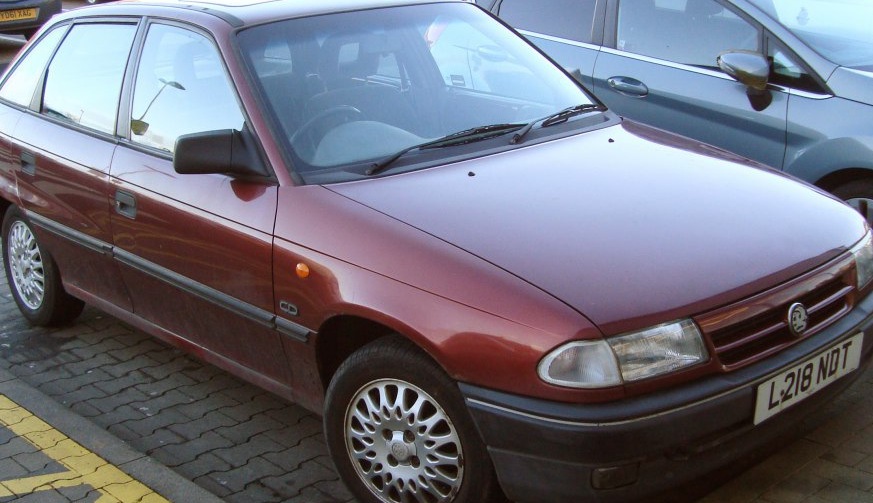
The Vauxhall Astra Mk III, produced from 1991 to 1998, represented a significant step forward for the British manufacturer, building upon the success of its predecessors. Within the Mk III range, the 1.6i variant, producing 71 horsepower, served as a core entry-level model, particularly popular in the United Kingdom and broader European markets. This model, often configured as a five-door hatchback, aimed to provide affordable and practical transportation for families and commuters. It was positioned below the more powerful 1.8 and 2.0-liter versions, and significantly below the sportier GSi models, offering a balance of economy and usability. The Astra Mk III chassis (designated as the 1HX0) was a key component of the General Motors T-platform, shared with other European Opel and Saab models.
Technical Specifications
| Brand | Vauxhall |
| Model | Astra |
| Generation | Astra Mk III CC |
| Type (Engine) | 1.6i (71 Hp) |
| Start of production | 1991 |
| End of production | 1998 |
| Powertrain Architecture | Internal Combustion engine |
| Body type | Hatchback |
| Seats | 5 |
| Doors | 5 |
| Fuel consumption (combined) | 6.9 l/100 km |
| Fuel consumption (US mpg) | 34.1 |
| Fuel consumption (UK mpg) | 40.9 |
| CO2 emissions | 164 g/km |
| Fuel Type | Petrol (Gasoline) |
| Acceleration 0 – 100 km/h | 14 sec |
| Acceleration 0 – 62 mph | 14 sec |
| Acceleration 0 – 60 mph | 13.3 sec |
| Maximum speed | 171 km/h (106.25 mph) |
| Weight-to-power ratio | 13.9 kg/Hp |
| Weight-to-torque ratio | 7.7 kg/Nm |
| Power | 71 Hp @ 5000 rpm |
| Power per litre | 44.4 Hp/l |
| Torque | 128 Nm @ 2800 rpm (94.41 lb.-ft. @ 2800 rpm) |
| Engine layout | Front, Transverse |
| Engine Model/Code | X16SZ |
| Engine displacement | 1598 cm3 (97.52 cu. in.) |
| Number of cylinders | 4 |
| Engine configuration | Inline |
| Compression ratio | 9.6:1 |
| Number of valves per cylinder | 2 |
| Fuel injection system | Single-point injection |
| Engine aspiration | Naturally aspirated |
| Engine oil capacity | 3.5 l (3.7 US qt | 3.08 UK qt) |
| Coolant capacity | 5.6 l (5.92 US qt | 4.93 UK qt) |
| Kerb Weight | 985 kg (2171.55 lbs) |
| Max. weight | 1495 kg (3295.91 lbs) |
| Max load | 510 kg (1124.36 lbs) |
| Trunk (boot) space – minimum | 360 l (12.71 cu. ft.) |
| Trunk (boot) space – maximum | 1201 l (42.41 cu. ft.) |
| Length | 4049 mm (159.41 in.) |
| Width | 1689 mm (66.5 in.) |
| Height | 1410 mm (55.51 in.) |
| Wheelbase | 2520 mm (99.21 in.) |
| Front track | 1420 mm (55.91 in.) |
| Rear track | 1420 mm (55.91 in.) |
| Ride height (ground clearance) | 135 mm (5.31 in.) |
| Drag coefficient (Cd) | 0.31 |
| Drivetrain Architecture | Front wheel drive |
| Number of gears | 5 |
| Gearbox type | Manual transmission |
| Front brakes | Ventilated discs |
| Rear brakes | Drum |
| Tires size | 175/70 R13 |
| Wheel rims size | 13 |
Powertrain & Engine Architecture
The heart of the Astra Mk III 1.6i was the X16SZ engine, a 1.6-liter inline-four cylinder unit. This engine utilized a single-point fuel injection system, a relatively common technology in the early 1990s, delivering fuel into the intake manifold rather than directly into the cylinders. The engine featured a two-valve per cylinder configuration, contributing to its simplicity and affordability. The X16SZ produced 71 horsepower at 5000 rpm and 128 Nm (94.41 lb-ft) of torque at 2800 rpm. This power was transmitted to the front wheels through a five-speed manual transmission, the most common configuration. While an automatic transmission was offered, it was less frequently selected due to its impact on fuel economy and performance. The engine’s design prioritized reliability and low running costs over outright performance.
Driving Characteristics
The 1.6i Astra Mk III offered a predictable, if not particularly exciting, driving experience. Acceleration from 0-60 mph took around 13.3 seconds, and top speed was approximately 106 mph. The five-speed manual transmission provided adequate control, but the engine lacked the low-end torque found in larger displacement engines. Drivers often needed to downshift to maintain momentum when climbing hills or overtaking. Compared to the 1.8 and 2.0-liter versions, the 1.6i felt noticeably slower, but it offered a more economical driving experience. The gear ratios were tuned for fuel efficiency rather than spirited driving. The suspension, while comfortable for everyday use, wasn’t particularly sporty, resulting in some body roll during cornering.
Equipment & Trim Levels
The 1.6i Astra Mk III typically came with a fairly basic level of equipment. Standard features included central locking, power steering, and an adjustable steering column. Interior upholstery was typically cloth, and the dashboard featured a simple, functional design. Optional extras included electric windows, a sunroof, and upgraded audio systems. Trim levels varied slightly depending on the market, but generally, the 1.6i represented the entry point to the Astra Mk III range. Higher trim levels added features like alloy wheels, upgraded interior trim, and more sophisticated audio systems.
Chassis & Braking
The Astra Mk III utilized a MacPherson strut front suspension and a torsion beam rear suspension. The front brakes were ventilated discs, providing adequate stopping power, while the rear brakes were drums, a cost-saving measure common in this class of vehicle. The suspension was tuned for comfort, prioritizing ride quality over handling precision. Stabilizer bars were fitted to both the front and rear axles, helping to reduce body roll. The relatively lightweight nature of the 1.6i model (approximately 985 kg or 2171.55 lbs) helped to offset the engine’s modest power output.
Market Reception & Comparison
The Astra Mk III 1.6i was generally well-received as an affordable and practical family car. Critics praised its fuel economy and reliability, but noted its lack of performance compared to higher-spec models. Compared to rivals like the Ford Escort and Peugeot 306, the Astra Mk III offered a competitive package in terms of price and features. The 1.8-liter Astra offered a noticeable performance improvement, but at a higher price point and with slightly reduced fuel economy. The 2.0-liter and GSi models provided even more performance, but were aimed at a different segment of the market. The 1.6i’s simplicity and reliability made it a popular choice for first-time car buyers and those seeking a low-cost, dependable vehicle.
Legacy
The X16SZ engine, while not known for its performance, proved to be a durable and reliable unit. Astra Mk III 1.6i models are still found on the roads today, often with high mileage. Parts availability remains relatively good, and maintenance costs are generally low. In the used car market, these models represent an affordable entry point into classic European motoring. The Astra Mk III as a whole is remembered as a solid and dependable car that helped to establish Vauxhall as a major player in the British automotive market. The 1.6i variant, in particular, is valued for its simplicity, fuel efficiency, and affordability.