Technical Specifications
| Brand | Vauxhall |
| Model | Astra |
| Generation | Astra Mk III CC |
| Type (Engine) | 1.6i (75 Hp) |
| Start of production | 1991 |
| End of production | 1998 |
| Powertrain Architecture | Internal Combustion engine |
| Body type | Hatchback |
| Seats | 5 |
| Doors | 3-5 |
| Fuel consumption (combined) | 6.9 l/100 km |
| Fuel consumption (US mpg) | 34.1 US mpg |
| Fuel consumption (UK mpg) | 40.9 UK mpg |
| Fuel consumption (km/l) | 14.5 km/l |
| CO2 emissions | 165 g/km |
| Fuel Type | Petrol (Gasoline) |
| Acceleration 0 – 100 km/h | 14 sec |
| Acceleration 0 – 62 mph | 14 sec |
| Acceleration 0 – 60 mph | 13.3 sec |
| Maximum speed | 171 km/h (106.25 mph) |
| Weight-to-power ratio | 13.1 kg/Hp |
| Weight-to-torque ratio | 7.9 kg/Nm |
| Power | 75 Hp @ 5200 rpm |
| Power per litre | 46.9 Hp/l |
| Torque | 125 Nm @ 3200 rpm (92.2 lb.-ft. @ 3200 rpm) |
| Engine layout | Front, Transverse |
| Engine Model/Code | C16NZ |
| Engine displacement | 1598 cm3 (97.52 cu. in.) |
| Number of cylinders | 4 |
| Engine configuration | Inline |
| Cylinder Bore | 79 mm (3.11 in.) |
| Piston Stroke | 81.5 mm (3.21 in.) |
| Compression ratio | 9.6:1 |
| Number of valves per cylinder | 2 |
| Fuel injection system | Single-point injection |
| Engine aspiration | Naturally aspirated |
| Engine oil capacity | 3.5 l (3.7 US qt | 3.08 UK qt) |
| Coolant capacity | 5.6 l (5.92 US qt | 4.93 UK qt) |
| Kerb Weight | 985 kg (2171.55 lbs.) |
| Max. weight | 1495 kg (3295.91 lbs.) |
| Max load | 510 kg (1124.36 lbs.) |
| Trunk (boot) space – minimum | 360 l (12.71 cu. ft.) |
| Trunk (boot) space – maximum | 1201 l (42.41 cu. ft.) |
| Length | 4049 mm (159.41 in.) |
| Width | 1689 mm (66.5 in.) |
| Height | 1410 mm (55.51 in.) |
| Wheelbase | 2520 mm (99.21 in.) |
| Front track | 1420 mm (55.91 in.) |
| Rear track | 1420 mm (55.91 in.) |
| Ride height (ground clearance) | 135 mm (5.31 in.) |
| Drag coefficient (Cd) | 0.31 |
| Drive wheel | Front wheel drive |
| Number of gears | 5 gears, manual transmission |
| Front brakes | Ventilated discs |
| Rear brakes | Drum |
| Tires size | 175/70 R13 |
| Wheel rims size | 13 |
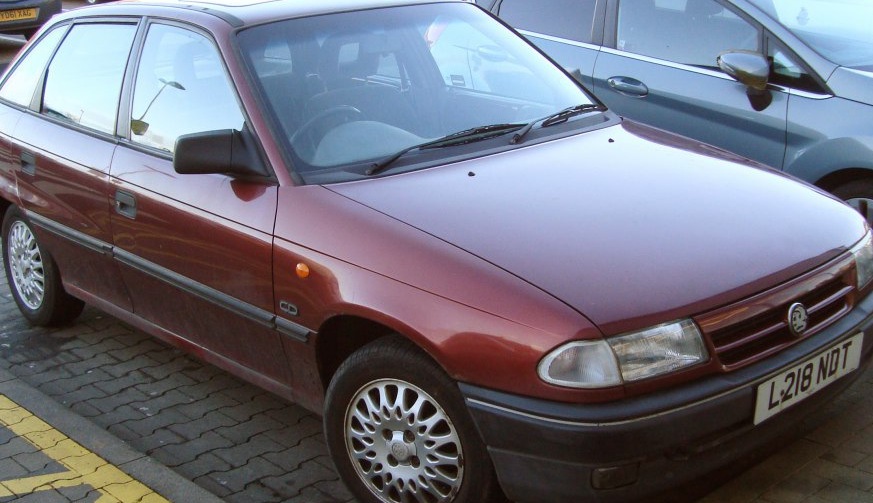
The Vauxhall Astra Mk III, produced from 1991 to 1998, was a pivotal model for the British automaker, building on the success of its predecessors and establishing a strong presence in the competitive European compact car segment. Within the Mk III range, the 1.6i variant, delivering 75 horsepower, served as a popular and accessible entry point into the lineup, particularly in the sporty 3-door coupe (CC) body style. This model occupied a crucial position, offering affordable personal transportation with reasonable fuel economy and a degree of practicality for families and individuals alike. It became a common sight on British roads throughout the 1990s, directly competing with rivals such as the Ford Escort and Peugeot 309. The Astra Mk III was built on the GM T platform, a versatile architecture shared with other Opel/Vauxhall and Isuzu models.
Powertrain & Engine Architecture
The engine powering the Astra Mk III 1.6i was the C16NZ, a 1.6-liter inline-four cylinder unit. This engine employed a single-point fuel injection system – a relatively simple and cost-effective technology for the early 1990s. The C16NZ featured a two-valve per cylinder configuration and a compression ratio of 9.6:1. While not designed for high performance, the engine prioritized durability and ease of maintenance. The standard transmission was a five-speed manual, providing adequate gear spacing for everyday driving. This transmission was a conventional design, emphasizing reliability over sporty responsiveness. The engine’s transverse mounting and front-wheel drive layout were typical for European hatchbacks of the era, maximizing interior space and enhancing traction in various driving conditions.
Driving Characteristics
The 1.6i Astra Mk III provided a comfortable, though not particularly thrilling, driving experience. With 75 horsepower, acceleration was modest, requiring approximately 14 seconds to reach 60 mph. The engine’s peak torque of 125 Nm (92.2 lb-ft) at 3200 rpm offered sufficient power for routine overtaking and hill climbing, but often necessitated downshifting for more assertive maneuvers. Compared to the more powerful 1.8 and 2.0-liter versions, the 1.6i felt noticeably less responsive. However, the five-speed gearbox allowed drivers to maintain the engine within its optimal power band. The suspension, tuned for comfort, delivered a reasonably smooth ride, although it lacked the firmness of sportier setups. The steering was light and easy, making it well-suited for navigating urban environments.
Equipment & Trim Levels
The 1.6i Astra Mk III generally came equipped with a basic set of features, reflecting its position as the entry-level model. Standard amenities typically included central locking, power steering, and an adjustable steering column. Interior upholstery was usually cloth, with a straightforward dashboard layout. Optional extras included electric windows, a sunroof, and upgraded audio systems. Higher trim levels, such as the LS and GLS, added features like alloy wheels, enhanced interior trim, and more sophisticated audio systems. The CC (Coupe) variant often featured a slightly more sporty interior aesthetic compared to the 5-door hatchback.
Chassis & Braking
The Astra Mk III utilized a MacPherson strut front suspension and a torsion beam rear suspension. This configuration struck a balance between ride comfort and handling. The front brakes were ventilated discs, providing adequate stopping power, while the rear brakes were drums – a cost-saving measure common in vehicles of this class. The 175/70 R13 tires offered reasonable grip in most conditions. Stabilizer bars were fitted to both the front and rear axles, helping to minimize body roll during cornering maneuvers.
Market Reception & Comparison
The Astra Mk III 1.6i was generally well-received by automotive critics as a practical and affordable family car. Its fuel economy, averaging around 34.1 US mpg, was considered respectable for its time. However, its performance was often criticized as being somewhat underwhelming, particularly when compared to competitors like the Ford Escort 1.6. Reliability was generally good, although the single-point fuel injection system occasionally required maintenance. The 1.6i presented a compelling value proposition for buyers seeking a dependable and economical hatchback.
Legacy
The C16NZ engine, while not celebrated for its outright performance, proved to be a durable and reliable powerplant. A significant number of Astra Mk III 1.6i models remain on the road today, a testament to their robust build quality. In the used car market, these Astras are often sought after by enthusiasts looking for a classic 1990s hatchback. Parts availability remains relatively good, making them reasonably easy to maintain. While not a highly sought-after collector’s item, the Astra Mk III 1.6i evokes a sense of nostalgia for many drivers who remember it as a dependable and affordable means of transportation.