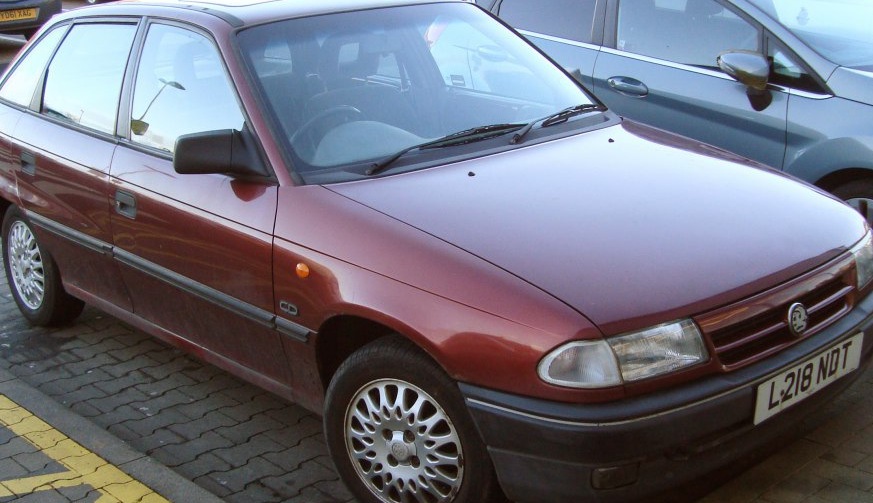
The Vauxhall Astra Mk III, produced from 1991 to 1998, represented a significant step forward for the British marque, offering a more refined and modern package than its predecessor. Within the Mk III range, the 1.8i 16V variant, available from 1994, occupied a middle ground, appealing to buyers seeking a balance between performance and economy. This model, often found in both 3-door and 5-door hatchback configurations, was a common sight on British roads and played a key role in solidifying the Astra’s position as a popular family car. It was built on the GM T platform, shared with other European Opel/Vauxhall models.
Technical Specifications
| Brand | Vauxhall |
| Model | Astra |
| Generation | Astra Mk III CC |
| Type (Engine) | 1.8i 16V (115 Hp) |
| Start of production | 1994 |
| End of production | 1998 |
| Powertrain Architecture | Internal Combustion engine |
| Body type | Hatchback |
| Seats | 5 |
| Doors | 3-5 |
| Fuel consumption (urban) | 12.1 l/100 km (19.4 US mpg, 23.3 UK mpg, 8.3 km/l) |
| Fuel consumption (extra urban) | 6 l/100 km (39.2 US mpg, 47.1 UK mpg, 16.7 km/l) |
| Fuel consumption (combined) | 8.2 l/100 km (28.7 US mpg, 34.4 UK mpg, 12.2 km/l) |
| Fuel Type | Petrol (Gasoline) |
| Acceleration 0 – 100 km/h | 9.5 sec |
| Acceleration 0 – 62 mph | 9.5 sec |
| Acceleration 0 – 60 mph | 9 sec |
| Maximum speed | 200 km/h (124.27 mph) |
| Weight-to-power ratio | 9.3 kg/Hp, 107 Hp/tonne |
| Weight-to-torque ratio | 6.4 kg/Nm, 156.3 Nm/tonne |
| Power | 115 Hp @ 5600 rpm |
| Power per litre | 63.9 Hp/l |
| Torque | 168 Nm @ 4800 rpm (123.91 lb.-ft. @ 4800 rpm) |
| Engine layout | Front, Transverse |
| Engine Model/Code | C18XEL |
| Engine displacement | 1799 cm3 (109.78 cu. in.) |
| Number of cylinders | 4 |
| Engine configuration | Inline |
| Fuel injection system | Multi-port manifold injection |
| Engine aspiration | Naturally aspirated engine |
| Engine oil capacity | 4 l (4.23 US qt | 3.52 UK qt) |
| Coolant capacity | 7 l (7.4 US qt | 6.16 UK qt) |
| Kerb Weight | 1075/1080 kg (2369.97 lbs.) |
| Max. weight | 1590/1595 kg (3505.35 lbs.) |
| Max load | 515 kg (1135.38 lbs.) |
| Trunk (boot) space – minimum | 360 l (12.71 cu. ft.) |
| Trunk (boot) space – maximum | 1201 l (42.41 cu. ft.) |
| Length | 4049 mm (159.41 in.) |
| Width | 1689 mm (66.5 in.) |
| Height | 1410 mm (55.51 in.) |
| Wheelbase | 2520 mm (99.21 in.) |
| Front track | 1420 mm (55.91 in.) |
| Rear track | 1420 mm (55.91 in.) |
| Ride height (ground clearance) | 135 mm (5.31 in.) |
| Drag coefficient (Cd) | 0.28 |
| Drivetrain Architecture | The Internal combustion engine (ICE) drives the front wheels of the vehicle. |
| Drive wheel | Front wheel drive |
| Number of gears and type of gearbox | 5 gears, manual transmission |
| Front brakes | Ventilated discs |
| Rear brakes | Disc |
| Tires size | 195/55 R15 |
| Wheel rims size | 15 |
INTRODUCTION
The Vauxhall Astra Mk III 1.8i 16V, produced between 1994 and 1998, was a popular choice for drivers seeking a well-rounded and reliable hatchback. Positioned above the base 1.4-liter models, it offered a noticeable performance boost without the higher running costs associated with the more powerful (and often more expensive) GSi variants. This trim level aimed for a broader audience, appealing to families and individuals who needed a practical and comfortable car for everyday use. The ‘CC’ designation signified the coupe/hatchback body style, differentiating it from the estate version.
Powertrain & Engine Architecture
At the heart of the Astra 1.8i 16V lies the C18XEL engine, a 1.8-liter inline-four cylinder powerplant. This engine is a naturally aspirated unit featuring multi-port fuel injection, a crucial element in achieving its 115 horsepower output at 5600 rpm and 168 Nm (124 lb-ft) of torque at 4800 rpm. The 16-valve cylinder head, with two valves per cylinder, contributes to improved breathing and higher revving capability compared to older 8-valve designs. The engine’s block is constructed from cast iron, providing durability, while the cylinder head is made of aluminum, helping to reduce weight. The engine was typically paired with a five-speed manual transmission, although a four-speed automatic was also available, albeit less common. The automatic transmission, while offering convenience, did impact acceleration and fuel economy.
Driving Characteristics
The 1.8i 16V offered a noticeable improvement in performance over the lower-capacity Astra models. Acceleration to 60 mph took around 9.5 seconds, making it reasonably quick for its time. The engine felt responsive, particularly in the mid-range, providing enough power for overtaking maneuvers and comfortable cruising. The five-speed manual gearbox was well-matched to the engine, allowing drivers to keep the engine in its optimal power band. The automatic transmission, while smooth, resulted in slightly slower acceleration and a less engaging driving experience. The Astra’s suspension provided a comfortable ride, absorbing bumps and imperfections in the road well, although it wasn’t particularly sporty in its handling characteristics.
Equipment & Trim Levels
The 1.8i 16V typically came equipped with a reasonable level of standard equipment. This included central locking, power steering, and an adjustable steering column. Interior trim generally consisted of cloth upholstery, with options for upgraded materials available. Higher trim levels, such as the ‘GL’ or ‘SE’, added features like electric windows, a sunroof, and alloy wheels. Air conditioning was often an optional extra. The dashboard layout was functional and straightforward, with clearly labeled controls. The Astra Mk III offered a practical and spacious interior, with ample room for passengers and luggage.
Chassis & Braking
The Astra Mk III utilized a MacPherson strut front suspension and a torsion beam rear suspension. This setup provided a good balance between ride comfort and handling. Braking duties were handled by ventilated discs on the front wheels and discs on the rear, offering adequate stopping power for most driving situations. Anti-lock braking (ABS) was available as an option, enhancing safety. The steering was rack and pinion, providing precise and responsive control. The Astra’s chassis was relatively lightweight, contributing to its nimble handling characteristics.
Market Reception & Comparison
The Astra 1.8i 16V was generally well-received by automotive critics. It was praised for its comfortable ride, spacious interior, and respectable performance. Compared to the base 1.4-liter models, the 1.8i 16V offered a significant improvement in driving enjoyment. However, it wasn’t as sporty or engaging as the GSi variants. Fuel economy was reasonable for its class, averaging around 28.7 US mpg on the combined cycle. The 1.8i 16V offered a good value proposition, providing a well-equipped and reliable car at a competitive price point. Compared to rivals like the Ford Escort and Peugeot 306, the Astra offered a similar level of performance and practicality.
Legacy
The C18XEL engine proved to be a durable and reliable unit, and many Astra 1.8i 16V models are still on the road today. While age-related issues such as corrosion and wear and tear are common, the engine itself is generally considered to be robust. The Astra Mk III, and particularly the 1.8i 16V variant, has gained a following among classic car enthusiasts. Parts availability is generally good, making it relatively easy to maintain and repair. In the used car market, these Astras represent an affordable and practical option for those seeking a classic 1990s hatchback.