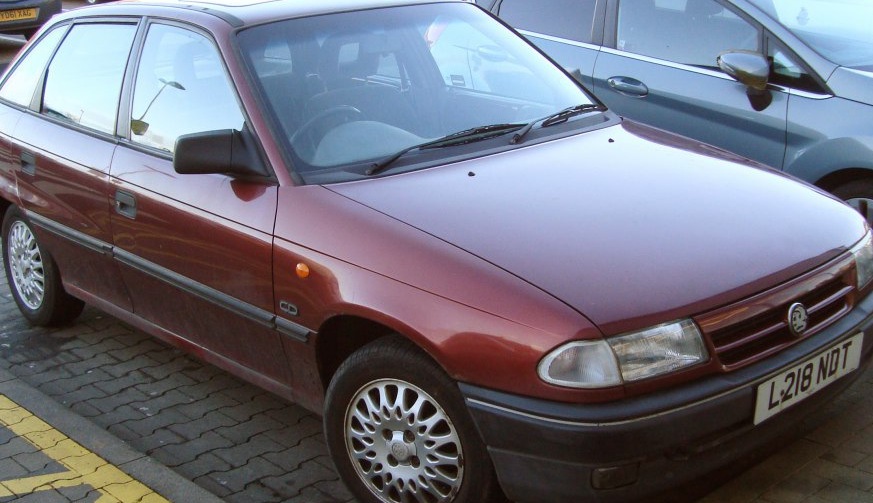
The Vauxhall Astra Mk III, produced between 1991 and 1994, represented a significant step forward for the British marque, building upon the success of its predecessors. The 1.8i variant, equipped with a 90 horsepower engine and a four-speed automatic transmission, occupied a middle ground within the Mk III lineup. It aimed to provide a balance of affordability, practicality, and ease of use, appealing to buyers who prioritized comfort over outright performance. This model was a key component of Vauxhall’s strategy to capture a larger share of the competitive European compact car market, particularly in the UK where it was a common sight on British roads.
Technical Specifications
| Brand | Vauxhall |
| Model | Astra |
| Generation | Astra Mk III CC |
| Type (Engine) | 1.8i (90 Hp) Automatic |
| Start of production | 1991 |
| End of production | 1994 |
| Powertrain Architecture | Internal Combustion engine |
| Body type | Hatchback |
| Seats | 5 |
| Doors | 3-5 |
| Fuel consumption (combined) | 8.2 l/100 km |
| Fuel consumption (US mpg) | 28.7 US mpg |
| Fuel consumption (UK mpg) | 34.4 UK mpg |
| Fuel consumption (km/l) | 12.2 km/l |
| Fuel Type | Petrol (Gasoline) |
| Acceleration 0 – 100 km/h | 14.5 sec |
| Acceleration 0 – 62 mph | 14.5 sec |
| Acceleration 0 – 60 mph | 13.8 sec |
| Maximum speed | 175 km/h (108.74 mph) |
| Weight-to-power ratio | 11.6 kg/Hp |
| Weight-to-torque ratio | 7.2 kg/Nm |
| Power | 90 Hp @ 5400 rpm |
| Power per litre | 50.1 Hp/l |
| Torque | 145 Nm @ 3000 rpm (106.95 lb.-ft. @ 3000 rpm) |
| Engine layout | Front, Transverse |
| Engine Model/Code | C18NZ |
| Engine displacement | 1796 cm3 (109.6 cu. in.) |
| Number of cylinders | 4 |
| Engine configuration | Inline |
| Cylinder Bore | 84.8 mm (3.34 in.) |
| Piston Stroke | 79.5 mm (3.13 in.) |
| Compression ratio | 9.2:1 |
| Number of valves per cylinder | 2 |
| Fuel injection system | Single-point injection |
| Engine aspiration | Naturally aspirated |
| Engine oil capacity | 4 l (4.23 US qt | 3.52 UK qt) |
| Coolant capacity | 6.9 l (7.29 US qt | 6.07 UK qt) |
| Kerb Weight | 1040/1060 kg (2292.81 lbs.) |
| Max. weight | 1580 kg (3483.3 lbs.) |
| Max load | 520-540 kg (1146.4 – 1190.5 lbs.) |
| Trunk (boot) space – minimum | 360 l (12.71 cu. ft.) |
| Trunk (boot) space – maximum | 1201 l (42.41 cu. ft.) |
| Length | 4049 mm (159.41 in.) |
| Width | 1689 mm (66.5 in.) |
| Height | 1410 mm (55.51 in.) |
| Wheelbase | 2520 mm (99.21 in.) |
| Front track | 1420 mm (55.91 in.) |
| Rear track | 1420 mm (55.91 in.) |
| Ride height (ground clearance) | 135 mm (5.31 in.) |
| Drag coefficient (Cd) | 0.31 |
| Drive wheel | Front wheel drive |
| Number of gears | 4 |
| Gearbox type | automatic transmission |
| Front brakes | Ventilated discs |
| Rear brakes | Drum |
| Tires size | 175/65 R14 |
| Wheel rims size | 14 |
Powertrain & Engine Architecture
The heart of the Astra 1.8i Automatic was the C18NZ engine, an 1.8-liter inline-four cylinder powerplant. This engine utilized a single-point fuel injection system, a relatively common technology in the early 1990s, delivering fuel into the intake manifold rather than directly into the cylinders. The engine featured a two-valve per cylinder configuration, contributing to its simplicity and reliability. The four-speed automatic transmission, while providing convenience, was not known for its sportiness. It was a traditional hydraulic automatic, offering smooth but somewhat leisurely shifts. The transmission’s gear ratios were geared towards fuel efficiency and comfortable cruising rather than rapid acceleration.
Driving Characteristics
The 1.8i Automatic offered a comfortable, if not particularly exciting, driving experience. With 90 horsepower, acceleration was modest, taking around 14.5 seconds to reach 62 mph. The automatic transmission further dulled performance, as it lacked the responsiveness of a manual gearbox. However, the engine provided adequate torque for everyday driving, making it suitable for urban commutes and highway cruising. Compared to the more powerful 2.0-liter variants, the 1.8i Automatic felt noticeably slower. The manual transmission versions of the 1.8 offered a more engaging driving experience, while the higher-output engines provided significantly more performance.
Equipment & Trim Levels
The 1.8i Automatic typically came equipped with a reasonable level of standard features for its time. These included central locking, power steering, and an AM/FM radio. Interior upholstery was typically cloth, with a relatively simple dashboard layout. Optional extras included electric windows, a sunroof, and upgraded audio systems. The trim level often dictated the quality of the interior materials and the availability of additional features. This variant generally sat in the mid-range of the Astra Mk III lineup, offering a step up in comfort and convenience over the base models but lacking the premium features of the higher-spec trims.
Chassis & Braking
The Astra Mk III utilized a MacPherson strut front suspension and a torsion beam rear suspension. The 1.8i Automatic models typically featured ventilated disc brakes on the front wheels and drum brakes on the rear. This configuration was adequate for the car’s weight and performance, but lacked the stopping power of all-disc brake setups found on higher-spec models. Stabilizer bars were fitted to both the front and rear axles, helping to reduce body roll during cornering. The suspension was tuned for comfort, providing a relatively smooth ride over uneven surfaces.
Market Reception & Comparison
The Astra 1.8i Automatic was generally well-received by critics as a practical and affordable family car. However, its performance was often criticized as being underwhelming, particularly when compared to its rivals. Fuel economy was respectable for the time, averaging around 28.7 US mpg. Reliability was generally good, although the automatic transmission could be prone to issues if not properly maintained. Compared to the manual transmission versions, the automatic offered less fuel efficiency and slightly reduced performance. The 2.0-liter variants provided a more engaging driving experience, but at a higher price point.
Legacy
The C18NZ engine and the associated four-speed automatic transmission proved to be relatively durable powertrains. Many examples of the Astra 1.8i Automatic are still on the road today, testament to their inherent reliability. In the used car market, these models are often sought after by enthusiasts looking for a classic 1990s hatchback. While not a performance icon, the Astra 1.8i Automatic remains a fondly remembered and practical car, representing a significant chapter in Vauxhall’s history. Maintenance costs are generally low, making it an attractive option for budget-conscious buyers. However, finding replacement parts for the automatic transmission can sometimes be challenging.