
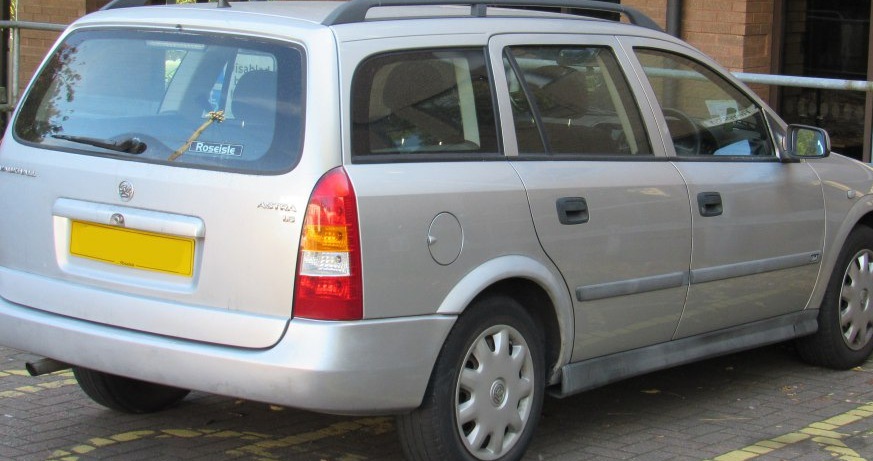
The Vauxhall Astra Mk IV Estate 2.0 DI (82 hp) was a diesel-powered station wagon produced between 1998 and 2000. It represented a practical, fuel-efficient option within the broader Mk IV Astra range (1998-2004), which itself was based on the GM240/H platform, shared with the Opel Astra G. This particular variant aimed to provide estate car practicality with a focus on economy, targeting buyers who needed space and low running costs rather than outright performance. It occupied a mid-range position in the estate lineup, sitting below the more powerful petrol variants and above the base-level models.
Technical Specifications
| Brand | Vauxhall |
| Model | Astra |
| Generation | Astra Mk IV Estate |
| Type (Engine) | 2.0 DI (82 Hp) |
| Start of production | 1998 |
| End of production | 2000 |
| Powertrain Architecture | Internal Combustion engine |
| Body type | Station wagon (estate) |
| Seats | 5 |
| Doors | 5 |
| Fuel consumption (urban) | 7.7 l/100 km (30.5 US mpg, 36.7 UK mpg, 13 km/l) |
| Fuel consumption (extra urban) | 5 l/100 km (47 US mpg, 56.5 UK mpg, 20 km/l) |
| Fuel consumption (combined) | 6 l/100 km (39.2 US mpg, 47.1 UK mpg, 16.7 km/l) |
| CO2 emissions | 161 g/km |
| Fuel Type | Diesel |
| Acceleration 0 – 100 km/h | 15 sec |
| Acceleration 0 – 62 mph | 15 sec |
| Acceleration 0 – 60 mph | 14.3 sec |
| Maximum speed | 174 km/h (108.12 mph) |
| Weight-to-power ratio | 15 kg/Hp, 66.7 Hp/tonne |
| Weight-to-torque ratio | 6.6 kg/Nm, 150.4 Nm/tonne |
| Power | 82 Hp @ 4300 rpm |
| Power per litre | 41.1 Hp/l |
| Torque | 185 Nm @ 1800 rpm (136.45 lb.-ft. @ 1800 rpm) |
| Engine layout | Front, Transverse |
| Engine Model/Code | X20DTL, Y20DTL |
| Engine displacement | 1995 cm3 (121.74 cu. in.) |
| Number of cylinders | 4 |
| Engine configuration | Inline |
| Fuel injection system | Direct injection |
| Engine aspiration | Turbocharger |
| Engine oil capacity | 5.5 l (5.81 US qt | 4.84 UK qt) |
| Coolant capacity | 7.9 l (8.35 US qt | 6.95 UK qt) |
| Kerb Weight | 1230 kg (2711.69 lbs) |
| Max. weight | 1830 kg (4034.46 lbs) |
| Max load | 600 kg (1322.77 lbs) |
| Trunk (boot) space – minimum | 481 l (16.99 cu. ft.) |
| Fuel tank capacity | 52 l (13.74 US gal | 11.44 UK gal) |
| Length | 4290 mm (168.9 in) |
| Width | 1709 mm (67.28 in) |
| Height | 1509 mm (59.41 in) |
| Wheelbase | 2611 mm (102.8 in) |
| Front track | 1481 mm (58.31 in) |
| Ride height (ground clearance) | 140 mm (5.51 in) |
| Drivetrain Architecture | The Internal combustion engine (ICE) drives the front wheels of the vehicle. |
| Drive wheel | Front wheel drive |
| Number of gears | 5 gears, manual transmission |
| Front brakes | Ventilated discs |
| Rear brakes | Drum |
| Tires size | 195/60 R15 |
| Wheel rims size | 15 |
Powertrain & Engine Architecture
The 2.0 DI engine, designated with engine codes X20DTL and Y20DTL, was a four-cylinder, inline diesel engine featuring direct injection. This direct injection system, a relatively advanced technology for the time, allowed for more precise fuel delivery and improved combustion efficiency. The engine was turbocharged, providing a modest boost in power and torque. The turbocharger helped to overcome the inherent limitations of a naturally aspirated diesel engine of this displacement. The engine utilized a conventional valvetrain with two valves per cylinder. The 5-speed manual transmission was the only gearbox option available with this engine, prioritizing fuel economy over sporty driving. The transmission’s gear ratios were geared towards maximizing fuel efficiency and providing adequate, though not exhilarating, acceleration.
Driving Characteristics
The 82 hp output and 185 Nm (136 lb-ft) of torque resulted in a driving experience focused on practicality rather than performance. Acceleration was leisurely, taking around 15 seconds to reach 60 mph. The engine felt most comfortable in the mid-range, providing adequate power for everyday driving and overtaking maneuvers on open roads. Compared to the petrol-powered Astra estates, the 2.0 DI offered significantly better fuel economy, but at the expense of responsiveness. The manual transmission, while not particularly sporty, allowed for a degree of driver control and helped to extract the most from the engine’s limited power. The gear ratios were spaced to keep the engine within its optimal torque band.
Equipment & Trim Levels
The 2.0 DI estate typically came with a reasonable level of standard equipment, reflecting its position as a mid-range offering. This included central locking, power steering, and an adjustable steering column. Interior upholstery was typically cloth, with a durable and practical finish. Optional extras included air conditioning, alloy wheels, and an upgraded stereo system. Trim levels varied slightly depending on the market, but generally focused on adding comfort and convenience features rather than significantly altering the car’s performance.
Chassis & Braking
The Astra Mk IV Estate featured a MacPherson strut front suspension and a torsion beam rear suspension. This setup provided a comfortable ride, although it wasn’t particularly sporty. The front brakes were ventilated discs, offering adequate stopping power, while the rear brakes were drums, a cost-saving measure common in this class of vehicle. The suspension was tuned for comfort and stability, prioritizing ride quality over handling precision. Stabilizer bars were fitted to both the front and rear axles to reduce body roll during cornering.
Market Reception & Comparison
The Vauxhall Astra Mk IV Estate 2.0 DI was generally well-received as a practical and economical family car. Critics praised its spacious interior, large boot capacity, and fuel efficiency. However, the engine’s lack of power was often noted as a drawback. Compared to the petrol-powered Astra estates, the 2.0 DI offered superior fuel economy but inferior performance. Against competitors like the Ford Focus Estate and Renault Megane Estate, the Astra offered a competitive package in terms of price, space, and running costs. The diesel engine’s reliability was generally good, but maintenance costs could be higher than those of petrol engines due to the more complex fuel injection system.
Legacy
The 2.0 DI engine, while not a performance icon, proved to be a relatively durable and reliable unit. Many examples are still on the road today, testament to its robust construction. In the used car market, these Astra estates are valued for their practicality, fuel efficiency, and affordability. However, potential buyers should be aware of the age-related issues common to all vehicles of this era, such as corrosion and wear and tear on suspension components. The 2.0 DI represents a significant step in the development of diesel engines for passenger cars, offering a viable alternative to petrol power for those seeking low running costs and long-distance cruising capability.