Technical Specifications
| Brand | Vauxhall |
| Model | Astra |
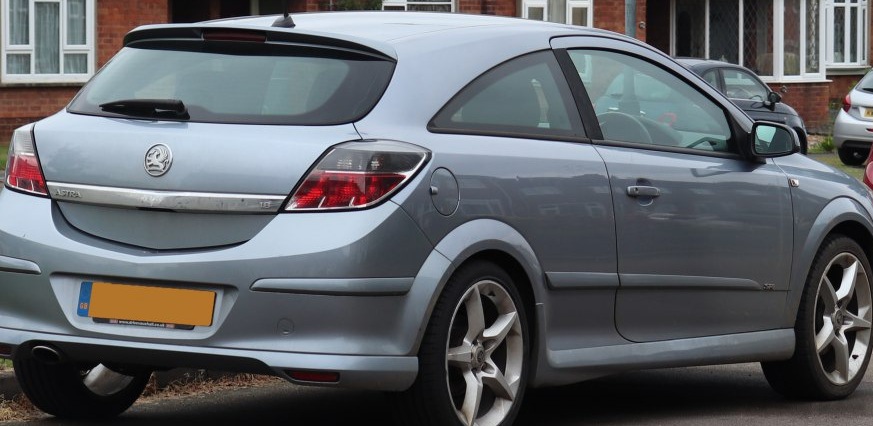
| Generation | Astra Mk V CC Sport Hatch |
| Type (Engine) | 1.8 VVT 16V (140 Hp) Automatic |
| Start of production | 2005 |
| End of production | 2010 |
| Powertrain Architecture | Internal Combustion engine |
| Body type | Hatchback |
| Seats | 5 |
| Doors | 3 |
| Fuel consumption (urban) | 10.4 l/100 km (22.6 US mpg, 27.2 UK mpg, 9.6 km/l) |
| Fuel consumption (extra urban) | 6.1 l/100 km (38.6 US mpg, 46.3 UK mpg, 16.4 km/l) |
| Fuel consumption (combined) | 7.7 l/100 km (30.5 US mpg, 36.7 UK mpg, 13 km/l) |
| CO2 emissions | 185 g/km |
| Fuel Type | Petrol (Gasoline) |
| Acceleration 0 – 100 km/h | 11.2 sec |
| Acceleration 0 – 62 mph | 11.2 sec |
| Acceleration 0 – 60 mph | 10.6 sec |
| Maximum speed | 190 km/h (118.06 mph) |
| Weight-to-power ratio | 8.9 kg/Hp, 112.9 Hp/tonne |
| Weight-to-torque ratio | 7.1 kg/Nm, 141.1 Nm/tonne |
| Power | 140 Hp @ 6300 rpm |
| Power per litre | 78 Hp/l |
| Torque | 175 Nm @ 3800 rpm (129.07 lb.-ft. @ 3800 rpm) |
| Engine layout | Front, Transverse |
| Engine Model/Code | Z18XER |
| Engine displacement | 1796 cm3 (109.6 cu. in.) |
| Number of cylinders | 4 |
| Engine configuration | Inline |
| Cylinder Bore | 80.5 mm (3.17 in.) |
| Piston Stroke | 88.2 mm (3.47 in.) |
| Compression ratio | 10.5:1 |
| Number of valves per cylinder | 4 |
| Fuel injection system | Multi-port manifold injection |
| Engine aspiration | Naturally aspirated engine |
| Valvetrain | DOHC |
| Engine oil capacity | 4.25 l (4.49 US qt | 3.74 UK qt) |
| Coolant | 6.1 l (6.45 US qt | 5.37 UK qt) |
| Kerb Weight | 1240 kg (2733.73 lbs.) |
| Max. weight | 1900 kg (4188.78 lbs.) |
| Max load | 660 kg (1455.05 lbs.) |
| Trunk (boot) space – minimum | 312 l (11.02 cu. ft.) |
| Fuel tank capacity | 52 l (13.74 US gal | 11.44 UK gal) |
| Permitted trailer load with brakes (12%) | 1300 kg (2866.01 lbs.) |
| Permitted trailer load without brakes | 630 kg (1388.91 lbs.) |
| Length | 4290 mm (168.9 in.) |
| Width | 1753 mm (69.02 in.) |
| Width including mirrors | 2033 mm (80.04 in.) |
| Height | 1415 mm (55.71 in.) |
| Wheelbase | 2614 mm (102.91 in.) |
| Front track | 1488 mm (58.58 in.) |
| Rear (Back) track | 1488 mm (58.58 in.) |
| Front overhang | 910 mm (35.83 in.) |
| Rear overhang | 766 mm (30.16 in.) |
| Ride height (ground clearance) | 130 mm (5.12 in.) |
| Drag coefficient (Cd) | 0.28 |
| Minimum turning circle (turning diameter) | 10 m (32.81 ft.) |
| Drivetrain Architecture | The Internal combustion engine (ICE) drives the front wheels of the vehicle. |
| Drive wheel | Front wheel drive |
| Number of gears and type of gearbox | 4 gears, automatic transmission |
| Front brakes | Ventilated discs |
| Rear brakes | Disc |
| Assisting systems | ABS (Anti-lock braking system) |
| Steering type | Steering rack and pinion |
| Tires size | 205/55 R16 |
| Wheel rims size | 6.5J x 16 |
The Vauxhall Astra Mk V CC Sport Hatch 1.8 VVT Automatic, produced between 2005 and 2010, represented a compelling entry point into the Astra range for buyers seeking a blend of practicality, reasonable performance, and the convenience of an automatic transmission. Positioned within the H-series Astra (Mk V) generation, which utilized the GM Delta platform, this variant offered a more accessible alternative to the higher-performance models like the SRi and VXR. The “CC” designation signified a coupé-hatchback body style, offering a sportier profile than the traditional five-door Astra. This particular 1.8-liter automatic configuration aimed to appeal to drivers prioritizing ease of use and fuel efficiency over outright speed, making it a popular choice for commuting and family transport in the United Kingdom and Europe.
Powertrain & Engine Architecture
At the heart of the Astra Mk V 1.8 VVT Automatic lies the Z18XER engine, a 1.8-liter (1796 cc) inline-four cylinder petrol engine. This engine is part of Vauxhall/Opel’s ‘Family 1’ series, known for its relatively simple design and durability. The ‘VVT’ designation indicates Variable Valve Timing, a technology employed to optimize engine performance and fuel efficiency across a wider range of engine speeds. The Z18XER utilizes a multi-port fuel injection system, delivering fuel directly into the intake ports. The engine features a double overhead camshaft (DOHC) valvetrain with four valves per cylinder, contributing to its breathing efficiency. Paired with this engine was a four-speed automatic transmission, a common choice for this class of vehicle at the time. While not as sophisticated as modern automatic transmissions with more gears, it provided smooth and convenient gear changes for everyday driving. The transmission was designed to prioritize fuel economy and comfort over sporty performance.
Driving Characteristics
The 140 horsepower and 175 Nm (129 lb-ft) of torque produced by the 1.8-liter engine, when coupled with the four-speed automatic, resulted in a driving experience geared towards practicality rather than exhilaration. Acceleration from 0-60 mph took around 10.6 seconds, and top speed was approximately 118 mph. Compared to the manual transmission version of the same engine, the automatic offered slightly reduced performance due to the inherent power losses within the torque converter. However, the automatic transmission provided a smoother and more relaxed driving experience, particularly in urban traffic. The gear ratios were tuned for fuel efficiency, meaning the engine often felt somewhat strained during rapid acceleration or when overtaking. The automatic transmission’s shift points were generally well-programmed, but lacked the responsiveness of a manual gearbox.
Equipment & Trim Levels
The Astra Mk V CC Sport Hatch 1.8 VVT Automatic typically came equipped with a reasonable level of standard features. These included air conditioning, power steering, electric front windows, a CD player with radio, and ABS brakes. The “Sport” trim level added some visual enhancements, such as alloy wheels and a sportier interior trim. Optional extras included a sunroof, upgraded audio system, and parking sensors. Interior upholstery was typically cloth, with a functional and durable design. The dashboard layout was straightforward and user-friendly, with logically placed controls.
Chassis & Braking
The Astra Mk V utilized a MacPherson strut front suspension and a torsion beam rear suspension. This setup provided a good balance between ride comfort and handling. The front brakes were ventilated discs, offering adequate stopping power, while the rear brakes were solid discs. ABS (Anti-lock Braking System) was standard, enhancing safety during emergency braking situations. The chassis was relatively lightweight, contributing to the car’s overall agility. Stabilizer bars were fitted to both the front and rear axles to reduce body roll during cornering.
Market Reception & Comparison
The Astra Mk V 1.8 VVT Automatic was generally well-received by critics as a sensible and practical family car. It was praised for its comfortable ride, spacious interior, and reasonable fuel economy. However, some reviewers noted that the engine felt underpowered, particularly when fully loaded or driving uphill. Compared to other trims in the Astra lineup, such as the 1.9 CDTi diesel or the 2.0 Turbo SRi, the 1.8 Automatic offered less performance but greater refinement and lower running costs. The diesel models provided superior fuel economy, while the SRi offered a more engaging driving experience.
Legacy
The Z18XER engine, when properly maintained, proved to be a reliable unit. Common issues included occasional oil leaks and sensor failures, but these were generally not major concerns. The four-speed automatic transmission, while not the most advanced, was also relatively durable. Today, the Astra Mk V 1.8 VVT Automatic represents an affordable and practical used car option. Its simplicity and relatively low maintenance costs make it an attractive choice for budget-conscious buyers. While it may not offer the performance or features of more modern vehicles, it remains a capable and dependable mode of transportation.