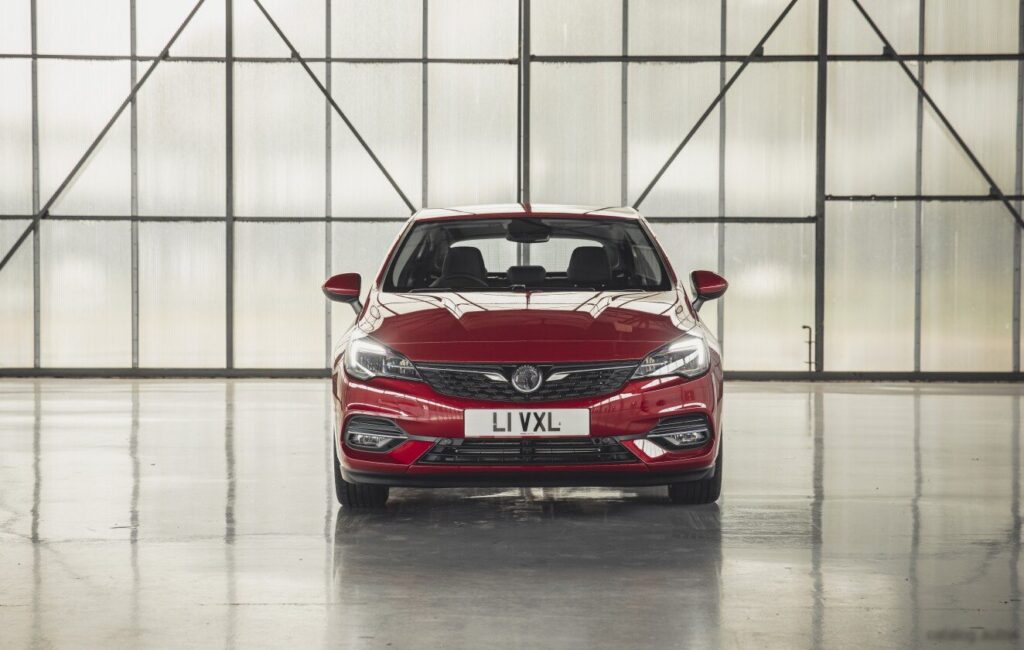
The Vauxhall Astra Mk VII (facelift, 2019) 1.2 Turbo, producing 130 horsepower, represents a significant iteration within the seventh generation of Vauxhall’s popular compact hatchback. Introduced as part of a mid-cycle refresh in 2019 and continuing through November 2021, this variant occupied a key position in the Astra lineup, offering a balance between fuel efficiency, performance, and affordability. Built on the GM/PSA EMP2 platform (also known as the 1HX0 platform), the facelift brought updated styling, improved technology, and refined engine options. The 1.2 Turbo 130 hp model aimed to appeal to buyers seeking a practical and economical daily driver without sacrificing a reasonable level of performance.
Technical Specifications
| Brand | Vauxhall |
| Model | Astra |
| Generation | Astra Mk VII (facelift 2019) |
| Type (Engine) | 1.2 Turbo (130 Hp) |
| Start of production | 2019 |
| End of production | November, 2021 |
| Powertrain Architecture | Internal Combustion engine |
| Body type | Hatchback |
| Seats | 5 |
| Doors | 5 |
| Combined fuel consumption (WLTP) | 5.2-5.5 l/100 km (45.2 – 42.8 US mpg, 54.3 – 51.4 UK mpg, 19.2 – 18.2 km/l) |
| CO2 emissions (NEDC, WLTP equivalent) | 99 g/km |
| Fuel Type | Petrol (Gasoline) |
| Maximum speed | 216 km/h (134.22 mph) |
| Emission standard | Euro 6d |
| Power | 130 Hp @ 5500 rpm |
| Power per litre | 108.4 Hp/l |
| Torque | 225 Nm @ 2000-3500 rpm (165.95 lb.-ft. @ 2000-3500 rpm) |
| Engine layout | Front, Transverse |
| Engine Model/Code | F12SHT |
| Engine displacement | 1199 cm3 (73.17 cu. in.) |
| Number of cylinders | 3 |
| Engine configuration | Inline |
| Number of valves per cylinder | 4 |
| Fuel injection system | Direct injection |
| Engine aspiration | Turbocharger, Intercooler |
| Valvetrain | DOHC, VVT |
| Engine oil capacity | 4 l (4.23 US qt | 3.52 UK qt) |
| Coolant | 5.4 l (5.71 US qt | 4.75 UK qt) |
| Engine systems | Start & Stop System |
| Max. weight | 1805 kg (3979.34 lbs.) |
| Trunk (boot) space – minimum | 370 l (13.07 cu. ft.) |
| Trunk (boot) space – maximum | 1210 l (42.73 cu. ft.) |
| Fuel tank capacity | 48 l (12.68 US gal | 10.56 UK gal) |
| Permitted trailer load with brakes (12%) | 1350 kg (2976.24 lbs.) |
| Permitted trailer load without brakes | 620 kg (1366.87 lbs.) |
| Length | 4370 mm (172.05 in.) |
| Width | 1809 mm (71.22 in.) |
| Width including mirrors | 2042 mm (80.39 in.) |
| Height | 1485 mm (58.46 in.) |
| Wheelbase | 2662 mm (104.8 in.) |
| Front overhang | 960 mm (37.8 in.) |
| Rear overhang | 748 mm (29.45 in.) |
| Drag coefficient (Cd) | 0.26 |
| Minimum turning circle (turning diameter) | 11.05 m (36.25 ft.) |
| Drivetrain Architecture | The Internal combustion engine (ICE) drives the front wheels of the vehicle. |
| Drive wheel | Front wheel drive |
| Number of gears and type of gearbox | 6 gears, manual transmission |
| Front suspension | Independent type McPherson |
| Rear suspension | Semi-independent, coil spring |
| Front brakes | Ventilated discs, 276 mm |
| Rear brakes | Disc, 264 mm |
| Assisting systems | ABS (Anti-lock braking system) |
| Steering type | Steering rack and pinion |
| Power steering | Electric Steering |
| Tires size | 205/55 R16; 225/45 R17 |
| Wheel rims size | 16; 17 |
INTRODUCTION
The 2019 facelift of the Vauxhall Astra Mk VII brought a refreshed look and updated technology to the popular British hatchback. The 1.2 Turbo 130 hp variant was positioned as a mid-range offering, slotting between the lower-powered 1.2 Turbo 110 hp and the more performance-oriented models like the 1.4 Turbo. This engine and trim level aimed to provide a sweet spot for buyers prioritizing fuel economy and everyday usability, while still delivering adequate performance for most driving situations. The Astra Mk VII, as a whole, was a crucial model for Vauxhall in the European market, competing directly with rivals like the Ford Focus, Volkswagen Golf, and Peugeot 308.
Powertrain & Engine Architecture
At the heart of the Astra 1.2 Turbo 130 hp lies the F12SHT engine, a 1.2-liter, three-cylinder turbocharged gasoline engine. This engine is part of Vauxhall/Opel’s Small Engine Family (SEF), known for its compact size and efficiency. The F12SHT utilizes direct fuel injection, delivering fuel directly into the combustion chamber for improved combustion efficiency and reduced emissions. The engine also features a double overhead camshaft (DOHC) valvetrain with variable valve timing (VVT) on both intake and exhaust valves, optimizing engine performance across a wider RPM range. The turbocharger, coupled with an intercooler, forces more air into the engine, boosting power output. This specific variant was exclusively offered with a six-speed manual transmission, designed to maximize fuel efficiency and provide a reasonably engaging driving experience. The transmission’s gear ratios were tuned to complement the engine’s torque curve, providing good acceleration in everyday driving conditions.
Driving Characteristics
The Astra 1.2 Turbo 130 hp offers a surprisingly refined driving experience. While not a performance powerhouse, the engine delivers adequate power for typical commuting and highway driving. The turbocharger provides a noticeable boost in acceleration, particularly in the mid-range, making overtaking maneuvers relatively effortless. The six-speed manual transmission allows drivers to maintain optimal engine speed for efficiency or performance. Compared to the 110 hp version, the 130 hp model offers a more responsive and confident feel, especially when fully loaded or tackling inclines. However, it doesn’t match the outright acceleration of the higher-output 1.4 Turbo variants. The steering is precise and well-weighted, providing good feedback to the driver. Overall, the driving experience is comfortable and composed, making it a suitable choice for long journeys.
Equipment & Trim Levels
The 1.2 Turbo 130 hp Astra typically came equipped with a respectable level of standard features. Depending on the specific trim level (Design & Tech, Energy, etc.), standard equipment often included air conditioning, a touchscreen infotainment system with Apple CarPlay and Android Auto compatibility, Bluetooth connectivity, cruise control, and alloy wheels. Higher trim levels added features such as heated seats, a panoramic sunroof, and advanced safety systems like lane departure warning and automatic emergency braking. Interior upholstery was typically cloth, with options for leather upgrades on higher trims. The dashboard layout was clean and modern, with a focus on user-friendliness.
Chassis & Braking
The Astra Mk VII utilizes a McPherson strut front suspension and a semi-independent coil spring rear suspension. This setup provides a good balance between ride comfort and handling. The front brakes are ventilated discs, providing ample stopping power, while the rear brakes are solid discs. All models were equipped with ABS (Anti-lock Braking System) as standard. The chassis was designed to be lightweight yet rigid, contributing to the car’s overall handling characteristics. Stabilizer bars were fitted to both the front and rear axles to reduce body roll during cornering.
Market Reception & Comparison
The Astra 1.2 Turbo 130 hp was generally well-received by automotive critics. It was praised for its fuel efficiency, comfortable ride, and refined engine. However, some reviewers noted that the engine could feel a little strained when pushed hard. Compared to the 110 hp version, the 130 hp model offered a noticeable improvement in performance, making it a more appealing option for drivers who frequently travel on motorways or carry passengers. In terms of fuel economy, it was comparable to other similarly powered compact hatchbacks. Reliability reports suggest that the F12SHT engine is generally reliable, although regular maintenance is essential.
Legacy
The Vauxhall Astra Mk VII 1.2 Turbo 130 hp remains a popular choice in the used car market. Its combination of fuel efficiency, practicality, and affordability makes it an attractive option for buyers seeking a reliable and economical compact hatchback. The F12SHT engine has proven to be relatively durable, although it’s important to check for regular maintenance records. As with any used car, a thorough inspection by a qualified mechanic is recommended before purchase. The Astra Mk VII, and particularly this variant, represents a solid all-rounder in the competitive compact car segment.