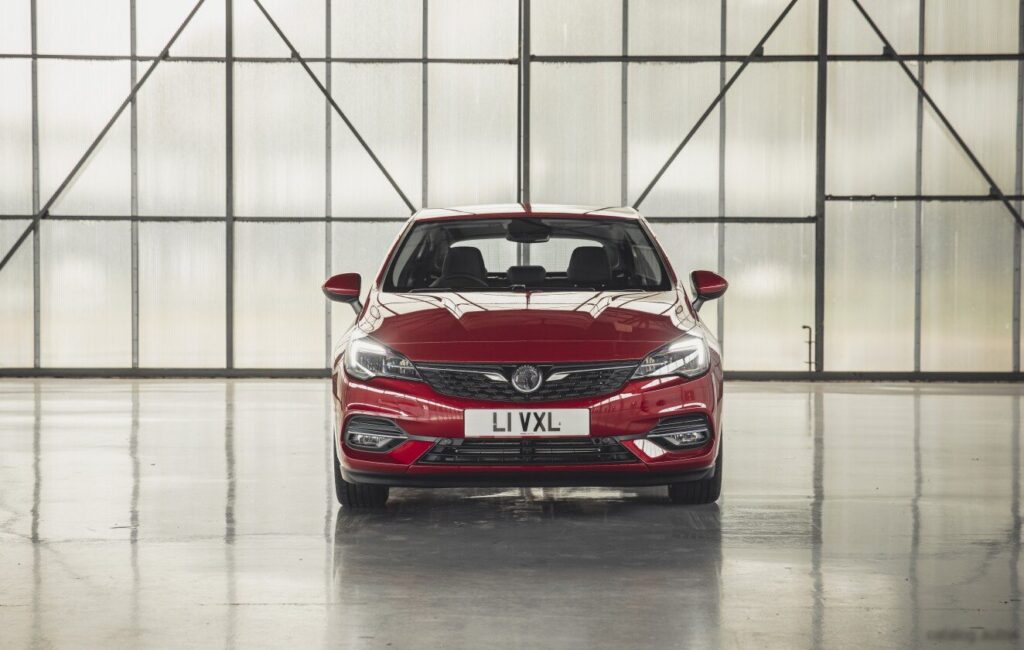
The Vauxhall Astra Mk VII (facelift, 2019) 1.4 Turbo (145 hp) Automatic represents a mid-cycle refresh of the seventh-generation Astra, produced from 2019 until November 2021. Positioned as a mainstream offering within the Astra range, this variant aimed to provide a balance of fuel efficiency, reasonable performance, and convenience through its automatic transmission. It was part of the A platform shared with other PSA Group (now Stellantis) vehicles, including the Peugeot 308 and Citroën C4 Cactus. The facelift brought styling updates, revised technology, and refinements to the powertrain options, including this 1.4-liter turbocharged engine paired with a continuously variable transmission (CVT).
Technical Specifications
| Brand | Vauxhall |
| Model | Astra |
| Generation | Astra Mk VII (facelift 2019) |
| Type (Engine) | 1.4 Turbo (145 Hp) Automatic |
| Start of production | 2019 |
| End of production | November, 2021 |
| Powertrain Architecture | Internal Combustion engine |
| Body type | Hatchback |
| Seats | 5 |
| Doors | 5 |
| Combined fuel consumption (WLTP) | 5.6-6 l/100 km (42 – 39.2 US mpg, 50.4 – 47.1 UK mpg, 17.9 – 16.7 km/l) |
| CO2 emissions (NEDC, WLTP equivalent) | 115 g/km |
| Fuel Type | Petrol (Gasoline) |
| Maximum speed | 209 km/h (129.87 mph) |
| Emission standard | Euro 6d |
| Power | 145 Hp @ 5000-6000 rpm |
| Power per litre | 108 Hp/l |
| Torque | 236 Nm @ 1500-3500 rpm (174.06 lb.-ft. @ 1500-3500 rpm) |
| Engine layout | Front, Transverse |
| Engine Model/Code | F14SHT |
| Engine displacement | 1342 cm3 (81.89 cu. in.) |
| Number of cylinders | 3 |
| Engine configuration | Inline |
| Number of valves per cylinder | 4 |
| Fuel injection system | Direct injection |
| Engine aspiration | Turbocharger, Intercooler |
| Valvetrain | DOHC, VVT |
| Engine oil capacity | 4 l (4.23 US qt | 3.52 UK qt) |
| Coolant | 6.25 l (6.6 US qt | 5.5 UK qt) |
| Trunk (boot) space – minimum | 370 l (13.07 cu. ft.) |
| Trunk (boot) space – maximum | 1210 l (42.73 cu. ft.) |
| Fuel tank capacity | 48 l (12.68 US gal | 10.56 UK gal) |
| Length | 4370 mm (172.05 in.) |
| Width | 1809 mm (71.22 in.) |
| Width including mirrors | 2042 mm (80.39 in.) |
| Height | 1485 mm (58.46 in.) |
| Wheelbase | 2662 mm (104.8 in.) |
| Front overhang | 960 mm (37.8 in.) |
| Rear overhang | 748 mm (29.45 in.) |
| Drag coefficient (Cd) | 0.26 |
| Minimum turning circle (turning diameter) | 11.05 m (36.25 ft.) |
| Drivetrain Architecture | The Internal combustion engine (ICE) drives the front wheels of the vehicle. |
| Drive wheel | Front wheel drive |
| Number of gears and type of gearbox | automatic transmission Stepless |
| Front suspension | Independent type McPherson |
| Rear suspension | Semi-independent, coil spring |
| Front brakes | Ventilated discs, 276 mm |
| Rear brakes | Disc, 264 mm |
| Assisting systems | ABS (Anti-lock braking system) |
| Steering type | Steering rack and pinion |
| Power steering | Electric Steering |
| Tires size | 205/55 R16; 225/45 R17; 225/40 R18 |
| Wheel rims size | 16; 17; 18 |
Introduction
The 2019 facelift of the Vauxhall Astra Mk VII saw the introduction of the 1.4 Turbo (145 hp) Automatic variant as a key model in the lineup. Building upon the established strengths of the Mk VII platform – first introduced in 2015 – this version aimed to appeal to buyers seeking a comfortable and efficient hatchback. The Astra Mk VII competed directly with rivals like the Ford Focus, Volkswagen Golf, and Peugeot 308 in the highly competitive European C-segment. The facelift brought updated styling, improved infotainment systems, and enhancements to safety features, solidifying the Astra’s position as a popular choice for family and commuter vehicles. This particular engine and transmission combination was intended to offer a more relaxed driving experience compared to the manual transmission options.
Powertrain & Engine Architecture
At the heart of the Astra 1.4 Turbo Automatic lies the F14SHT engine, a 1.4-liter inline-three cylinder gasoline engine. This engine utilizes direct fuel injection and a turbocharger with an intercooler to deliver a respectable 145 horsepower and 236 Nm (174 lb-ft) of torque. The engine employs a Double Overhead Camshaft (DOHC) valvetrain with Variable Valve Timing (VVT) to optimize performance and efficiency across the rev range. The engine’s compact size and lightweight construction contribute to the Astra’s overall balanced handling.
The engine is paired with a continuously variable transmission (CVT), offering seamless gear changes and contributing to improved fuel economy. Unlike traditional automatic transmissions with fixed gear ratios, a CVT provides an infinite number of ratios within its operating range. This allows the engine to operate at its most efficient point more often. While CVTs are known for their smoothness, some drivers find their operation less engaging than traditional automatics, as the engine speed may not always correlate directly with vehicle speed.
Driving Characteristics
The 1.4 Turbo Automatic Astra delivers a comfortable and refined driving experience. The CVT transmission provides smooth acceleration, although it lacks the responsiveness of a traditional automatic or manual gearbox. The 145 hp output is adequate for everyday driving, providing sufficient power for overtaking and merging onto highways. However, it doesn’t offer the brisk acceleration of higher-powered Astra variants like the 1.6 Turbo. The CVT is programmed to prioritize fuel efficiency, which can sometimes result in a slight delay in response when demanding more power. The Astra’s suspension provides a good balance between comfort and handling, absorbing bumps and imperfections in the road while maintaining a stable feel in corners. The steering is light and precise, making it easy to maneuver in urban environments.
Equipment & Trim Levels
The 1.4 Turbo Automatic trim typically came equipped with a generous level of standard features. These included air conditioning, a touchscreen infotainment system with Apple CarPlay and Android Auto compatibility, Bluetooth connectivity, cruise control, and alloy wheels. Higher trim levels offered additional features such as heated seats, a panoramic sunroof, advanced safety systems (like lane departure warning and automatic emergency braking), and upgraded interior upholstery. Interior materials were generally of good quality, with a focus on durability and comfort. The dashboard layout was clean and intuitive, with logically placed controls.
Chassis & Braking
The Astra Mk VII utilized a McPherson strut front suspension and a semi-independent coil spring rear suspension. This setup provided a good balance of ride comfort and handling. The front brakes were ventilated discs measuring 276mm, while the rear brakes were solid discs measuring 264mm. Anti-lock Braking System (ABS) was standard, enhancing safety and control during emergency braking situations. The Astra’s chassis was designed to be lightweight yet rigid, contributing to its overall stability and responsiveness.
Market Reception & Comparison
The Astra 1.4 Turbo Automatic received generally positive reviews from automotive critics. It was praised for its fuel efficiency, comfortable ride, and well-equipped interior. However, some reviewers noted that the CVT transmission could feel somewhat sluggish and lacked the engagement of a traditional automatic. Compared to the 1.6 Turbo variants, the 1.4 Turbo offered lower running costs but less outright performance. The 1.6 Turbo was favored by drivers who prioritized a more dynamic driving experience. The 1.5 diesel variants offered even better fuel economy but came with a higher purchase price and potential concerns about diesel emissions.
Legacy
The Vauxhall Astra Mk VII 1.4 Turbo Automatic has proven to be a reliable and durable vehicle in the used car market. The F14SHT engine is generally considered to be robust, although regular maintenance is essential to ensure its longevity. The CVT transmission, while not as sporty as some alternatives, has also proven to be relatively reliable when properly maintained. These Astras represent a good value proposition for buyers seeking a practical, efficient, and well-equipped hatchback. Their continued presence on the used car market is a testament to their overall quality and appeal.