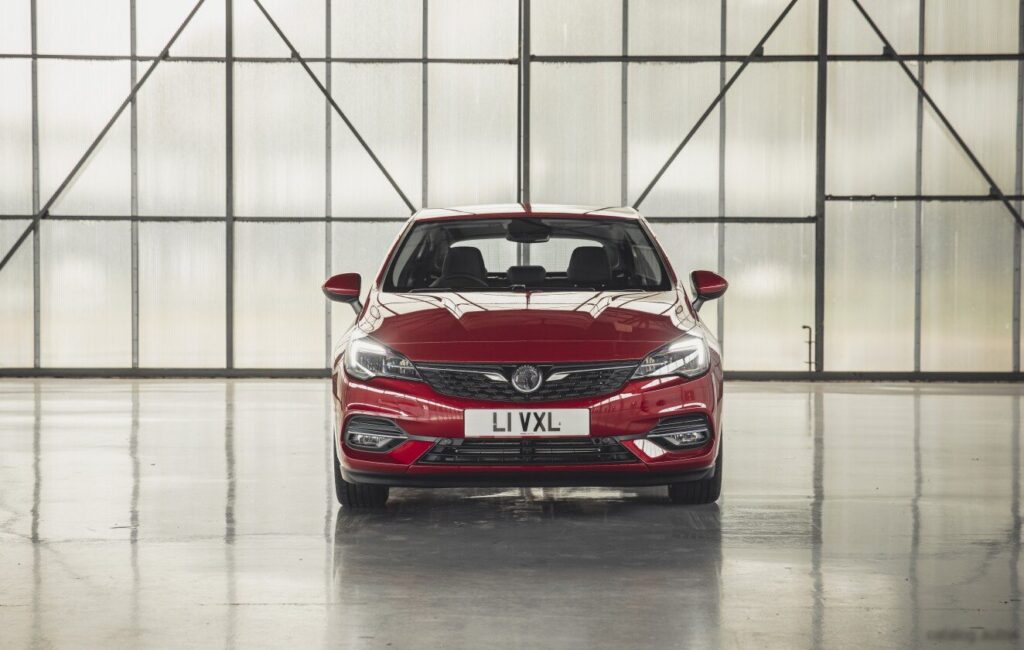
The Vauxhall Astra Mk VII (facelift, 2019) 1.5 Turbo D (105 hp) represents a significant iteration within the seventh generation of Vauxhall’s popular compact hatchback. Introduced as part of a mid-life refresh in 2019 and continuing through November 2021, this variant aimed to provide a balance of fuel efficiency and reasonable performance for the European market. Positioned as a mid-range offering, it slotted between the lower-powered diesel options and the more potent petrol variants, appealing to drivers prioritizing economy and lower running costs. The Mk VII Astra, built on the GM Delta platform, was a crucial model for Vauxhall, competing directly with rivals like the Ford Focus, Volkswagen Golf, and Peugeot 308.
Technical Specifications
| Brand | Vauxhall |
| Model | Astra |
| Generation | Astra Mk VII (facelift 2019) |
| Type (Engine) | 1.5 Turbo D (105 Hp) |
| Start of production | 2019 |
| End of production | November, 2021 |
| Powertrain Architecture | Internal Combustion engine |
| Body type | Hatchback |
| Seats | 5 |
| Doors | 5 |
| Combined fuel consumption (WLTP) | 4.3-4.5 l/100 km (54.7 – 52.3 US mpg, 65.7 – 62.8 UK mpg, 23.3 – 22.2 km/l) |
| CO2 emissions (NEDC, WLTP equivalent) | 90 g/km |
| Fuel Type | Diesel |
| Maximum speed | 200 km/h (124.27 mph) |
| Emission standard | Euro 6d |
| Power | 105 Hp @ 3250 rpm |
| Power per litre | 70.2 Hp/l |
| Torque | 260 Nm @ 1500-2500 rpm (191.77 lb.-ft. @ 1500-2500 rpm) |
| Engine layout | Front, Transverse |
| Engine Model/Code | F15DVC |
| Engine displacement | 1496 cm3 (91.29 cu. in.) |
| Number of cylinders | 3 |
| Engine configuration | Inline |
| Number of valves per cylinder | 4 |
| Fuel injection system | Diesel Commonrail |
| Engine aspiration | Turbocharger, Intercooler |
| Valvetrain | DOHC |
| Engine oil capacity | 4.25 l (4.49 US qt | 3.74 UK qt) |
| Coolant | 7 l (7.4 US qt | 6.16 UK qt) |
| Trunk (boot) space – minimum | 370 l (13.07 cu. ft.) |
| Trunk (boot) space – maximum | 1210 l (42.73 cu. ft.) |
| Fuel tank capacity | 48 l (12.68 US gal | 10.56 UK gal) |
| Length | 4370 mm (172.05 in.) |
| Width | 1809 mm (71.22 in.) |
| Width including mirrors | 2042 mm (80.39 in.) |
| Height | 1485 mm (58.46 in.) |
| Wheelbase | 2662 mm (104.8 in.) |
| Front overhang | 960 mm (37.8 in.) |
| Rear overhang | 748 mm (29.45 in.) |
| Drag coefficient (Cd) | 0.26 |
| Minimum turning circle (turning diameter) | 11.05 m (36.25 ft.) |
| Drivetrain Architecture | The Internal combustion engine (ICE) drives the front wheels of the vehicle. |
| Drive wheel | Front wheel drive |
| Number of gears and type of gearbox | 6 gears, manual transmission |
| Front suspension | Independent type McPherson |
| Rear suspension | Semi-independent, coil spring |
| Front brakes | Ventilated discs, 276 mm |
| Rear brakes | Disc, 264 mm |
| Assisting systems | ABS (Anti-lock braking system) |
| Steering type | Steering rack and pinion |
| Power steering | Electric Steering |
| Tires size | 205/55 R16; 225/45 R17 |
| Wheel rims size | 16; 17 |
Introduction
The 1.5 Turbo D (105 hp) variant of the Vauxhall Astra Mk VII facelift, produced from 2019 to 2021, was a key component of the Astra lineup. It represented a downsized engine strategy, moving away from larger displacement diesels in favor of a more efficient three-cylinder unit. This engine was part of Vauxhall’s efforts to meet increasingly stringent European emissions regulations while still providing a practical and affordable option for buyers. The facelift brought styling updates, improved technology, and refined engine options, aiming to keep the Astra competitive in a crowded segment. This particular configuration, paired with a six-speed manual transmission, was designed for drivers seeking low running costs and acceptable performance for everyday driving.
Powertrain & Engine Architecture
At the heart of this Astra variant lies the F15DVC engine, a 1.5-liter inline three-cylinder diesel. This engine utilizes a turbocharger with an intercooler to boost power and efficiency. The engine employs a diesel commonrail direct injection system, delivering fuel directly into the combustion chamber at high pressure for optimized combustion. The engine features a Double Overhead Camshaft (DOHC) valvetrain, controlling the intake and exhaust valves for efficient gas exchange. The 105 hp output is achieved at 3250 rpm, while the peak torque of 260 Nm (191.77 lb.-ft.) is available from 1500-2500 rpm, providing a useful amount of pulling power at lower engine speeds. The six-speed manual transmission was the standard offering, providing a good balance between fuel economy and driver engagement. The gear ratios were tuned to maximize efficiency and provide adequate acceleration, though it wasn’t designed for sporty driving.
Driving Characteristics
The 1.5 Turbo D (105 hp) Astra offered a comfortable and refined driving experience, prioritizing fuel economy over outright performance. Acceleration was adequate for everyday driving, but it wasn’t particularly quick. The engine’s torque delivery meant that it felt responsive in city driving and when overtaking at moderate speeds. However, when fully loaded or tackling steep inclines, the engine could feel strained. Compared to the higher-powered petrol versions, the diesel lacked the immediate responsiveness and punch. The manual transmission was smooth and precise, contributing to a pleasant driving experience. The suspension setup provided a good balance between comfort and handling, absorbing bumps well while maintaining reasonable body control. The steering was light and accurate, making it easy to maneuver in urban environments.
Equipment & Trim Levels
The 1.5 Turbo D (105 hp) Astra typically came equipped with a reasonable level of standard features. Depending on the specific trim level (Design, Tech Line, Elite Nav), standard equipment included air conditioning, a touchscreen infotainment system with Bluetooth connectivity, alloy wheels, and a suite of safety features such as ABS, ESP, and multiple airbags. Higher trim levels offered additional features like navigation, parking sensors, a rearview camera, and upgraded interior upholstery. Interior materials were generally of good quality, with a focus on durability and practicality. Optional extras included a panoramic sunroof, heated seats, and advanced driver assistance systems.
Chassis & Braking
The Astra Mk VII utilized a McPherson strut front suspension setup, providing a good balance of comfort and handling. The rear suspension employed a semi-independent torsion beam configuration, which was cost-effective and space-efficient. The braking system consisted of ventilated discs on the front wheels and solid discs on the rear, providing adequate stopping power for the vehicle’s weight and performance. ABS (Anti-lock Braking System) was standard, enhancing safety during emergency braking situations. Stabilizer bars were fitted to both the front and rear axles to reduce body roll during cornering.
Market Reception & Comparison
The 1.5 Turbo D (105 hp) Astra was generally well-received by critics as a practical and economical choice. It was praised for its fuel efficiency, comfortable ride, and reasonable equipment levels. However, some reviewers noted that the engine lacked the refinement and performance of some of its rivals. Compared to the 1.0-liter petrol versions, the diesel offered better fuel economy and torque, but at the expense of some refinement. Against competitors like the Ford Focus EcoBoost and Volkswagen Golf TDI, the Astra offered a competitive package, particularly in terms of value for money. Reliability reports suggest that the 1.5 Turbo D engine is generally reliable, although regular servicing is essential to maintain optimal performance.
Legacy
The 1.5 Turbo D (105 hp) Astra Mk VII remains a popular choice on the used car market, appealing to buyers seeking an affordable and economical hatchback. The engine’s relatively simple design and robust construction contribute to its long-term reliability. While it may not offer the excitement of higher-performance variants, it provides a practical and dependable mode of transportation. The Astra Mk VII, as a whole, established itself as a well-rounded and competitive compact car, and the 1.5 Turbo D variant played a significant role in its success, offering a compelling blend of efficiency and affordability.