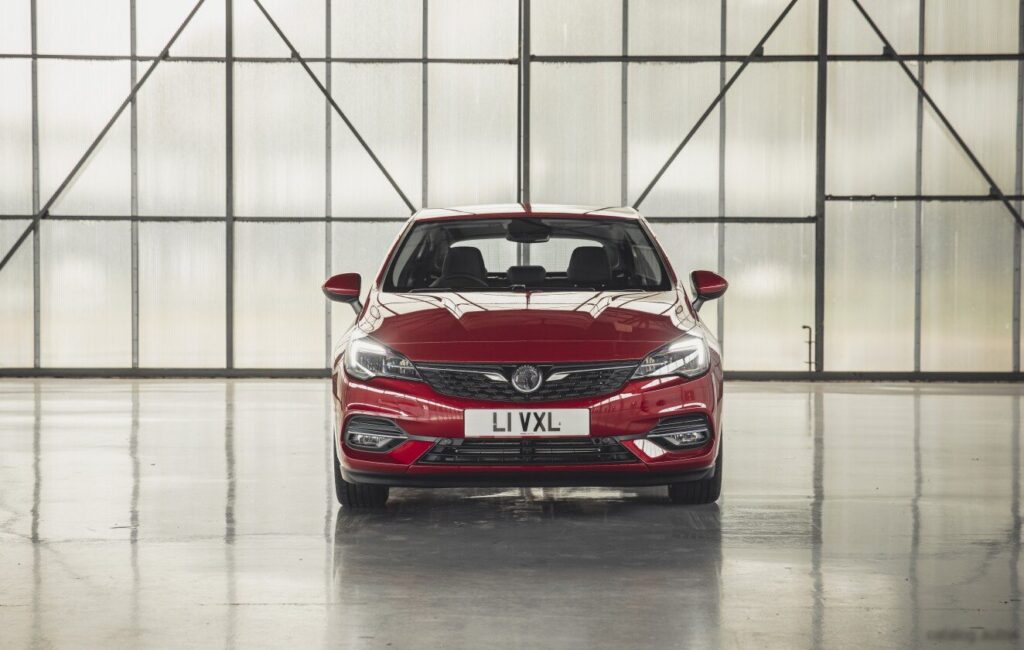
The Vauxhall Astra Mk VII (facelift, 2019) 1.5 Turbo D (122 hp) represents a mid-cycle refresh of the seventh generation Astra, produced from 2019 until November 2021. Positioned as a fuel-efficient option within the Astra range, this variant aimed to appeal to buyers prioritizing economy and practicality. It utilized a downsized, turbocharged diesel engine paired with a six-speed manual transmission. The facelift brought styling updates and revised technology, building upon the foundation of the A3/1HX0 platform shared with other PSA Group vehicles like the Peugeot 308 and Citroën C4 Cactus. This model was primarily marketed in Europe, where diesel engines remained popular due to favorable taxation and fuel efficiency.
Technical Specifications
| Brand | Vauxhall |
| Model | Astra |
| Generation | Astra Mk VII (facelift 2019) |
| Type (Engine) | 1.5 Turbo D (122 Hp) |
| Start of production | 2019 |
| End of production | November, 2021 |
| Powertrain Architecture | Internal Combustion engine |
| Body type | Hatchback |
| Seats | 5 |
| Doors | 5 |
| Combined fuel consumption (WLTP) | 4.4-4.7 l/100 km (53.5 – 50 US mpg, 64.2 – 60.1 UK mpg, 22.7 – 21.3 km/l) |
| CO2 emissions (NEDC, WLTP equivalent) | 92 g/km |
| Fuel Type | Diesel |
| Maximum speed | 209 km/h (129.87 mph) |
| Emission standard | Euro 6d |
| Power | 122 Hp @ 3500 rpm |
| Power per litre | 81.6 Hp/l |
| Torque | 300 Nm @ 1750-2500 rpm (221.27 lb.-ft. @ 1750-2500 rpm) |
| Engine layout | Front, Transverse |
| Engine Model/Code | F15DVH |
| Engine displacement | 1496 cm3 (91.29 cu. in.) |
| Number of cylinders | 3 |
| Engine configuration | Inline |
| Number of valves per cylinder | 4 |
| Fuel injection system | Diesel Commonrail |
| Engine aspiration | Turbocharger, Intercooler |
| Valvetrain | DOHC |
| Engine oil capacity | 4.25 l (4.49 US qt | 3.74 UK qt) |
| Coolant | 7 l (7.4 US qt | 6.16 UK qt) |
| Trunk (boot) space – minimum | 370 l (13.07 cu. ft.) |
| Trunk (boot) space – maximum | 1210 l (42.73 cu. ft.) |
| Fuel tank capacity | 48 l (12.68 US gal | 10.56 UK gal) |
| Length | 4370 mm (172.05 in.) |
| Width | 1809 mm (71.22 in.) |
| Width including mirrors | 2042 mm (80.39 in.) |
| Height | 1485 mm (58.46 in.) |
| Wheelbase | 2662 mm (104.8 in.) |
| Front overhang | 960 mm (37.8 in.) |
| Rear overhang | 748 mm (29.45 in.) |
| Drag coefficient (Cd) | 0.26 |
| Minimum turning circle (turning diameter) | 11.05 m (36.25 ft.) |
| Drivetrain Architecture | The Internal combustion engine (ICE) drives the front wheels of the vehicle. |
| Drive wheel | Front wheel drive |
| Number of gears and type of gearbox | 6 gears, manual transmission |
| Front suspension | Independent type McPherson |
| Rear suspension | Semi-independent, coil spring |
| Front brakes | Ventilated discs, 276 mm |
| Rear brakes | Disc, 264 mm |
| Assisting systems | ABS (Anti-lock braking system) |
| Steering type | Steering rack and pinion |
| Power steering | Electric Steering |
| Tires size | 205/55 R16; 225/45 R17; 225/40 R18 |
| Wheel rims size | 16; 17; 18 |
Powertrain & Engine Architecture
The heart of this Astra variant is the F15DVH, a 1.5-liter inline three-cylinder diesel engine. This engine is part of Vauxhall/Opel’s (and subsequently Stellantis’) modular engine family, designed for efficiency and reduced emissions. It features a turbocharger with an intercooler to boost power output, and utilizes a diesel commonrail fuel injection system for precise fuel delivery. The engine employs a Double Overhead Camshaft (DOHC) valvetrain with four valves per cylinder, optimizing gas flow for improved performance. The 1.5-liter engine benefits from a particulate filter to reduce soot emissions, complying with stringent Euro 6d emission standards. Paired with this engine is a six-speed manual transmission, chosen for its efficiency and driver engagement. The transmission’s gear ratios are tuned to maximize fuel economy while providing adequate acceleration.
Driving Characteristics
The 122 hp output and 300 Nm (221 lb-ft) of torque provide adequate, though not exhilarating, performance. Acceleration from 0 to 60 mph takes around 9.8 seconds. The engine delivers its peak torque between 1750 and 2500 rpm, offering a usable powerband for everyday driving. Compared to higher-output Astra variants, such as those with larger gasoline engines, this 1.5 Turbo D feels less responsive, particularly at higher engine speeds. However, the manual transmission allows for greater control over the engine’s power delivery. The gear ratios are well-matched for cruising on motorways, but may require frequent downshifts when tackling hilly terrain or overtaking. Compared to the automatic transmission options available on other Astra models, the manual gearbox provides a more engaging driving experience, albeit requiring more driver input.
Equipment & Trim Levels
The 1.5 Turbo D (122 hp) typically sat in the mid-range of the Astra Mk VII facelift lineup. Standard equipment generally included air conditioning, a touchscreen infotainment system with Bluetooth connectivity, alloy wheels (typically 16 or 17 inch), and a suite of safety features such as ABS, ESP (Electronic Stability Program), and multiple airbags. Higher trim levels, such as ‘Elite’ or ‘Ultimate’, added features like heated seats, a larger touchscreen display, advanced driver-assistance systems (ADAS) like lane departure warning and automatic emergency braking, and premium interior trim materials. Interior upholstery was typically cloth, with options for leather upgrades on higher trims. Dashboard configuration was consistent across the range, featuring a modern design with integrated infotainment controls.
Chassis & Braking
The Astra Mk VII utilizes a McPherson strut front suspension and a semi-independent coil spring rear suspension. This setup provides a good balance between ride comfort and handling. The front brakes are ventilated discs measuring 276mm, while the rear brakes are solid discs measuring 264mm. ABS (Anti-lock Braking System) is standard, providing enhanced braking performance in emergency situations. Stabilizer bars are fitted to both the front and rear axles to reduce body roll during cornering. The suspension tuning is geared towards comfort, making it well-suited for everyday driving. Compared to sportier Astra variants, the suspension is softer, resulting in a less aggressive driving experience.
Market Reception & Comparison
The 1.5 Turbo D (122 hp) Astra was generally well-received by critics for its fuel efficiency and low running costs. It offered a compelling alternative to petrol-powered Astra models, particularly for drivers covering high annual mileages. Fuel economy figures of 4.4-4.7 l/100 km (50-53.5 mpg US) were highly competitive in its class. However, some reviewers noted the engine could be somewhat noisy and lacked the refinement of some of its rivals. Compared to the 1.0-liter turbocharged petrol engine, the diesel offered superior torque and fuel economy, but at the expense of some refinement. Against other diesel-powered competitors, the Astra 1.5 Turbo D offered a good balance of performance, economy, and equipment.
Legacy
The F15DVH engine has proven to be a relatively reliable unit, although, like all diesel engines, it is susceptible to issues related to the diesel particulate filter (DPF) if not properly maintained. Regular servicing and the use of high-quality diesel fuel are crucial for ensuring long-term reliability. On the used car market, the 1.5 Turbo D Astra variants tend to hold their value reasonably well, due to their fuel efficiency and practicality. They remain a popular choice for buyers seeking an economical and reliable family hatchback. The Astra Mk VII, in general, is considered a well-built and comfortable car, and the 1.5 Turbo D variant offers a compelling package for those prioritizing fuel economy and low running costs.