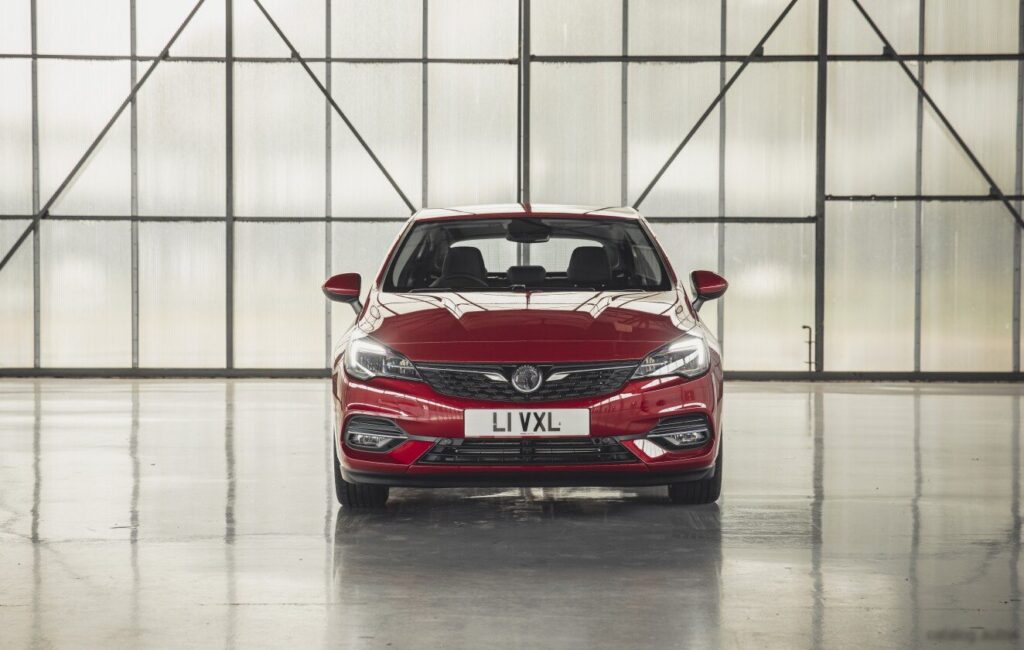
The Vauxhall Astra Mk VII (facelift, 2019) 1.5 Turbo D (122 hp) Automatic represents a mid-cycle refresh of the seventh-generation Astra, produced from 2019 until November 2021. This variant occupied a significant position within the Astra lineup, targeting buyers seeking a balance between fuel efficiency, reasonable performance, and the convenience of an automatic transmission. It was primarily marketed in Europe, where the Astra competed in the highly competitive compact hatchback segment against rivals like the Volkswagen Golf, Ford Focus, and Peugeot 308. The facelift brought styling updates, revised technology, and refinements to the engine range, including this 1.5-liter diesel option.
Technical Specifications
| Brand | Vauxhall |
| Model | Astra |
| Generation | Astra Mk VII (facelift 2019) |
| Type (Engine) | 1.5 Turbo D (122 Hp) Automatic |
| Start of production | 2019 |
| End of production | November, 2021 |
| Powertrain Architecture | Internal Combustion engine |
| Body type | Hatchback |
| Seats | 5 |
| Doors | 5 |
| Combined fuel consumption (WLTP) | 5-5.3 l/100 km (47 – 44.4 US mpg, 56.5 – 53.3 UK mpg, 20 – 18.9 km/l) |
| CO2 emissions | 109 g/km |
| Fuel Type | Diesel |
| Maximum speed | 204 km/h (126.76 mph) |
| Emission standard | Euro 6d |
| Power | 122 Hp @ 3500 rpm |
| Power per litre | 81.6 Hp/l |
| Torque | 285 Nm @ 1500-2750 rpm (210.21 lb.-ft. @ 1500-2750 rpm) |
| Engine layout | Front, Transverse |
| Engine Model/Code | F15DVH |
| Engine displacement | 1496 cm3 (91.29 cu. in.) |
| Number of cylinders | 3 |
| Engine configuration | Inline |
| Number of valves per cylinder | 4 |
| Fuel injection system | Diesel Commonrail |
| Engine aspiration | Turbocharger, Intercooler |
| Valvetrain | DOHC |
| Engine oil capacity | 4.25 l (4.49 US qt | 3.74 UK qt) |
| Coolant | 7 l (7.4 US qt | 6.16 UK qt) |
| Trunk (boot) space – minimum | 370 l (13.07 cu. ft.) |
| Trunk (boot) space – maximum | 1210 l (42.73 cu. ft.) |
| Fuel tank capacity | 48 l (12.68 US gal | 10.56 UK gal) |
| Length | 4370 mm (172.05 in.) |
| Width | 1809 mm (71.22 in.) |
| Width including mirrors | 2042 mm (80.39 in.) |
| Height | 1485 mm (58.46 in.) |
| Wheelbase | 2662 mm (104.8 in.) |
| Front overhang | 960 mm (37.8 in.) |
| Rear overhang | 748 mm (29.45 in.) |
| Drag coefficient (Cd) | 0.26 |
| Minimum turning circle (turning diameter) | 11.05 m (36.25 ft.) |
| Drivetrain Architecture | The Internal combustion engine (ICE) drives the front wheels of the vehicle. |
| Drive wheel | Front wheel drive |
| Number of gears and type of gearbox | 9 gears, automatic transmission |
| Front suspension | Independent type McPherson |
| Rear suspension | Semi-independent, coil spring |
| Front brakes | Ventilated discs, 276 mm |
| Rear brakes | Disc, 264 mm |
| Assisting systems | ABS (Anti-lock braking system) |
| Steering type | Steering rack and pinion |
| Power steering | Electric Steering |
| Tires size | 205/55 R16; 225/45 R17; 225/40 R18 |
| Wheel rims size | 16; 17; 18 |
Powertrain & Engine Architecture
The heart of this Astra variant is the F15DVH, a 1.5-liter inline three-cylinder turbocharged diesel engine. This engine is part of Vauxhall/Opel’s ‘Small Diesel’ family, designed for efficiency and reduced emissions. The engine utilizes a diesel commonrail direct injection system, delivering fuel directly into the combustion chamber at extremely high pressure. This, combined with the turbocharger and intercooler, allows for a good balance of power and fuel economy. The engine features a Double Overhead Camshaft (DOHC) valvetrain with four valves per cylinder, optimizing gas flow for improved performance. The nine-speed automatic transmission, sourced from Aisin, was a key feature, offering smooth gear changes and contributing to the car’s relaxed driving experience. This transmission was chosen for its efficiency and ability to handle the engine’s torque output effectively.
Driving Characteristics
The 122 hp output, coupled with the nine-speed automatic, provides adequate performance for everyday driving. Acceleration is not particularly brisk, with a 0-60 mph time estimated around 10.5 seconds. However, the engine’s 285 Nm (210 lb-ft) of torque, available from a low 1500 rpm, provides good responsiveness for overtaking and merging onto highways. The automatic transmission is well-programmed, offering smooth shifts and generally selecting the appropriate gear for the driving conditions. Compared to the more powerful petrol variants or the higher-output diesel models, this version prioritizes fuel economy over outright performance. The gear ratios are tuned for efficiency, meaning the engine doesn’t rev as high during cruising, further contributing to lower fuel consumption. The driving experience is generally comfortable and refined, making it well-suited for long journeys.
Equipment & Trim Levels
The 1.5 Turbo D Automatic typically came in mid-range trim levels, such as ‘Design’ or ‘Tech Line’. Standard equipment generally included air conditioning, a touchscreen infotainment system with Apple CarPlay and Android Auto compatibility, Bluetooth connectivity, cruise control, and a suite of safety features including automatic emergency braking and lane departure warning. Higher trim levels offered additional features like heated seats, a larger touchscreen display, navigation system, and parking sensors. Interior upholstery was typically cloth, with options for leather upgrades. The dashboard layout was modern and functional, with a focus on ease of use.
Chassis & Braking
The Astra Mk VII utilizes a McPherson strut front suspension and a semi-independent coil spring rear suspension. This setup provides a good balance between ride comfort and handling. The front brakes are ventilated discs, providing ample stopping power, while the rear brakes are solid discs. ABS (Anti-lock Braking System) is standard, enhancing safety during emergency braking situations. Stabilizer bars are fitted to both the front and rear axles to reduce body roll during cornering. The chassis is relatively lightweight, contributing to the car’s agility and fuel efficiency.
Market Reception & Comparison
The 1.5 Turbo D Automatic Astra was generally well-received by automotive critics. It was praised for its fuel efficiency, comfortable ride, and smooth-shifting automatic transmission. However, some reviewers noted that the engine could feel a little underpowered, particularly when fully loaded or driving uphill. Compared to the 1.0-liter petrol version, the diesel offered significantly better fuel economy and more torque, making it a more practical choice for drivers covering long distances. Against rivals like the Volkswagen Golf TDI, the Astra offered a competitive package in terms of price, equipment, and running costs. Reliability reports suggest that the F15DVH engine is generally robust, although regular servicing is essential to maintain optimal performance.
Legacy
The Vauxhall Astra Mk VII 1.5 Turbo D Automatic has established itself as a reliable and economical used car option. The 1.5-liter diesel engine, while not the most powerful, has proven to be durable and relatively trouble-free. The nine-speed automatic transmission has also demonstrated good longevity. In the used car market, these Astras represent good value for money, offering a comfortable and practical driving experience at an affordable price. The combination of fuel efficiency, practicality, and reasonable running costs continues to make this variant a popular choice for buyers seeking a dependable compact hatchback.