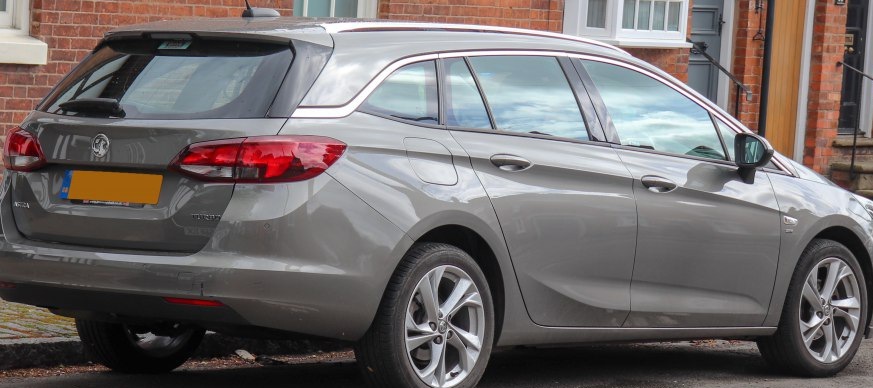
The Vauxhall Astra Mk VII Sports Tourer 1.0i (105 hp) ecoFLEX start&stop, produced from 2015 to 2019, represented an entry-level offering within the broader Astra Mk VII Sports Tourer (estate) range. Positioned as a fuel-efficient option, it catered to buyers prioritizing economy over outright performance. This variant was part of the J-series Astra, built on the General Motors Delta platform (also known as the 1HX0/A3 platform), and aimed to provide a practical and affordable family vehicle in the European market. The “ecoFLEX” designation signified Vauxhall’s efforts to optimize fuel consumption through various technologies, including start/stop functionality.
Technical Specifications
| Brand | Vauxhall |
| Model | Astra |
| Generation | Astra Mk VII Sports Tourer |
| Type (Engine) | 1.0i (105 Hp) ecoFLEX start&stop |
| Start of production | 2015 |
| End of production | 2019 |
| Powertrain Architecture | Internal Combustion engine |
| Body type | Station wagon (estate) |
| Seats | 5 |
| Doors | 5 |
| Fuel consumption (urban) | 5.3 l/100 km (44.4 US mpg, 53.3 UK mpg, 18.9 km/l) |
| Fuel consumption (extra urban) | 4 l/100 km (58.8 US mpg, 70.6 UK mpg, 25 km/l) |
| Fuel consumption (combined) | 4.5 l/100 km (52.3 US mpg, 62.8 UK mpg, 22.2 km/l) |
| CO2 emissions | 103 g/km |
| Fuel Type | Petrol (Gasoline) |
| Acceleration 0 – 100 km/h | 11.7 sec |
| Acceleration 0 – 62 mph | 11.7 sec |
| Acceleration 0 – 60 mph | 11.1 sec |
| Maximum speed | 195 km/h (121.17 mph) |
| Emission standard | Euro 6 |
| Weight-to-power ratio | 11.4 kg/Hp, 87.6 Hp/tonne |
| Weight-to-torque ratio | 7 kg/Nm, 141.9 Nm/tonne |
| Power | 105 Hp @ 5500 rpm |
| Power per litre | 105.1 Hp/l |
| Torque | 170 Nm @ 1800-4250 rpm (125.39 lb.-ft. @ 1800-4250 rpm) |
| Engine layout | Front, Transverse |
| Engine Model/Code | B10XFL |
| Engine displacement | 999 cm3 (60.96 cu. in.) |
| Number of cylinders | 3 |
| Engine configuration | Inline |
| Cylinder Bore | 74 mm (2.91 in.) |
| Piston Stroke | 77.4 mm (3.05 in.) |
| Fuel injection system | Direct injection |
| Engine aspiration | Turbocharger, Intercooler |
| Engine oil capacity | 4 l (4.23 US qt | 3.52 UK qt) |
| Kerb Weight | 1198 kg (2641.14 lbs.) |
| Max. weight | 1830 kg (4034.46 lbs.) |
| Max load | 632 kg (1393.32 lbs.) |
| Trunk (boot) space – minimum | 540 l (19.07 cu. ft.) |
| Trunk (boot) space – maximum | 1630 l (57.56 cu. ft.) |
| Fuel tank capacity | 48 l (12.68 US gal | 10.56 UK gal) |
| Max. roof load | 75 kg (165.35 lbs.) |
| Permitted trailer load with brakes (12%) | 800 kg (1763.7 lbs.) |
| Permitted trailer load without brakes | 610 kg (1344.82 lbs.) |
| Length | 4702 mm (185.12 in.) |
| Width | 1809 mm (71.22 in.) |
| Width with mirrors folded | 1871 mm (73.66 in.) |
| Width including mirrors | 2042 mm (80.39 in.) |
| Height | 1510 mm (59.45 in.) |
| Wheelbase | 2662 mm (104.8 in.) |
| Front track | 1548 mm (60.94 in.) |
| Rear (Back) track | 1565 mm (61.61 in.) |
| Front overhang | 960 mm (37.8 in.) |
| Rear overhang | 1080 mm (42.52 in.) |
| Minimum turning circle | 11.05 m (36.25 ft.) |
| Drivetrain Architecture | Front wheel drive |
| Drive wheel | Front wheel drive |
| Number of gears and type of gearbox | 5 gears, manual transmission |
| Front brakes | Disc |
| Rear brakes | Disc |
| Assisting systems | ABS (Anti-lock braking system) |
| Steering type | Steering rack and pinion |
| Tires size | 195/65 R15; 205/55 R16 |
| Wheel rims size | 6J x 15; 6.5J x 16 |
Powertrain & Engine Architecture
The heart of this Astra variant is the 999cc B10XFL three-cylinder turbocharged petrol engine. This engine is part of Vauxhall/Opel’s “Small Displacement Family” (SDF), designed for efficiency and reduced emissions. The B10XFL utilizes direct fuel injection and a single scroll turbocharger with an intercooler to boost power output. The engine’s aluminum block and cylinder head contribute to weight reduction. The engine produces 105 horsepower at 5500 rpm and 170 Nm (125 lb-ft) of torque between 1800 and 4250 rpm. This torque curve provides reasonable responsiveness for everyday driving. The engine is paired with a five-speed manual transmission, which was the standard offering for this trim level. The start/stop system automatically shuts off the engine when the vehicle is stationary, further enhancing fuel economy.
Driving Characteristics
The 1.0i (105 hp) Sports Tourer offers adequate, but not exhilarating, performance. Acceleration from 0-60 mph takes around 11.1 seconds, and top speed is 195 km/h (121 mph). The turbocharger provides a noticeable boost in power, but the engine can feel strained when fully loaded or during rapid acceleration. The five-speed gearbox is well-matched to the engine’s characteristics, offering reasonable gear spacing. Compared to higher-output Astra variants, such as those with 1.6-liter petrol or 1.7-liter diesel engines, this version feels less powerful, particularly when overtaking. However, its lighter weight and efficient engine contribute to better fuel economy and lower running costs.
Equipment & Trim Levels
The 1.0i ecoFLEX typically came with a relatively basic level of equipment, reflecting its position as an entry-level model. Standard features generally included air conditioning, electric front windows, a basic audio system with USB connectivity, and stability control. Higher trim levels, such as Tech Line or Energy, offered additional features like alloy wheels, cruise control, a touchscreen infotainment system, and more advanced safety features. Interior upholstery was typically cloth, and the dashboard featured a functional, if somewhat utilitarian, design. Optional extras included parking sensors, a rearview camera, and upgraded audio systems.
Chassis & Braking
The Astra Mk VII Sports Tourer utilizes a MacPherson strut front suspension and a torsion beam rear suspension. This setup provides a comfortable ride quality, although it’s not particularly sporty. The front brakes are ventilated discs, while the rear brakes are solid discs. Anti-lock Braking System (ABS) is standard. The steering is electrically assisted, providing light and precise control. The suspension is tuned for comfort and practicality, prioritizing ride quality over handling precision. Stabilizer bars are fitted to both the front and rear axles to reduce body roll.
Market Reception & Comparison
The Astra 1.0i ecoFLEX was generally well-received by critics for its fuel efficiency and affordability. However, some reviewers noted its lack of outright performance and somewhat basic interior. Compared to other engines in the Astra lineup, the 1.0i offered the lowest running costs but also the slowest acceleration. The 1.6-liter petrol engine provided a noticeable performance upgrade, while the 1.7-liter diesel offered even better fuel economy and more torque. The 1.0i appealed to buyers who prioritized economy and practicality over driving excitement.
Legacy
The B10XFL engine has proven to be a relatively reliable unit, although regular maintenance is crucial. Common issues include turbocharger wear and potential problems with the direct injection system. In the used car market, the Astra 1.0i ecoFLEX represents a budget-friendly option for those seeking a practical and economical estate car. Its fuel efficiency and relatively low maintenance costs make it an attractive choice for first-time buyers or those on a tight budget. However, potential buyers should be aware of its limited performance and the importance of a thorough pre-purchase inspection.