Technical Specifications
| Brand | Vauxhall |
| Model | Astra |
| Generation | Astra Mk VIII |
| Type (Engine) | 1.2 Turbo (130 Hp) Automatic |
| Start of production | November, 2021 |
| Powertrain Architecture | Internal Combustion engine |
| Body type | Hatchback |
| Seats | 5 |
| Doors | 5 |
| Combined fuel consumption (WLTP) | 5.6-5.8 l/100 km (42 – 40.6 US mpg, 50.4 – 48.7 UK mpg, 17.9 – 17.2 km/l) |
| CO2 emissions (WLTP) | 127-130 g/km |
| Fuel Type | Petrol (Gasoline) |
| Acceleration 0 – 60 mph | 9.7 sec |
| Maximum speed | 209 km/h (129.87 mph) |
| Emission standard | Euro 6d |
| Power | 130 Hp @ 5500 rpm |
| Power per litre | 108.4 Hp/l |
| Torque | 230 Nm @ 1750 rpm (169.64 lb.-ft. @ 1750 rpm) |
| Engine layout | Front, Transverse |
| Engine Model/Code | F12XHT |
| Engine displacement | 1199 cm3 (73.17 cu. in.) |
| Number of cylinders | 3 |
| Engine configuration | Inline |
| Number of valves per cylinder | 4 |
| Fuel injection system | Direct injection |
| Engine aspiration | Turbocharger, Intercooler |
| Valvetrain | DOHC, VVT |
| Engine oil capacity | 3.5 l (3.7 US qt | 3.08 UK qt) |
| Max. weight | 1880 kg (4144.69 lbs.) |
| Trunk (boot) space – minimum | 367 l (12.96 cu. ft.) |
| Trunk (boot) space – maximum | 1182 l (41.74 cu. ft.) |
| Fuel tank capacity | 52 l (13.74 US gal | 11.44 UK gal) |
| Permitted trailer load with brakes (12%) | 1200 kg (2645.55 lbs.) |
| Permitted trailer load without brakes | 680 kg (1499.14 lbs.) |
| Length | 4374 mm (172.2 in.) |
| Width | 1860 mm (73.23 in.) |
| Width including mirrors | 2062 mm (81.18 in.) |
| Height | 1441 mm (56.73 in.) |
| Wheelbase | 2675 mm (105.31 in.) |
| Front overhang | 933 mm (36.73 in.) |
| Rear overhang | 869 mm (34.21 in.) |
| Minimum turning circle (turning diameter) | 10.51 m (34.48 ft.) |
| Drivetrain Architecture | The Internal combustion engine (ICE) drives the front wheels of the vehicle. |
| Drive wheel | Front wheel drive |
| Number of gears and type of gearbox | 8 gears, automatic transmission |
| Front brakes | Ventilated discs |
| Rear brakes | Disc |
| Tires size | 205/55 R16; 225/45 R17; 225/40 R18 |
| Wheel rims size | 16; 17; 18 |
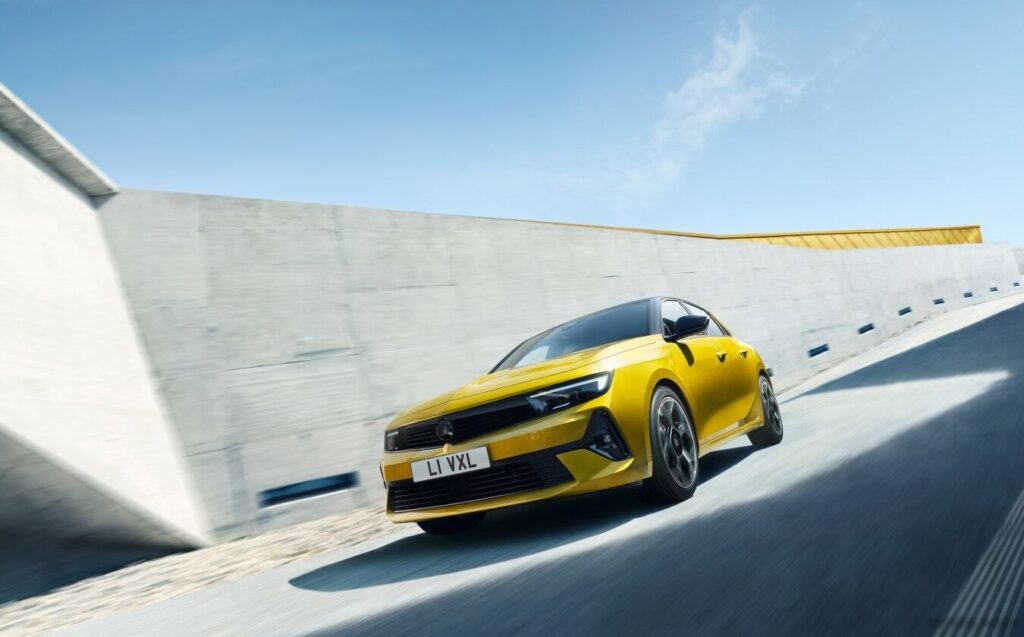
The Vauxhall Astra Mk VIII 1.2 Turbo (130 hp) Automatic, launched in November 2021, represents a key variant within the eighth generation of Vauxhall’s popular compact hatchback. Positioned as a mid-range offering, this model aimed to balance fuel efficiency with acceptable performance, appealing to buyers seeking a comfortable and practical daily driver. It’s built on the EMP2 platform, shared with other Stellantis brands like Peugeot and Citroën, and marked a significant redesign for the Astra, incorporating a more modern aesthetic and a suite of updated technologies. This variant played a crucial role in Vauxhall’s transition towards electrification, offering a gasoline-powered option alongside plug-in hybrid and fully electric models.
Powertrain & Engine Architecture
At the heart of the Astra Mk VIII 1.2 Turbo Automatic lies the F12XHT engine, a 1.2-liter, three-cylinder turbocharged gasoline engine. This engine is part of Stellantis’s “PureTech” family, known for its compact size and efficiency. The engine utilizes direct fuel injection, delivering fuel directly into the combustion chamber for improved combustion efficiency and reduced emissions. It also features a dual overhead camshaft (DOHC) valvetrain with variable valve timing (VVT) on both intake and exhaust valves, optimizing engine performance across a wider RPM range. The turbocharger, coupled with an intercooler, provides a boost in power and torque, compensating for the relatively small displacement. Paired with this engine is an eight-speed automatic transmission, providing smooth and efficient gear changes. This transmission is a conventional torque-converter automatic, prioritizing comfort and ease of use over outright performance.
Driving Characteristics
The 130 hp 1.2 Turbo Automatic delivers adequate performance for everyday driving. Acceleration from 0-60 mph takes approximately 9.7 seconds, which is competitive within its class but noticeably slower than higher-powered Astra variants like the 1.6 Diesel or the more potent gasoline engines. The engine’s peak torque of 230 Nm (169.64 lb-ft) is available from a low 1750 rpm, providing decent responsiveness in urban driving conditions. However, when overtaking or climbing hills, the engine can feel strained, requiring the transmission to downshift. The eight-speed automatic transmission generally shifts smoothly, but can sometimes exhibit a slight hesitation when responding to sudden throttle inputs. Compared to the six-speed manual transmission available on other Astra models, the automatic prioritizes comfort and convenience over driver engagement.
Equipment & Trim Levels
The 1.2 Turbo Automatic trim typically included a generous level of standard equipment. Features commonly found on this variant include air conditioning, a touchscreen infotainment system with Apple CarPlay and Android Auto compatibility, a suite of safety features such as lane departure warning and automatic emergency braking, and alloy wheels. Higher trim levels offered upgrades such as heated seats, a larger touchscreen display, a panoramic sunroof, and adaptive cruise control. Interior upholstery was typically cloth, with options for leather upgrades on higher-spec models. The dashboard layout was modern and driver-focused, with a digital instrument cluster available on select trims.
Chassis & Braking
The Astra Mk VIII utilizes a MacPherson strut front suspension and a torsion beam rear suspension. This setup provides a good balance between ride comfort and handling. The front brakes are ventilated discs, providing ample stopping power, while the rear brakes are solid discs. The steering is electrically assisted, offering a light and precise feel. Stabilizer bars are fitted to both the front and rear axles to reduce body roll during cornering. The chassis was tuned to prioritize comfort and refinement, making it a pleasant vehicle for long journeys.
Market Reception & Comparison
The Astra Mk VIII 1.2 Turbo Automatic received generally positive reviews from automotive critics. It was praised for its comfortable ride, spacious interior, and fuel efficiency (achieving between 40.6 and 42 US mpg). However, some critics noted that the engine could feel underpowered, particularly when fully loaded or driving on inclines. Compared to the 1.5 Diesel variant, the 1.2 Turbo offered lower running costs but less torque and slightly slower acceleration. Against competitors like the Volkswagen Golf and Ford Focus, the Astra 1.2 Turbo Automatic offered a competitive package in terms of price, features, and fuel economy.
Legacy
The Vauxhall Astra Mk VIII 1.2 Turbo Automatic has proven to be a reliable and relatively trouble-free vehicle. The 1.2 PureTech engine, while occasionally subject to reports of timing chain issues (a concern across the Stellantis group), generally offers good long-term durability with regular maintenance. On the used car market, these models represent a good value proposition, offering a well-equipped and comfortable hatchback at an affordable price. The combination of a fuel-efficient engine and a smooth automatic transmission makes it a popular choice for buyers seeking a practical and economical daily driver.