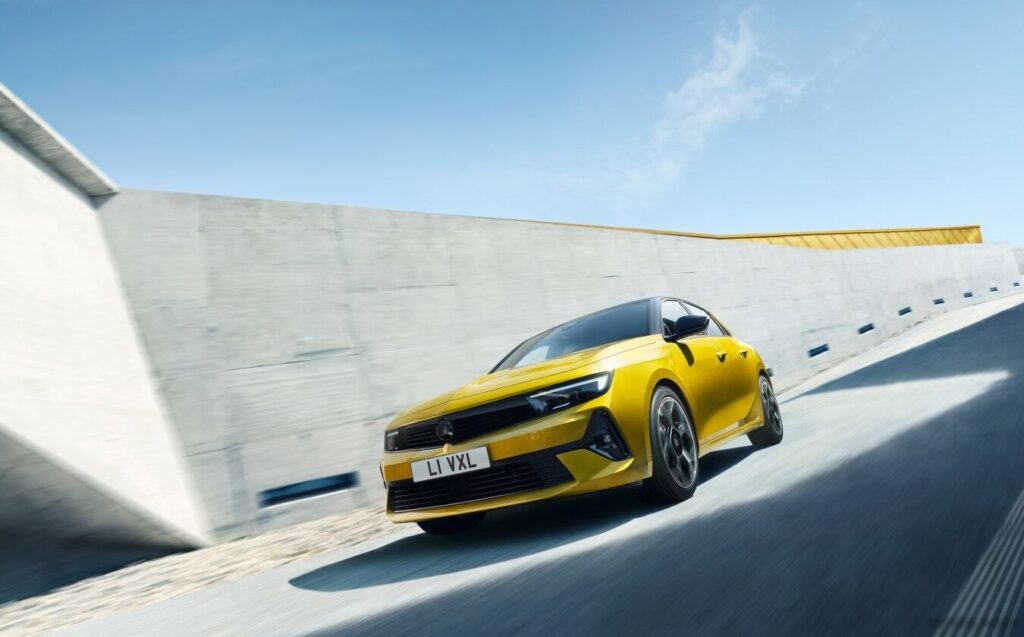
The Vauxhall Astra Mk VIII 1.2 Turbo (136 hp) Mild Hybrid e-DCT represents a significant step forward in the Astra lineage, launched in February 2024. Positioned as a mid-range offering within the Mk VIII generation, this variant blends fuel efficiency with respectable performance, leveraging mild hybrid technology to enhance the driving experience. It’s built on the Stellantis EMP2 platform, shared with other Peugeot and Citroën models, and aims to compete in the highly contested compact hatchback segment. This model is a key part of Vauxhall’s strategy to offer electrified options across its range, appealing to buyers seeking lower running costs and reduced emissions.
Technical Specifications
| Brand | Vauxhall |
| Model | Astra |
| Generation | Astra Mk VIII |
| Type (Engine) | 1.2 Turbo (136 Hp) Mild Hybrid e-DCT |
| Start of production | February, 2024 |
| Powertrain Architecture | MHEV (Mild Hybrid Electric Vehicle) |
| Body type | Hatchback |
| Seats | 5 |
| Doors | 5 |
| Combined fuel consumption (WLTP) | 4.7-5 l/100 km (50 – 47 US mpg, 60.1 – 56.5 UK mpg, 21.3 – 20 km/l) |
| CO2 emissions (WLTP) | 106-112 g/km |
| Fuel Type | Petrol (Gasoline) |
| Acceleration 0 – 100 km/h | 9 sec |
| Acceleration 0 – 62 mph | 9 sec |
| Acceleration 0 – 60 mph | 8.6 sec |
| Maximum speed | 210 km/h (130.49 mph) |
| Emission standard | Euro 6.4 |
| Gross battery capacity | 0.89 kWh |
| Net (usable) battery capacity | 0.432 kWh |
| Battery voltage | 48 V |
| Battery technology | Lithium-ion (Li-Ion) |
| Battery location | Under the front seats |
| All-electric range | 1 km (0.62 mi) |
| Electric motor power | 28 Hp |
| Electric motor Torque | 55 Nm (40.57 lb.-ft.) |
| Electric motor location | Integrated into the transmission |
| Electric motor type | Synchronous |
| Power | 136 Hp @ 5500 rpm |
| Torque | 230 Nm @ 1750 rpm (169.64 lb.-ft. @ 1750 rpm) |
| Engine layout | Front, Transverse |
| Engine Model/Code | EB2LTDH2 |
| Engine displacement | 1199 cm3 (73.17 cu. in.) |
| Number of cylinders | 3 |
| Engine configuration | Inline |
| Cylinder Bore | 75 mm (2.95 in.) |
| Piston Stroke | 90.5 mm (3.56 in.) |
| Number of valves per cylinder | 4 |
| Fuel injection system | Direct injection |
| Engine aspiration | Turbocharger, Intercooler |
| Valvetrain | DOHC, VVT |
| Engine oil capacity | 3.5 l (3.7 US qt | 3.08 UK qt) |
| Max. weight | 1950 kg (4299.01 lbs.) |
| Trunk (boot) space – minimum | 422 l (14.9 cu. ft.) |
| Trunk (boot) space – maximum | 1339 l (47.29 cu. ft.) |
| Fuel tank capacity | 52 l (13.74 US gal | 11.44 UK gal) |
| Permitted trailer load with brakes (12%) | 1150 kg (2535.32 lbs.) |
| Permitted trailer load without brakes | 600 kg (1322.77 lbs.) |
| Length | 4374 mm (172.2 in.) |
| Width | 1860 mm (73.23 in.) |
| Width including mirrors | 2062 mm (81.18 in.) |
| Height | 1441 mm (56.73 in.) |
| Wheelbase | 2675 mm (105.31 in.) |
| Front overhang | 906 mm (35.67 in.) |
| Rear overhang | 793 mm (31.22 in.) |
| Minimum turning circle | 10.51 m (34.48 ft.) |
| Drivetrain Architecture | Front wheel drive. MHEV. ICE and electric motor drive the front wheels. |
| Number of gears and type of gearbox | 6 gears, automatic transmission e-DCT |
| Front suspension | Independent, McPherson with coil spring and anti-roll bar |
| Rear suspension | Coil spring, Torsion |
| Front brakes | Ventilated discs |
| Rear brakes | Disc |
| Tires size | 225/45 R17; 225/40 R18 |
| Wheel rims size | 7.5J x 17; 7.5J x 18; 8J x 18 |
Powertrain & Engine Architecture
At the heart of the Astra Mk VIII 1.2 Turbo Mild Hybrid is the EB2LTDH2 engine, a 1.2-liter turbocharged three-cylinder petrol engine. This engine is part of the PureTech family developed by the PSA Group (now part of Stellantis). It utilizes direct fuel injection and a single scroll turbocharger with an intercooler to deliver 136 horsepower at 5500 rpm and 230 Nm (169.64 lb-ft) of torque at 1750 rpm. The ‘Mild Hybrid’ aspect comes from a 48V electrical system and a small electric motor integrated with the dual-clutch transmission (e-DCT). This system provides a power boost during acceleration and allows for extended periods of engine-off coasting, improving fuel economy. The e-DCT transmission itself is a six-speed unit, chosen for its efficiency and responsiveness. The 48V battery, located under the front seats, has a gross capacity of 0.89 kWh and a usable capacity of 0.432 kWh, enabling a limited all-electric driving range of approximately 1 kilometer (0.62 miles).
Driving Characteristics
The 1.2 Turbo Mild Hybrid e-DCT offers a comfortable and refined driving experience. While not overtly sporty, the powertrain delivers adequate performance for everyday driving. Acceleration from 0-60 mph takes around 8.6 seconds, and the car feels responsive in most situations. The e-DCT transmission provides smooth and quick gear changes, contributing to a seamless driving experience. Compared to the more powerful Astra variants, such as those with larger engines, this version prioritizes fuel efficiency over outright performance. The mild hybrid system helps to mitigate turbo lag and provides a subtle boost during acceleration. The gear ratios are tuned for efficiency, meaning the engine doesn’t always feel strained when cruising at highway speeds. However, overtaking maneuvers may require a bit more planning than with higher-powered models.
Equipment & Trim Levels
The Astra Mk VIII 1.2 Turbo Mild Hybrid e-DCT typically comes well-equipped, even in base trim levels. Standard features often include a touchscreen infotainment system with Apple CarPlay and Android Auto compatibility, a digital instrument cluster, automatic climate control, and a suite of safety features such as lane departure warning, automatic emergency braking, and traffic sign recognition. Higher trim levels add features like adaptive cruise control, heated seats, a panoramic sunroof, and premium upholstery. Interior materials are generally of good quality, with a focus on creating a modern and comfortable cabin environment. Optional extras can include a premium sound system, wireless phone charging, and advanced parking assist features.
Chassis & Braking
The Astra Mk VIII utilizes an independent McPherson strut suspension setup at the front and a torsion beam suspension at the rear. This configuration provides a good balance between ride comfort and handling. The chassis is relatively lightweight, contributing to the car’s agility. Braking duties are handled by ventilated discs at the front and solid discs at the rear. Anti-lock Braking System (ABS) and Electronic Stability Control (ESC) are standard features, ensuring safe and controlled braking performance. The steering is electrically assisted, providing a light and precise feel.
Market Reception & Comparison
The Astra Mk VIII 1.2 Turbo Mild Hybrid e-DCT has been generally well-received by automotive critics. It’s praised for its fuel efficiency, comfortable ride, and well-equipped interior. However, some reviewers have noted that the engine can feel a bit strained under hard acceleration. Compared to other trims in the Astra lineup, this variant offers a compelling balance of price and efficiency. The 1.5 Diesel, for example, offers better fuel economy but comes with the higher running costs associated with diesel ownership. The more powerful petrol engines provide more performance but at the expense of fuel efficiency. Against competitors like the Volkswagen Golf, Ford Focus, and Peugeot 308, the Astra 1.2 Turbo Mild Hybrid e-DCT holds its own, offering a competitive package with a strong emphasis on technology and efficiency.
Legacy
The 1.2 Turbo Mild Hybrid powertrain represents a key step in Vauxhall’s transition towards electrification. While it’s still relatively early to assess the long-term reliability of this specific powertrain, the PureTech engine family has generally proven to be durable. The mild hybrid system adds complexity, but it’s designed to reduce stress on the engine and improve overall efficiency. In the used car market, this variant is likely to appeal to buyers seeking a fuel-efficient and well-equipped compact hatchback. Its relatively low running costs and modern features should ensure continued demand for years to come.