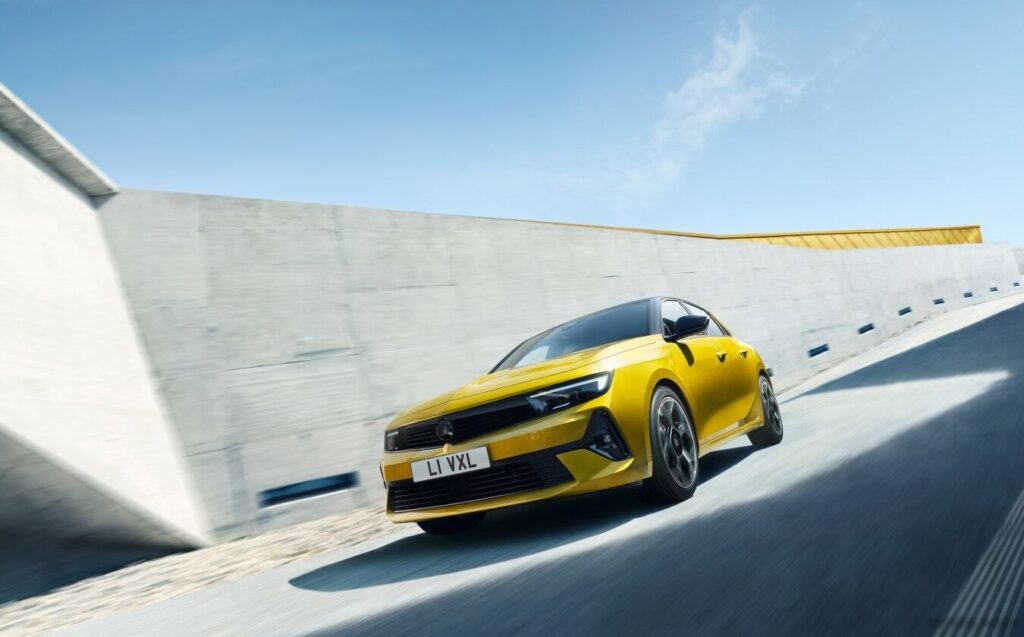
The Vauxhall Astra Mk VIII 1.6 Turbo Plug-in Hybrid e-DCT, launched in November 2025, represents a significant step in the Astra’s evolution, blending internal combustion with electric power. This variant sits within the Mk VIII Astra range (introduced as a successor to the Mk VII) which utilizes the Stellantis EMP2 platform, shared with Peugeot and Citroën models. Positioned as a mid-range offering, it caters to buyers seeking improved fuel efficiency and reduced emissions without fully committing to a fully electric vehicle. The “e-DCT” designation refers to the efficient dual-clutch transmission paired with the hybrid powertrain.
Technical Specifications
| Brand | Vauxhall |
| Model | Astra |
| Generation | Astra Mk VIII |
| Type (Engine) | 1.6 Turbo (195 Hp) Plug-in Hybrid e-DCT |
| Start of production | November, 2025 |
| Powertrain Architecture | PHEV (Plug-in Hybrid Electric Vehicle) |
| Body type | Hatchback |
| Seats | 5 |
| Doors | 5 |
| Combined fuel consumption (WLTP) | 2.3 l/100 km (102.3 US mpg / 122.8 UK mpg / 43.5 km/l) |
| CO2 emissions (WLTP) | 49-51 g/km |
| Fuel Type | Petrol / electricity |
| Acceleration 0 – 100 km/h | 7.9 sec |
| Acceleration 0 – 62 mph | 7.9 sec |
| Acceleration 0 – 60 mph | 7.5 sec |
| Maximum speed | 225 km/h (139.81 mph) |
| Emission standard | Euro 6e-bis |
| Weight-to-power ratio | 8.6 kg/Hp, 116.2 Hp/tonne |
| Weight-to-torque ratio | 4.7 kg/Nm, 214.5 Nm/tonne |
| Gross battery capacity | 17.2 kWh |
| Battery technology | Lithium-ion (Li-Ion) |
| All-electric range (WLTP) | 82-84 km (50.95 – 52.2 mi) |
| Electric motor power | 125 Hp @ 2500 rpm |
| Electric motor location | Between the combustion engine and the transmission |
| System power | 195 Hp @ 6000 rpm |
| System torque | 360 Nm @ 1750 rpm (265.52 lb.-ft. @ 1750 rpm) |
| Engine Power | 150 Hp @ 5500 rpm |
| Engine Torque | 250 Nm @ 1750 rpm (184.39 lb.-ft. @ 1750 rpm) |
| Engine layout | Front, Transverse |
| Engine displacement | 1598 cm3 (97.52 cu. in.) |
| Number of cylinders | 4 |
| Engine configuration | Inline |
| Cylinder Bore | 77 mm (3.03 in.) |
| Piston Stroke | 85.8 mm (3.38 in.) |
| Number of valves per cylinder | 4 |
| Fuel injection system | Direct injection |
| Engine aspiration | Turbocharger, Intercooler |
| Valvetrain | DOHC, VVT |
| Engine oil capacity | 4.3 l (4.54 US qt | 3.78 UK qt) |
| Kerb Weight | 1678 kg (3699.36 lbs.) |
| Max. weight | 2120 kg (4673.8 lbs.) |
| Max load | 442 kg (974.44 lbs.) |
| Trunk (boot) space – minimum | 352 l (12.43 cu. ft.) |
| Trunk (boot) space – maximum | 1268 l (44.78 cu. ft.) |
| Fuel tank capacity | 42 l (11.1 US gal | 9.24 UK gal) |
| Permitted trailer load with brakes (12%) | 1450 kg (3196.7 lbs.) |
| Permitted trailer load without brakes | 750 kg (1653.47 lbs.) |
| Length | 4374 mm (172.2 in.) |
| Width | 1860 mm (73.23 in.) |
| Width including mirrors | 2062 mm (81.18 in.) |
| Height | 1441 mm (56.73 in.) |
| Wheelbase | 2675 mm (105.31 in.) |
| Minimum turning circle | 10.51 m (34.48 ft.) |
| Drivetrain Architecture | Front wheel drive. PHEV. ICE and electric motor drive front wheels. |
| Number of gears and type of gearbox | 7 gears, automatic transmission e-DCT |
| Front suspension | Independent, type McPherson with coil spring and anti-roll bar |
| Rear suspension | Coil spring, Torsion |
| Front brakes | Ventilated discs |
| Rear brakes | Disc |
| Tires size | 225/45 R17; 225/40 R18 |
| Wheel rims size | 17; 18 |
Powertrain & Engine Architecture
At the heart of the Astra Mk VIII 1.6 Turbo Plug-in Hybrid is a 1.6-liter turbocharged four-cylinder petrol engine (internal code likely related to the PSA/Stellantis family of engines). This engine produces 150 horsepower and 250 Nm (184 lb-ft) of torque. It’s paired with a 125 horsepower electric motor integrated between the engine and the 7-speed e-DCT automatic transmission. The combined system output is 195 horsepower and 360 Nm (265 lb-ft) of torque. The engine utilizes direct fuel injection and a turbocharger with an intercooler to enhance efficiency and power delivery. The electric motor draws power from a 17.2 kWh lithium-ion battery pack, providing an all-electric range of 82-84 km (51-52 miles) under WLTP testing. The e-DCT transmission is crucial for seamless transitions between electric and petrol power, offering quick and smooth gear changes.
Driving Characteristics
The 1.6 Turbo Plug-in Hybrid e-DCT offers a refined driving experience. In electric mode, the Astra provides near-silent acceleration and responsive performance for typical urban driving. When the petrol engine engages, the transition is generally smooth, and the combined power output delivers brisk acceleration – 0-60 mph in approximately 7.5 seconds. The e-DCT transmission contributes to this responsiveness, providing quick shifts. Compared to the standard petrol or diesel Astra variants, the hybrid model prioritizes efficiency over outright performance. While the higher-output petrol engines offer more spirited acceleration, the hybrid excels in fuel economy and reduced emissions. The gear ratios are tuned to maximize efficiency in electric mode and provide adequate performance when the petrol engine is engaged.
Equipment & Trim Levels
The 1.6 Turbo Plug-in Hybrid e-DCT trim typically includes a generous level of standard equipment. This often encompasses features like a touchscreen infotainment system with Apple CarPlay and Android Auto compatibility, digital instrument cluster, automatic climate control, and a suite of advanced driver-assistance systems (ADAS) such as lane keeping assist, adaptive cruise control, and automatic emergency braking. Interior upholstery is usually a comfortable cloth or partial leather, with options for full leather upgrades. Optional extras could include a panoramic sunroof, premium audio system, and heated seats. The trim level generally falls into the mid-range of the Astra lineup, offering a balance of features and affordability.
Chassis & Braking
The Astra Mk VIII utilizes a McPherson strut front suspension and a torsion beam rear suspension. This setup provides a good balance between ride comfort and handling. The plug-in hybrid variant, due to the added weight of the battery pack, may feature slightly stiffer spring rates to maintain handling composure. Braking is handled by ventilated discs at the front and solid discs at the rear. ABS (Anti-lock Braking System) is standard, along with electronic stability control. The steering is electric power-assisted, providing a light and responsive feel.
Market Reception & Comparison
The Astra Mk VIII 1.6 Turbo Plug-in Hybrid e-DCT has been generally well-received by automotive critics. Its fuel efficiency and all-electric range are key selling points, appealing to environmentally conscious buyers. Comparisons with rivals like the Peugeot 3008 Hybrid and the Volkswagen Golf eHybrid often highlight the Astra’s competitive pricing and well-equipped interior. However, some reviews have noted that the hybrid system adds weight, slightly impacting handling compared to lighter petrol-only models. Reliability reports are still emerging, but the Stellantis-sourced powertrain is expected to be reasonably dependable.
Legacy
The Astra Mk VIII 1.6 Turbo Plug-in Hybrid e-DCT represents Vauxhall’s commitment to electrification. Its long-term reliability will depend on the durability of the battery pack and the hybrid system components. In the used car market, these models are likely to hold their value reasonably well, particularly as demand for plug-in hybrid vehicles continues to grow. The powertrain’s efficiency and reduced emissions will likely make it an attractive option for buyers seeking a practical and environmentally friendly family hatchback.