
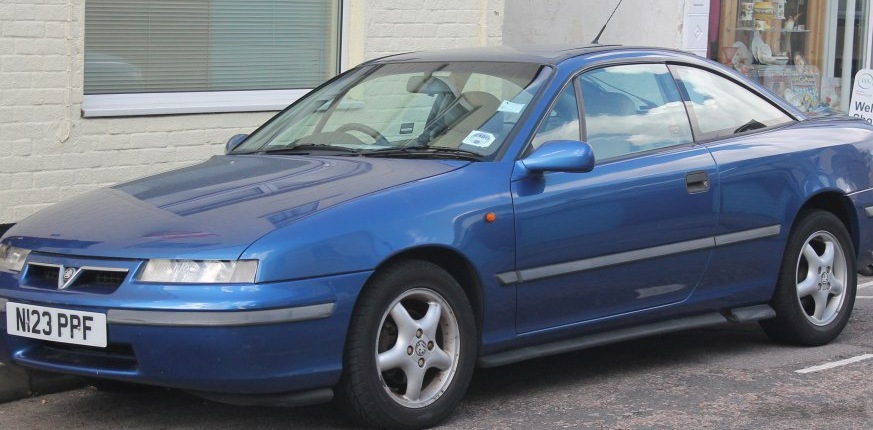
The Vauxhall Calibra 2.0 16V, produced between 1994 and 1997, represented a performance-oriented variant within the Calibra coupe range. Positioned as a step up from the base 1.6 and 1.8 models, it offered a significant increase in power and a more engaging driving experience. The Calibra itself was a distinctive coupe, known for its sleek, aerodynamic design and relatively affordable price point, aiming to attract buyers seeking a sporty and stylish vehicle. It was built on the GM410 platform, shared with the Opel Vectra and Cavalier, and represented Vauxhall’s attempt to capture a segment of the market dominated by rivals like the Ford Escort Cosworth and Mazda MX-6.
Technical Specifications
| Brand | Vauxhall |
| Model | Calibra |
| Generation | Calibra |
| Type (Engine) | 2.0 16V (136 Hp) |
| Start of production | 1994 |
| End of production | 1997 |
| Powertrain Architecture | Internal Combustion engine |
| Body type | Coupe |
| Seats | 4 |
| Doors | 2 |
| Fuel consumption (urban) | 12.5 l/100 km (18.8 US mpg, 22.6 UK mpg, 8 km/l) |
| Fuel consumption (extra urban) | 6.7 l/100 km (35.1 US mpg, 42.2 UK mpg, 14.9 km/l) |
| Fuel consumption (combined) | 8.8 l/100 km (26.7 US mpg, 32.1 UK mpg, 11.4 km/l) |
| CO2 emissions | 208 g/km |
| Fuel Type | Petrol (Gasoline) |
| Acceleration 0 – 60 mph | 8 sec |
| Maximum speed | 214 km/h (132.97 mph) |
| Weight-to-power ratio | 9.3 kg/Hp, 107.5 Hp/tonne |
| Weight-to-torque ratio | 6.7 kg/Nm, 148.6 Nm/tonne |
| Power | 136 Hp @ 5600 rpm |
| Power per litre | 68.1 Hp/l |
| Torque | 188 Nm @ 3200 rpm (138.66 lb.-ft. @ 3200 rpm) |
| Engine layout | Front, Transverse |
| Engine Model/Code | X20XEV |
| Engine displacement | 1998 cm3 (121.93 cu. in.) |
| Number of cylinders | 4 |
| Engine configuration | Inline |
| Cylinder Bore | 86 mm (3.39 in.) |
| Piston Stroke | 86 mm (3.39 in.) |
| Compression ratio | 10.8:1 |
| Number of valves per cylinder | 4 |
| Fuel injection system | Multi-port manifold injection |
| Engine aspiration | Naturally aspirated engine |
| Valvetrain | DOHC |
| Engine oil capacity | 4.5 l (4.76 US qt | 3.96 UK qt) |
| Coolant | 7.2 l (7.61 US qt | 6.34 UK qt) |
| Kerb Weight | 1265 kg (2788.85 lbs.) |
| Max. weight | 1670 kg (3681.72 lbs.) |
| Max load | 405 kg (892.87 lbs.) |
| Fuel tank capacity | 63 l (16.64 US gal | 13.86 UK gal) |
| Permitted trailer load with brakes (12%) | 1350 kg (2976.24 lbs.) |
| Permitted trailer load without brakes | 650 kg (1433 lbs.) |
| Length | 4492 mm (176.85 in.) |
| Width | 1688 mm (66.46 in.) |
| Width including mirrors | 1906 mm (75.04 in.) |
| Height | 1320 mm (51.97 in.) |
| Wheelbase | 2600 mm (102.36 in.) |
| Front overhang | 954 mm (37.56 in.) |
| Rear overhang | 938 mm (36.93 in.) |
| Drag coefficient (Cd) | 0.29 |
| Drivetrain Architecture | The Internal combustion engine (ICE) drives the front wheels of the vehicle. |
| Drive wheel | Front wheel drive |
| Front suspension | Independent type McPherson, Transverse stabilizer |
| Rear suspension | Transverse stabilizer, Trailing arm |
| Front brakes | Ventilated discs, 288 mm |
| Rear brakes | Disc, 270 mm |
| Assisting systems | ABS (Anti-lock braking system) |
| Steering type | Steering rack and pinion |
| Power steering | Hydraulic Steering |
| Tires size | 205/55 R15 |
| Wheel rims size | 6J x 15 |
Powertrain & Engine Architecture
The heart of the Calibra 2.0 16V was the X20XEV engine, a 1998cc inline-four cylinder unit. This engine featured a dual overhead camshaft (DOHC) valvetrain with four valves per cylinder, contributing to its relatively high power output for its displacement. It utilized Bosch Motronic multi-port fuel injection, a system common for the era, providing precise fuel delivery for optimal combustion. The X20XEV was known for its robust construction and relatively straightforward maintenance. The engine was transversely mounted, driving the front wheels. The transmission offered was a four-speed automatic, which, while providing convenience, did impact acceleration compared to the available five-speed manual gearbox.
Driving Characteristics
The 2.0 16V automatic Calibra offered a comfortable and capable driving experience, but wasn’t the most exhilarating. The automatic transmission, while smooth, resulted in a noticeable difference in acceleration compared to the manual version. The 0-60 mph time of around 8 seconds was respectable for the early 1990s, but the engine felt somewhat strained when pushed hard. The gear ratios were tuned for fuel efficiency and cruising comfort rather than outright performance. The front-wheel-drive layout provided predictable handling, although it could exhibit some understeer when pushed to the limits. The suspension, while adequate, wasn’t particularly sporty, prioritizing ride comfort over sharp handling.
Equipment & Trim Levels
The Calibra 2.0 16V typically came with a reasonable level of standard equipment. This included central locking, electric windows, power steering, and an upgraded interior trim compared to the lower-spec models. Optional extras included a sunroof, alloy wheels, and a more sophisticated audio system. Interior upholstery was typically cloth, although leather options were available. The dashboard layout was functional and driver-focused, with clear instrumentation. The Calibra aimed for a balance between affordability and features, offering a step up in refinement without the high price tag of more premium coupes.
Chassis & Braking
The Calibra’s chassis utilized independent McPherson strut suspension at the front and a trailing arm setup at the rear. A transverse stabilizer bar was fitted to both axles to reduce body roll. Braking was handled by ventilated discs at the front and solid discs at the rear. Anti-lock Braking System (ABS) was standard, enhancing safety and control during emergency braking. The suspension setup was tuned for a compromise between comfort and handling, providing a reasonably compliant ride while maintaining acceptable levels of stability. The braking system was adequate for the car’s performance, but lacked the stopping power of more modern systems.
Market Reception & Comparison
The Calibra 2.0 16V was generally well-received by automotive critics, who praised its stylish design and relatively affordable price. However, the automatic transmission was often criticized for detracting from the driving experience. Compared to the manual version, the automatic offered less engaging performance. Fuel economy was reasonable for a coupe of its size and performance, averaging around 26.7 US mpg on combined cycles. Reliability was generally good, although the X20XEV engine was known to be susceptible to oil leaks as it aged. Compared to rivals like the Ford Escort Cosworth, the Calibra offered a more refined and comfortable driving experience, but lacked the ultimate performance of the Cosworth.
Legacy
The Vauxhall Calibra 2.0 16V has developed a cult following among enthusiasts, particularly those who appreciate its distinctive styling and relatively affordable maintenance costs. The X20XEV engine is known for its durability, and many examples are still on the road today. However, finding well-maintained examples can be challenging, as many have suffered from neglect or have been modified. The automatic transmission, while reliable, is not as sought after as the manual version. The Calibra remains a popular choice for classic car enthusiasts and those seeking a stylish and affordable coupe from the 1990s.
