
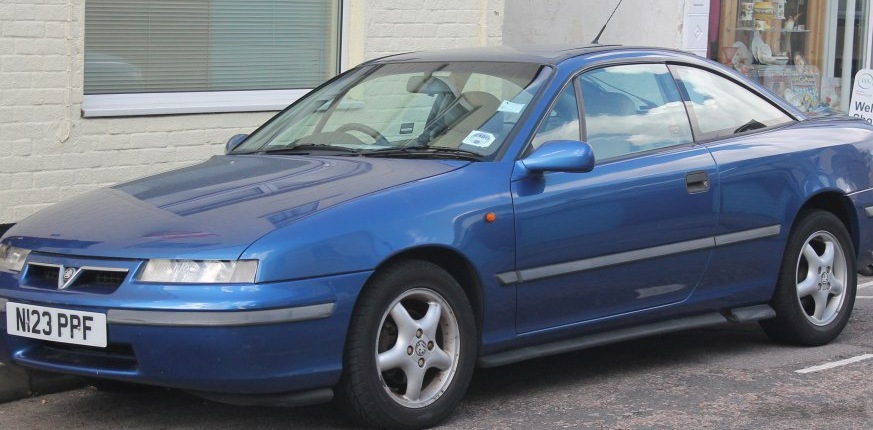
The Vauxhall Calibra 2.0 8V Automatic, produced between 1990 and 1996, represented a mid-range offering within the Calibra coupe lineup. Positioned between the entry-level 1.6-liter models and the performance-oriented 2.0 16V and turbocharged variants, the 2.0 8V Automatic aimed to provide a balance of affordability, comfort, and reasonable performance. It was a key model for Vauxhall in the UK market, appealing to buyers seeking a stylish coupe with the convenience of an automatic transmission. The Calibra itself was a significant vehicle for Vauxhall, representing a departure from more traditional designs and embracing a more aerodynamic and modern aesthetic.
Technical Specifications
| Brand | Vauxhall |
| Model | Calibra |
| Generation | Calibra |
| Type (Engine) | 2.0 8V (115 Hp) Automatic |
| Start of production | 1990 |
| End of production | 1996 |
| Powertrain Architecture | Internal Combustion engine |
| Body type | Coupe |
| Seats | 4 |
| Doors | 2 |
| Fuel consumption (urban) | 11.2 l/100 km (21 US mpg, 25.2 UK mpg, 8.9 km/l) |
| Fuel consumption (extra urban) | 5.8 l/100 km (40.6 US mpg, 48.7 UK mpg, 17.2 km/l) |
| Fuel Type | Petrol (Gasoline) |
| Acceleration 0 – 100 km/h | 12 sec |
| Acceleration 0 – 62 mph | 12 sec |
| Acceleration 0 – 60 mph | 11.4 sec |
| Maximum speed | 200 km/h (124.27 mph) |
| Weight-to-power ratio | 10.8 kg/Hp, 92.7 Hp/tonne |
| Weight-to-torque ratio | 7.3 kg/Nm, 137.1 Nm/tonne |
| Power | 115 Hp @ 5200 rpm |
| Power per litre | 57.6 Hp/l |
| Torque | 170 Nm @ 2600 rpm (125.39 lb.-ft. @ 2600 rpm) |
| Engine layout | Front, Transverse |
| Engine Model/Code | C20NE |
| Engine displacement | 1998 cm3 (121.93 cu. in.) |
| Number of cylinders | 4 |
| Engine configuration | Inline |
| Cylinder Bore | 86 mm (3.39 in.) |
| Piston Stroke | 86 mm (3.39 in.) |
| Compression ratio | 9.2:1 |
| Number of valves per cylinder | 2 |
| Fuel injection system | Multi-port manifold injection |
| Engine aspiration | Naturally aspirated engine |
| Valvetrain | SOHC |
| Engine oil capacity | 4 l (4.23 US qt | 3.52 UK qt) |
| Coolant | 7.4 l (7.82 US qt | 6.51 UK qt) |
| Kerb Weight | 1240 kg (2733.73 lbs.) |
| Max. weight | 1615 kg (3560.47 lbs.) |
| Max load | 375 kg (826.73 lbs.) |
| Trunk (boot) space – minimum | 300 l (10.59 cu. ft.) |
| Trunk (boot) space – maximum | 980 l (34.61 cu. ft.) |
| Max. roof load | 100 kg (220.46 lbs.) |
| Permitted trailer load with brakes (12%) | 1350 kg (2976.24 lbs.) |
| Permitted trailer load without brakes | 580 kg (1278.68 lbs.) |
| Permitted towbar download | 75 kg (165.35 lbs.) |
| Length | 4492 mm (176.85 in.) |
| Width | 1688 mm (66.46 in.) |
| Width including mirrors | 1906 mm (75.04 in.) |
| Height | 1320 mm (51.97 in.) |
| Wheelbase | 2600 mm (102.36 in.) |
| Front overhang | 938 mm (36.93 in.) |
| Rear overhang | 954 mm (37.56 in.) |
| Drag coefficient (Cd) | 0.26 |
| Minimum turning circle | 10.6 m (34.78 ft.) |
| Drivetrain Architecture | ICE to Front Wheels |
| Drive wheel | Front wheel drive |
| Number of gears and type of gearbox | 4 gears, automatic transmission |
| Front suspension | Independent, McPherson with coil spring and anti-roll bar |
| Rear suspension | Transverse stabilizer, Trailing arm |
| Front brakes | Ventilated discs |
| Rear brakes | Disc |
| Assisting systems | ABS (Anti-lock braking system) |
| Steering type | Steering rack and pinion |
| Power steering | Hydraulic Steering |
| Tires size | 195/60 R14; 205/55 R15 |
| Wheel rims size | 5.5J x 14; 6J x 15 |
Powertrain & Engine Architecture
The Calibra 2.0 8V Automatic was powered by the Vauxhall/Opel C20NE engine, a 1998cc inline-four cylinder unit. This engine featured a single overhead camshaft (SOHC) design with two valves per cylinder. The C20NE was a robust and relatively simple engine, known for its durability. Fuel delivery was handled by a multi-port fuel injection system, providing a good balance between efficiency and performance for its time. The engine produced 115 horsepower at 5200 rpm and 170 Nm (125 lb-ft) of torque at 2600 rpm. The automatic transmission was a four-speed unit, designed to provide smooth and convenient gear changes. While not known for its sportiness, it was well-suited to the engine’s torque curve and provided acceptable acceleration.
Driving Characteristics
The 2.0 8V Automatic Calibra offered a comfortable and relaxed driving experience. Acceleration from 0-60 mph took around 11.4 seconds, and top speed was approximately 124 mph. Compared to the manual transmission version of the same engine, the automatic suffered a slight performance penalty due to the inherent losses in the torque converter. However, the automatic transmission made the Calibra more accessible to a wider range of drivers, particularly those who preferred the ease of use in urban environments. The gear ratios were optimized for cruising, making it a capable long-distance vehicle. It didn’t possess the sharp handling of the 16V models, but the suspension provided a comfortable ride without excessive body roll.
Equipment & Trim Levels
The Calibra 2.0 8V Automatic typically came with a reasonable level of standard equipment. This included central locking, electric windows, and a basic stereo system. Interior upholstery was usually cloth, with options for upgraded materials available. Air conditioning was a popular optional extra. Trim levels varied slightly depending on the year and market, but generally, the 2.0 8V Automatic was positioned as a mid-range model, offering more features than the base 1.6-liter versions but lacking the sporty enhancements of the 16V and Turbo models. Alloy wheels were often included as standard or available as an option.
Chassis & Braking
The Calibra utilized a McPherson strut front suspension and a trailing arm rear suspension. The front suspension incorporated an anti-roll bar to reduce body roll during cornering. Braking was provided by ventilated discs at the front and solid discs at the rear. An Anti-lock Braking System (ABS) was standard, enhancing safety by preventing wheel lock-up during hard braking. The chassis was designed to provide a good balance between comfort and handling, prioritizing stability over outright sportiness. The steering was rack and pinion with hydraulic power assistance, offering a light and easy driving experience.
Market Reception & Comparison
The Calibra 2.0 8V Automatic was generally well-received by critics as a stylish and comfortable coupe. It offered a good value proposition for buyers seeking a practical and affordable coupe with the convenience of an automatic transmission. Compared to the more powerful 16V and Turbo models, the 8V Automatic was less focused on performance and more on everyday usability. Fuel economy was reasonable for its class, and the engine proved to be reliable. However, some reviewers noted that the automatic transmission could feel sluggish at times, and the overall driving experience lacked the excitement of the more potent Calibra variants.
Legacy
The C20NE engine, found in the Calibra 2.0 8V Automatic, is known for its longevity and relatively simple maintenance requirements. Many examples are still on the road today, testament to its robust design. The Calibra itself has gained a following among classic car enthusiasts, and well-maintained examples are becoming increasingly collectible. While not the most sought-after Calibra variant, the 2.0 8V Automatic remains a popular choice for those seeking a comfortable and stylish coupe that is relatively affordable to own and maintain. Parts availability is generally good, and the engine is well-understood by mechanics familiar with Vauxhall/Opel vehicles.
