
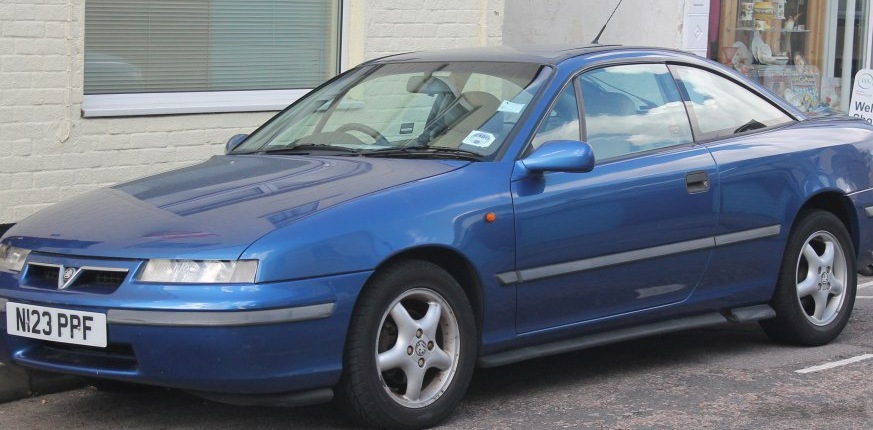
The Vauxhall Calibra 2.0 Turbo 4×4, produced between 1992 and 1997, represented the performance pinnacle of the Calibra range. Positioned as the flagship model, it combined a potent turbocharged engine with all-wheel drive, offering a compelling blend of speed and handling. The Calibra itself was a coupe based on the GM410 platform, shared with the Opel Vectra and Saab 9000, and aimed to provide a more stylish and sporty alternative to traditional family saloons. The 2.0 Turbo 4×4 was a relatively rare variant, appealing to enthusiasts seeking a capable and quick coupe. It was marketed primarily in Europe, where its combination of performance and practicality found a receptive audience.
Technical Specifications
| Brand | Vauxhall |
| Model | Calibra |
| Generation | Calibra |
| Type (Engine) | 2.0 Turbo (204 Hp) 4×4 |
| Start of production | 1992 |
| End of production | 1997 |
| Powertrain Architecture | Internal Combustion engine |
| Body type | Coupe |
| Seats | 4 |
| Doors | 2 |
| Fuel consumption (economy) – urban | 11.6 l/100 km (20.3 US mpg) |
| Fuel consumption (economy) – extra urban | 6.9 l/100 km (34.1 US mpg) |
| Fuel Type | Petrol (Gasoline) |
| Acceleration 0 – 100 km/h | 6.4 sec |
| Acceleration 0 – 62 mph | 6.4 sec |
| Acceleration 0 – 60 mph | 6.1 sec |
| Maximum speed | 245 km/h (152.24 mph) |
| Weight-to-power ratio | 6.7 kg/Hp |
| Weight-to-torque ratio | 4.9 kg/Nm |
| Power | 204 Hp @ 5600 rpm |
| Power per litre | 102.1 Hp/l |
| Torque | 280 Nm @ 2400 rpm (206.52 lb.-ft. @ 2400 rpm) |
| Engine layout | Front, Transverse |
| Engine Model/Code | C20LET |
| Engine displacement | 1998 cm3 (121.93 cu. in.) |
| Number of cylinders | 4 |
| Engine configuration | Inline |
| Cylinder Bore | 86 mm (3.39 in.) |
| Piston Stroke | 86 mm (3.39 in.) |
| Compression ratio | 9:1 |
| Number of valves per cylinder | 4 |
| Fuel injection system | Multi-port manifold injection |
| Engine aspiration | Turbocharger, Intercooler |
| Valvetrain | DOHC |
| Engine oil capacity | 4.5 l (4.76 US qt | 3.96 UK qt) |
| Coolant | 7.2 l (7.61 US qt | 6.34 UK qt) |
| Kerb Weight | 1365 kg (3009.31 lbs.) |
| Max. weight | 1735 kg (3825.02 lbs.) |
| Max load | 370 kg (815.71 lbs.) |
| Trunk (boot) space – minimum | 300 l (10.59 cu. ft.) |
| Trunk (boot) space – maximum | 980 l (34.61 cu. ft.) |
| Fuel tank capacity | 63 l (16.64 US gal | 13.86 UK gal) |
| Max. roof load | 100 kg (220.46 lbs.) |
| Permitted trailer load with brakes (12%) | 1300 kg (2866.01 lbs.) |
| Permitted trailer load without brakes | 580 kg (1278.68 lbs.) |
| Permitted towbar download | 75 kg (165.35 lbs.) |
| Length | 4492 mm (176.85 in.) |
| Width | 1688 mm (66.46 in.) |
| Width including mirrors | 1906 mm (75.04 in.) |
| Height | 1320 mm (51.97 in.) |
| Wheelbase | 2600 mm (102.36 in.) |
| Minimum turning circle | 10.6 m (34.78 ft.) |
| Drivetrain Architecture | All wheel drive (4×4) |
| Number of gears and type of gearbox | 6 gears, manual transmission |
| Front suspension | Independent, type McPherson with coil spring and anti-roll bar |
| Rear suspension | Independent coil spring, Transverse stabilizer, Trailing arm |
| Front brakes | Ventilated discs, 284.48 mm |
| Rear brakes | Disc, 269.24 mm |
| Assisting systems | ABS (Anti-lock braking system) |
| Steering type | Steering rack and pinion |
| Power steering | Hydraulic Steering |
Powertrain & Engine Architecture
The heart of the Calibra 2.0 Turbo 4×4 is the C20LET engine, a 1998cc inline-four cylinder unit. This engine is a derivative of the Family II series, known for its robust construction and tuning potential. The C20LET features a Garrett T25 turbocharger with an intercooler, boosting power output to 204 horsepower at 5600 rpm and 280 Nm (206.52 lb-ft) of torque at 2400 rpm. Fuel delivery is managed by Bosch Motronic multi-port fuel injection. The engine utilizes a dual overhead camshaft (DOHC) valvetrain with four valves per cylinder, contributing to its strong performance across the rev range. The engine is transversely mounted, and power is sent to all four wheels via a six-speed manual transmission. The 4×4 system employs a viscous coupling to distribute torque between the front and rear axles, providing enhanced traction without a permanent mechanical link.
Driving Characteristics
The Calibra 2.0 Turbo 4×4 delivers a noticeably more engaging driving experience than its naturally aspirated counterparts. The turbocharger provides a surge of power in the mid-range, resulting in strong acceleration. The 0-60 mph sprint takes approximately 6.1 seconds, and it can achieve a top speed of 152 mph. The all-wheel drive system significantly improves grip, particularly on slippery surfaces, and allows for confident cornering. The six-speed manual transmission offers precise shifts and helps to keep the engine in its optimal power band. Compared to the 1.8L or 2.0L non-turbo models, the 2.0 Turbo 4×4 feels considerably more responsive and capable. While the turbo lag is present, it’s manageable, and the overall driving experience is rewarding.
Equipment & Trim Levels
The 2.0 Turbo 4×4 was typically well-equipped, reflecting its position as the range-topping model. Standard features included central locking, electric windows, power steering, an anti-lock braking system (ABS), and alloy wheels. Interior appointments typically featured sport seats upholstered in cloth or leather (optional), and a sporty steering wheel. Optional extras included a sunroof, air conditioning, and upgraded audio systems. The dashboard layout is functional and driver-focused, with clear instrumentation. The Calibra’s fastback design provides reasonable rear passenger space for a coupe, although access can be somewhat restricted.
Chassis & Braking
The Calibra 2.0 Turbo 4×4 utilizes an independent suspension setup at all four corners. The front suspension employs McPherson struts with coil springs and an anti-roll bar, while the rear features a multi-link setup with coil springs and a transverse stabilizer. This configuration provides a good balance between ride comfort and handling precision. Braking duties are handled by ventilated discs at the front and solid discs at the rear, providing adequate stopping power. The ABS system enhances braking performance and stability, particularly in emergency situations.
Market Reception & Comparison
The Calibra 2.0 Turbo 4×4 was generally well-received by automotive critics, who praised its performance, handling, and stylish design. However, some criticisms were leveled at its relatively high price compared to other coupes in its class. Compared to the standard 2.0L Calibra, the Turbo 4×4 offered a significant performance upgrade, but at a considerable cost. The 2.0 Turbo 4×4 also offered a more practical alternative to rear-wheel-drive sports cars, providing all-weather capability thanks to its all-wheel-drive system. Fuel economy, while respectable for a performance car of its era, was not a strong point, averaging around 20-34 mpg.
Legacy
The Vauxhall Calibra 2.0 Turbo 4×4 has gained a cult following among enthusiasts. The C20LET engine is known for its durability and potential for modification. While finding well-maintained examples can be challenging, the Calibra 2.0 Turbo 4×4 remains a desirable classic coupe. Common issues include turbocharger wear, oil leaks, and corrosion. However, with proper maintenance, these cars can provide years of reliable performance. Today, the Calibra 2.0 Turbo 4×4 is increasingly sought after by collectors and enthusiasts who appreciate its unique blend of style, performance, and all-wheel-drive capability.
