
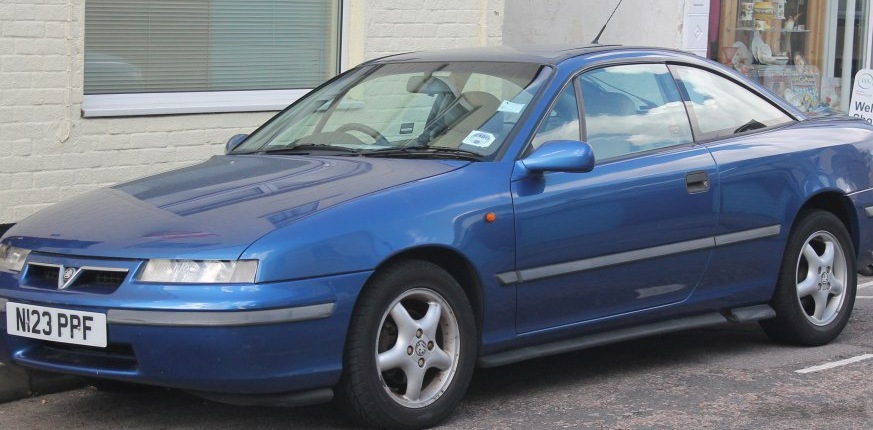
The Vauxhall Calibra 2.5 V6, produced between 1993 and 1997, represented the performance pinnacle of the Calibra coupe range. Positioned as the flagship model, it offered a significant step up in power and driving experience compared to the more economical 1.6 and 2.0-liter variants. The Calibra itself was a distinctive coupe, known for its sleek, aerodynamic design – a product of extensive wind tunnel testing – and was marketed as a stylish and sporty alternative to more conventional family cars. It was a key model for Vauxhall in the early to mid-1990s, appealing to buyers seeking a blend of performance, practicality, and head-turning aesthetics. The Calibra shared its underpinnings with the Opel Vectra A, being part of the GM Omega platform.
Technical Specifications
| Brand | Vauxhall |
| Model | Calibra |
| Generation | Calibra |
| Type (Engine) | 2.5 V6 (170 Hp) |
| Start of production | 1993 |
| End of production | 1997 |
| Powertrain Architecture | Internal Combustion engine |
| Body type | Coupe |
| Seats | 4 |
| Doors | 2 |
| Fuel consumption (urban) | 14.4 l/100 km (16.3 US mpg, 19.6 UK mpg, 6.9 km/l) |
| Fuel consumption (extra urban) | 7.8 l/100 km (30.2 US mpg, 36.2 UK mpg, 12.8 km/l) |
| Fuel consumption (combined) | 10.2 l/100 km (23.1 US mpg, 27.7 UK mpg, 9.8 km/l) |
| CO2 emissions | 241 g/km |
| Fuel Type | Petrol (Gasoline) |
| Acceleration 0 – 100 km/h | 7.3 sec |
| Acceleration 0 – 62 mph | 7.3 sec |
| Acceleration 0 – 60 mph | 6.9 sec |
| Maximum speed | 237 km/h (147.26 mph) |
| Weight-to-power ratio | 8.1 kg/Hp, 124.1 Hp/tonne |
| Weight-to-torque ratio | 6 kg/Nm, 165.7 Nm/tonne |
| Power | 170 Hp @ 6000 rpm |
| Power per litre | 68.1 Hp/l |
| Torque | 227 Nm @ 4200 rpm (167.43 lb.-ft. @ 4200 rpm) |
| Engine layout | Front, Transverse |
| Engine Model/Code | C25XE |
| Engine displacement | 2498 cm3 (152.44 cu. in.) |
| Number of cylinders | 6 |
| Engine configuration | V-engine |
| Cylinder Bore | 81.6 mm (3.21 in.) |
| Piston Stroke | 79.6 mm (3.13 in.) |
| Compression ratio | 10.8:1 |
| Number of valves per cylinder | 4 |
| Fuel injection system | Multi-port manifold injection |
| Engine aspiration | Naturally aspirated engine |
| Valvetrain | DOHC |
| Engine oil capacity | 4.5 l (4.76 US qt | 3.96 UK qt) |
| Coolant capacity | 7.5 l (7.93 US qt | 6.6 UK qt) |
| Kerb Weight | 1370 kg (3020.33 lbs.) |
| Max. weight | 1775 kg (3913.21 lbs.) |
| Max load | 405 kg (892.87 lbs.) |
| Trunk (boot) space – minimum | 300 l (10.59 cu. ft.) |
| Trunk (boot) space – maximum | 980 l (34.61 cu. ft.) |
| Fuel tank capacity | 63 l (16.64 US gal | 13.86 UK gal) |
| Max. roof load | 100 kg (220.46 lbs.) |
| Permitted trailer load with brakes (12%) | 1350 kg (2976.24 lbs.) |
| Permitted trailer load without brakes | 660 kg (1455.05 lbs.) |
| Permitted towbar download | 75 kg (165.35 lbs.) |
| Length | 4492 mm (176.85 in.) |
| Width | 1688 mm (66.46 in.) |
| Width including mirrors | 1906 mm (75.04 in.) |
| Height | 1320 mm (51.97 in.) |
| Wheelbase | 2600 mm (102.36 in.) |
| Front overhang | 938 mm (36.93 in.) |
| Rear overhang | 954 mm (37.56 in.) |
| Drivetrain Architecture | The Internal combustion engine (ICE) drives the front wheels of the vehicle. |
| Drive wheel | Front wheel drive |
| Number of gears and type of gearbox | 5 gears, manual transmission |
| Front suspension | Independent, type McPherson with coil spring and anti-roll bar |
| Rear suspension | Independent coil spring, Transverse stabilizer, Trailing arm |
| Front brakes | Ventilated discs, 288 mm |
| Rear brakes | Disc, 270 mm |
| Assisting systems | ABS (Anti-lock braking system) |
| Steering type | Steering rack and pinion |
| Power steering | Hydraulic Steering |
Powertrain & Engine Architecture
The heart of the Calibra 2.5 V6 is the C25XE engine, a 2.5-liter, 60-degree V6. This engine, part of Vauxhall/Opel’s family of V6s, is notable for its smooth power delivery and relatively high specific output. It features a cast iron block and aluminum cylinder heads, incorporating dual overhead camshafts (DOHC) and four valves per cylinder. Fuel is delivered via multi-port fuel injection, managed by a Bosch Motronic engine control unit. The engine produces 170 horsepower at 6,000 rpm and 227 Nm (167 lb-ft) of torque at 4,200 rpm. The engine’s design prioritized refinement and drivability over outright peak power. The Calibra 2.5 V6 was exclusively offered with a five-speed manual transmission, designed to handle the engine’s torque output.
Driving Characteristics
The Calibra 2.5 V6 offered a distinctly different driving experience compared to the four-cylinder models. The V6 engine provided strong acceleration, dispatching 0-60 mph in around 6.9 seconds and achieving a top speed of 147 mph. The five-speed manual transmission allowed drivers to fully exploit the engine’s powerband. While not a particularly lightweight car, the Calibra’s well-tuned suspension – featuring McPherson struts at the front and a multi-link setup at the rear – provided a good balance between ride comfort and handling. The steering was precise, contributing to a confident feel on winding roads. Compared to the 2.0-liter 16V, the V6 offered significantly more torque, making it more effortless in everyday driving and providing stronger in-gear acceleration.
Equipment & Trim Levels
The Calibra 2.5 V6 was generally well-equipped, reflecting its position as the range-topping model. Standard features typically included central locking, electric windows, power steering, an upgraded stereo system, and alloy wheels. Interior trim was typically cloth upholstery, although leather options were available. Optional extras included a sunroof, air conditioning, and upgraded sound systems. The dashboard layout was functional and driver-focused, with clear instrumentation. The Calibra’s interior, while not luxurious, was well-built and offered a comfortable environment for both driver and passengers.
Chassis & Braking
The Calibra’s chassis was designed to maximize rigidity and minimize weight. The front suspension utilized McPherson struts with coil springs and an anti-roll bar, while the rear featured an independent coil spring setup with a transverse stabilizer and trailing arms. Braking was handled by ventilated discs at the front and solid discs at the rear, assisted by an anti-lock braking system (ABS). The braking system provided adequate stopping power for the car’s performance capabilities. The Calibra’s suspension tuning aimed for a balance between comfort and handling, making it a capable all-rounder.
Market Reception & Comparison
The Calibra 2.5 V6 was generally well-received by automotive critics, who praised its stylish design, strong performance, and comfortable ride. However, some criticized its relatively high price compared to other coupes in its class. Compared to the 2.0-liter models, the V6 offered a significant performance upgrade but came at a higher cost in terms of fuel consumption and insurance. The V6’s fuel economy, averaging around 23 mpg combined, was considerably lower than the 2.0-liter’s 30+ mpg. Reliability was generally good, although the V6 engine required regular maintenance to ensure optimal performance.
Legacy
The Vauxhall Calibra 2.5 V6 has become a sought-after classic car, particularly among enthusiasts who appreciate its distinctive styling and strong performance. The C25XE engine is known for its durability, but regular maintenance is essential to prevent issues such as oil leaks and timing chain wear. Well-maintained examples of the Calibra 2.5 V6 are becoming increasingly rare and are commanding higher prices in the used car market. The Calibra, in general, remains a popular choice for classic car restoration projects, and the 2.5 V6 model is considered the most desirable variant due to its performance and exclusivity.
