
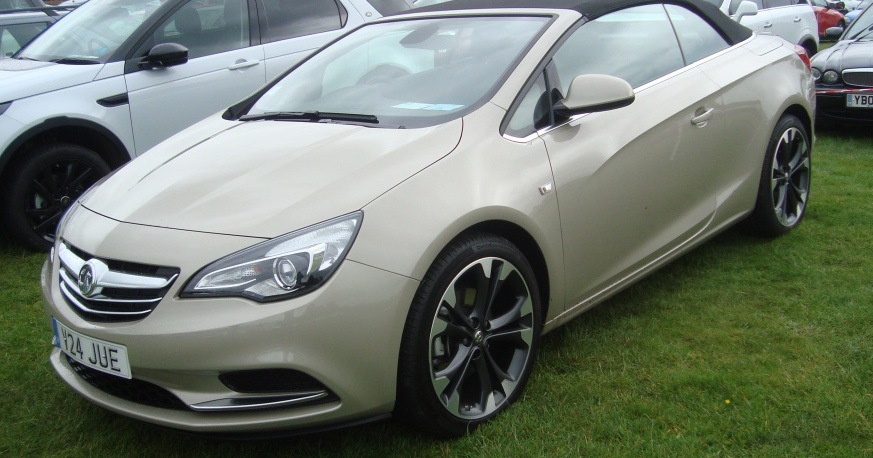
The Vauxhall Cascada 2.0 CDTi (170 hp) was a front-wheel-drive, four-seater convertible produced between 2013 and 2018. Positioned as a mid-range offering within the Cascada lineup, it aimed to provide a balance between fuel efficiency, respectable performance, and comfortable cruising. The Cascada itself was Vauxhall’s entry into the premium mid-size convertible market, competing with vehicles like the Audi A3 Cabriolet and BMW 2 Series Convertible. It was built on the General Motors Delta platform, shared with other vehicles like the Opel Astra and Chevrolet Cruze, but uniquely styled as a folding-roof convertible.
Technical Specifications
| Brand | Vauxhall |
| Model | Cascada |
| Generation | Cascada |
| Type (Engine) | 2.0 CDTi (170 Hp) |
| Start of production | 2013 |
| End of production | 2018 |
| Powertrain Architecture | Internal Combustion engine |
| Body type | Cabriolet |
| Seats | 4 |
| Doors | 2 |
| Fuel consumption (urban) | 6 l/100 km (39.2 US mpg, 47.1 UK mpg, 16.7 km/l) |
| Fuel consumption (extra urban) | 4.2 l/100 km (56 US mpg, 67.3 UK mpg, 23.8 km/l) |
| Fuel consumption (combined) | 4.9 l/100 km (48 US mpg, 57.6 UK mpg, 20.4 km/l) |
| CO2 emissions | 129 g/km |
| Fuel Type | Diesel |
| Maximum speed | 217 km/h (134.84 mph) |
| Emission standard | Euro 6 |
| Power | 170 Hp @ 4000 rpm |
| Power per litre | 86.9 Hp/l |
| Torque | 400 Nm @ 1750-2500 rpm (295.02 lb.-ft. @ 1750-2500 rpm) |
| Engine layout | Front, Transverse |
| Engine Model/Code | B20DTH |
| Engine displacement | 1956 cm3 (119.36 cu. in.) |
| Number of cylinders | 4 |
| Engine configuration | Inline |
| Number of valves per cylinder | 4 |
| Fuel injection system | Diesel Commonrail |
| Engine aspiration | Turbocharger, Intercooler |
| Engine oil capacity | 4.9 l (5.18 US qt, 4.31 UK qt) |
| Trunk (boot) space – minimum | 380 l (13.42 cu. ft.) |
| Trunk (boot) space – maximum | 750 l (26.49 cu. ft.) |
| Fuel tank capacity | 56 l (14.79 US gal, 12.32 UK gal) |
| Length | 4696 mm (184.88 in.) |
| Width | 1839 mm (72.4 in.) |
| Width including mirrors | 2020 mm (79.53 in.) |
| Height | 1443 mm (56.81 in.) |
| Wheelbase | 2695 mm (106.1 in.) |
| Minimum turning circle | 11.8 m (38.71 ft.) |
| Drivetrain Architecture | Front wheel drive |
| Number of gears and type of gearbox | 6 gears, manual transmission |
| Front brakes | Ventilated discs |
| Rear brakes | Disc |
| Assisting systems | ABS (Anti-lock braking system) |
| Steering type | Steering rack and pinion |
| Power steering | Electric Steering |
| Tires size | 245/40 R20 |
| Wheel rims size | 20 |
Powertrain & Engine Architecture
The heart of the Cascada 2.0 CDTi was the B20DTH engine, a 1.956-liter inline-four cylinder diesel. This engine was part of GM’s family of common-rail direct injection diesel engines. It featured a turbocharger with an intercooler to boost power and efficiency. The engine utilized a 16-valve configuration (four valves per cylinder) and was designed to meet stringent Euro 6 emissions standards, incorporating a diesel particulate filter (DPF). The common-rail fuel injection system allowed for precise fuel delivery, optimizing combustion and reducing emissions. The 6-speed manual transmission was the standard offering for this variant, providing drivers with full control over gear selection. The engine’s torque curve was relatively flat, delivering strong pulling power across a wide rev range, making it suitable for both city driving and highway cruising.
Driving Characteristics
The 170 hp 2.0 CDTi engine, paired with the six-speed manual transmission, provided a reasonably engaging driving experience. While not a sports car, the Cascada offered sufficient power for comfortable overtaking and maintaining highway speeds. The manual gearbox allowed for precise control, and the relatively long gearing contributed to good fuel economy. Compared to the lower-powered 1.6-liter petrol variants, the 2.0 CDTi offered significantly more torque, resulting in stronger acceleration, particularly in the mid-range. However, it wasn’t as responsive as some of its competitors with smaller, turbocharged petrol engines. The Cascada’s weight, inherent in a convertible design, did impact overall agility, but the well-tuned suspension provided a comfortable ride.
Equipment & Trim Levels
The Cascada 2.0 CDTi typically came with a good level of standard equipment. This included air conditioning, alloy wheels, a touchscreen infotainment system with Bluetooth connectivity, and electric windows and mirrors. Higher trim levels, such as the Elite and Sport, added features like leather upholstery, heated front seats, a premium sound system, and parking sensors. Optional extras included a panoramic sunroof, adaptive cruise control, and advanced safety features like lane departure warning. Interior upholstery was typically cloth on the base models, with leather options available on higher trims. The dashboard layout was modern and functional, with a focus on ease of use.
Chassis & Braking
The Cascada’s chassis was designed to provide a balance between comfort and handling. It utilized independent suspension at the front, typically a MacPherson strut setup, and a semi-independent torsion beam suspension at the rear. The front brakes were ventilated discs, providing ample stopping power, while the rear brakes were solid discs. Anti-lock Braking System (ABS) was standard, enhancing safety during emergency braking. The steering was electrically assisted, offering a light and precise feel. Stabilizer bars were fitted to both the front and rear axles to reduce body roll during cornering.
Market Reception & Comparison
The Vauxhall Cascada 2.0 CDTi received mixed reviews from automotive critics. It was praised for its comfortable ride, spacious interior, and fuel efficiency. However, some critics found the styling somewhat bland and the handling less engaging than some of its rivals. The 2.0 CDTi engine was generally well-regarded for its torque and economy, but some reviewers noted that it could be a bit noisy compared to some competitors. Compared to the petrol variants, the 2.0 CDTi offered superior fuel economy and torque, making it a popular choice for drivers who prioritized practicality and long-distance cruising. However, the diesel engine did come with a higher purchase price and potential maintenance costs associated with the DPF.
Legacy
The Vauxhall Cascada, including the 2.0 CDTi variant, enjoyed moderate success in the UK and European markets. While it didn’t achieve the sales figures of some of its more established competitors, it offered a compelling alternative for buyers seeking a stylish and comfortable convertible. The B20DTH engine proved to be relatively reliable, although owners should be mindful of the potential for DPF issues, particularly if the vehicle is primarily used for short journeys. On the used car market, the Cascada 2.0 CDTi represents a relatively affordable entry point into the mid-size convertible segment, offering a good balance of features, performance, and fuel economy. Regular maintenance and adherence to manufacturer’s service schedules are crucial for ensuring the long-term reliability of this powertrain.
