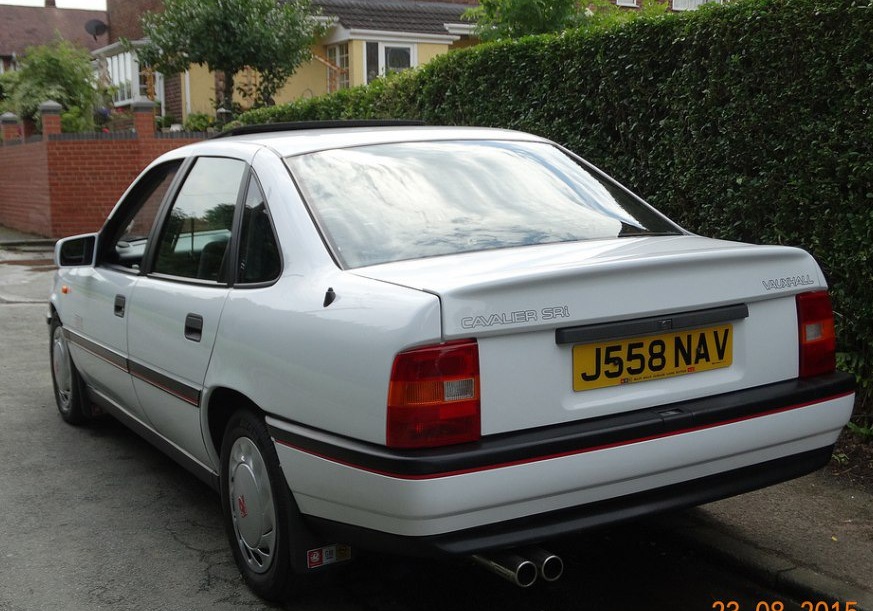
The Vauxhall Cavalier Mk III 1.6i, produced from 1988 to 1989, represented an entry-level offering within the broader Mk III Cavalier range (1988-1995). Positioned as a practical and affordable family saloon, it served as the gateway into the model line, appealing to buyers prioritizing economy and basic transportation. The Mk III Cavalier, built on the GM X platform (internally designated as the 81/82 platform in the UK), was a significant update over its predecessor, offering improved aerodynamics, a more modern interior, and a wider range of engine options. This 1.6i variant, with its 75 horsepower output, was primarily aimed at the cost-conscious consumer.
Technical Specifications
| Brand | Vauxhall |
| Model | Cavalier |
| Generation | Cavalier Mk III |
| Type (Engine) | 1.6i (75 Hp) |
| Start of production | 1988 |
| End of production | 1989 |
| Powertrain Architecture | Internal Combustion engine |
| Body type | Sedan |
| Seats | 5 |
| Doors | 4 |
| Fuel consumption (urban) | 8.9 l/100 km (26.4 US mpg) |
| Fuel consumption (extra urban) | 5.2 l/100 km (45.2 US mpg) |
| Fuel consumption (combined) | 6.8 l/100 km (34.6 US mpg) |
| Fuel Type | Petrol (Gasoline) |
| Acceleration 0 – 100 km/h | 14 sec |
| Acceleration 0 – 62 mph | 14 sec |
| Acceleration 0 – 60 mph | 13.3 sec |
| Maximum speed | 176 km/h (109.36 mph) |
| Weight-to-power ratio | 13.4 kg/Hp |
| Weight-to-torque ratio | 7.9 kg/Nm |
| Power | 75 Hp @ 5200 rpm |
| Torque | 127 Nm @ 2600 rpm (93.67 lb.-ft. @ 2600 rpm) |
| Engine layout | Front, Transverse |
| Engine Model/Code | E16NZ |
| Engine displacement | 1598 cm3 (97.52 cu. in.) |
| Number of cylinders | 4 |
| Engine configuration | Inline |
| Cylinder Bore | 79 mm (3.11 in.) |
| Piston Stroke | 81.5 mm (3.21 in.) |
| Compression ratio | 9.2:1 |
| Number of valves per cylinder | 2 |
| Fuel injection system | Single-point injection |
| Engine aspiration | Naturally aspirated |
| Valvetrain | OHC |
| Engine oil capacity | 3.5 l (3.7 US qt | 3.08 UK qt) |
| Coolant capacity | 5.8 l (6.13 US qt | 5.1 UK qt) |
| Kerb Weight | 1005 kg (2215.65 lbs.) |
| Max. weight | 1550 kg (3417.17 lbs.) |
| Max load | 545 kg (1201.52 lbs.) |
| Trunk (boot) space – minimum | 530 l (18.72 cu. ft.) |
| Trunk (boot) space – maximum | 840 l (29.66 cu. ft.) |
| Fuel tank capacity | 61 l (16.11 US gal | 13.42 UK gal) |
| Length | 4432 mm (174.49 in.) |
| Width | 1706 mm (67.17 in.) |
| Height | 1400 mm (55.12 in.) |
| Wheelbase | 2600 mm (102.36 in.) |
| Front track | 1437 mm (56.57 in.) |
| Rear track | 1432 mm (56.38 in.) |
| Drag coefficient (Cd) | 0.29 |
| Drivetrain Architecture | Front wheel drive |
| Number of gears | 5 |
| Gearbox type | Manual transmission |
| Front suspension | Independent type McPherson |
| Rear suspension | Coil spring |
| Front brakes | Disc |
| Rear brakes | Drum |
| Assisting systems | ABS (Anti-lock braking system) |
| Steering type | Steering rack and pinion |
| Power steering | Hydraulic |
| Tires size | 175/70 R14 |
| Wheel rims size | 14 |
Powertrain & Engine Architecture
The heart of the Cavalier 1.6i was the E16NZ engine, a 1.6-liter inline-four cylinder unit. This engine was part of Vauxhall’s Family I engine series, known for its relatively simple design and durability. The E16NZ featured a single overhead camshaft (OHC) operating two valves per cylinder. Fuel delivery was handled by a single-point fuel injection system, a common feature for vehicles of this era, offering a balance between cost and efficiency. This system, while less sophisticated than multi-point injection, provided improved fuel economy and reduced emissions compared to carbureted engines. The engine produced 75 horsepower at 5200 rpm and 127 Nm (93.67 lb-ft) of torque at 2600 rpm. The engine was transversely mounted, driving the front wheels through a five-speed manual transmission. This configuration was typical for European front-wheel-drive cars of the late 1980s.
Driving Characteristics
The 1.6i automatic Cavalier offered a comfortable, if uninspiring, driving experience. Acceleration was modest, taking around 14 seconds to reach 62 mph. The five-speed manual transmission helped to maximize the engine’s limited power, providing reasonable acceleration and allowing for efficient cruising. The automatic transmission, while offering convenience, noticeably dulled performance. Gear ratios were geared towards economy rather than outright speed. Handling was adequate for everyday driving, with the McPherson strut front suspension providing a decent level of comfort and control. However, it lacked the sharpness and responsiveness of the higher-performance Cavalier variants, such as the 2.0i or the later turbocharged models.
Equipment & Trim Levels
The 1.6i typically represented the base trim level in the Cavalier Mk III range. Standard equipment included central locking, electric front windows, and a basic stereo system. Interior upholstery was typically cloth, with a relatively simple dashboard layout. Optional extras included a sunroof, upgraded stereo systems, and alloy wheels. The interior was functional and durable, prioritizing practicality over luxury. The trim level was often denoted by badging on the rear of the car, though specific features could vary depending on the market and optional packages selected.
Chassis & Braking
The Cavalier Mk III utilized a front-wheel-drive chassis with independent McPherson strut suspension at the front and a coil spring rear suspension. The front brakes were discs, providing adequate stopping power, while the rear brakes were drums, a cost-saving measure common in this segment. Power steering was standard, making maneuvering easier, particularly in urban environments. The suspension was tuned for comfort, providing a relatively smooth ride, although it could feel somewhat soft and wallowy when pushed hard. ABS (Anti-lock Braking System) was available as an option, enhancing safety by preventing wheel lock-up during hard braking.
Market Reception & Comparison
The Cavalier 1.6i was generally well-received as a practical and affordable family car. Critics acknowledged its reasonable fuel economy and comfortable ride, but often noted its lack of performance. Compared to the higher-spec 2.0i models, the 1.6i offered significantly less power and a less engaging driving experience. However, it was considerably cheaper to purchase and run, making it an attractive option for budget-conscious buyers. The 1.6i also offered better fuel economy than the more powerful engines in the range. Compared to rivals like the Ford Sierra and Austin Montego, the Cavalier offered a more modern design and a wider range of features.
Legacy
The E16NZ engine, while not known for its high performance, proved to be a reliable and durable unit. Cavaliers equipped with this engine are still occasionally seen on the roads today, testament to their build quality and longevity. The 1.6i variant remains a relatively affordable classic car, appealing to enthusiasts looking for a simple and reliable vehicle. Parts availability is generally good, although some trim-specific components may be difficult to find. The Cavalier Mk III, in all its variants, played a significant role in the British automotive landscape of the late 1980s and early 1990s, offering a practical and affordable option for families and commuters.