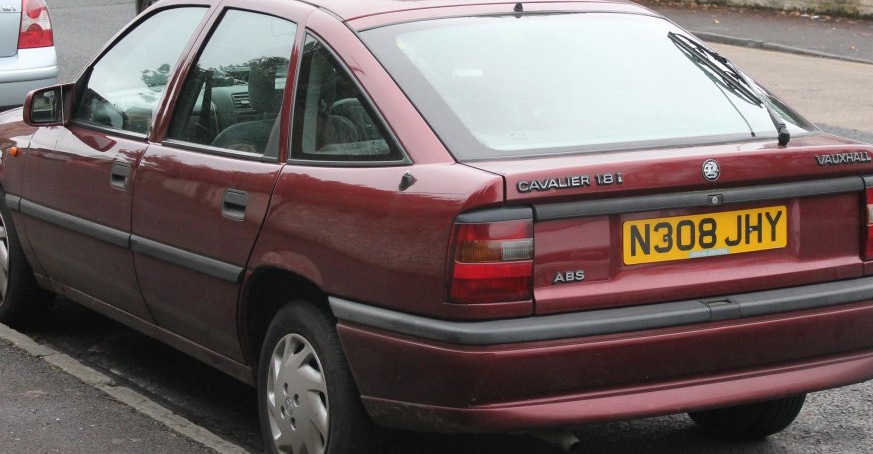
The Vauxhall Cavalier Mk III CC 1.8 (90 hp) was a popular family car produced between 1988 and 1989. Representing the mid-cycle refresh of the Mk III Cavalier, designated the ‘CC’ for ‘Cavalier Coupe’ despite being a five-door hatchback, this variant occupied the entry to mid-level position within the range. It offered a balance of affordability, practicality, and reasonable performance, appealing to buyers seeking a comfortable and economical vehicle. The Mk III Cavalier, built on the GM X platform (internally known as the 1HX0/A3 platform), was a significant model for Vauxhall, representing a move towards more modern design and engineering compared to its predecessors.
Powertrain & Engine Architecture
The heart of the Cavalier Mk III CC 1.8 (90 hp) was the 18SV inline-four cylinder gasoline engine, displacing 1796 cc (109.6 cubic inches). This engine was a naturally aspirated unit featuring a single overhead camshaft (OHC) valvetrain with two valves per cylinder. The 18SV utilized multi-port fuel injection, a relatively advanced feature for its time, contributing to improved fuel efficiency and smoother power delivery. The engine produced a maximum power output of 90 horsepower at 5400 rpm and 145 Nm (106.95 lb-ft) of torque at 3000 rpm. The compression ratio was set at 9.2:1. Engine oil capacity was 4 liters (4.23 US quarts / 3.52 UK quarts) and coolant capacity was 7 liters (7.4 US quarts / 6.16 UK quarts).
Crucially, this specific variant was typically paired with a three-speed automatic transmission. This transmission, while offering convenience, was a key differentiator from the more common five-speed manual gearbox available with other 1.8L engines and higher-performance models. The automatic transmission was designed for smooth operation and ease of use, prioritizing comfort over outright performance. The transmission’s gear ratios were optimized for fuel economy and everyday driving conditions.
Engine Code & Variations
While the 18SV designation is the most common, slight variations in engine codes existed depending on the specific production date and market. These variations generally related to minor emissions control equipment differences. However, the core engine architecture and performance characteristics remained largely consistent.
Driving Characteristics
The Cavalier Mk III CC 1.8 (90 hp) with the automatic transmission offered a comfortable, if not particularly exhilarating, driving experience. Acceleration from 0 to 60 mph took approximately 11.9 seconds, and 0-100 km/h was achieved in 12.5 seconds. The top speed was around 113.71 mph (183 km/h). The automatic transmission, while convenient, did detract from the engine’s potential. Compared to the five-speed manual version of the 1.8L engine, the automatic resulted in slightly slower acceleration and a less engaging driving experience. The power delivery was relatively linear, with usable torque available from lower engine speeds, making it suitable for urban driving and highway cruising. However, overtaking maneuvers required careful planning due to the engine’s modest power output.
The steering was light and precise, thanks to the hydraulic power steering system. The McPherson strut front suspension and coil spring rear suspension provided a reasonably comfortable ride, although it wasn’t as refined as some of its more expensive competitors. The weight-to-power ratio of 11.9 kg/hp and weight-to-torque ratio of 7.4 kg/Nm reflected the car’s moderate performance capabilities.
Equipment & Trim Levels
The Cavalier Mk III CC 1.8 (90 hp) automatic typically came with a reasonable level of standard equipment. This included central locking, electric front windows, and a basic stereo system. Interior upholstery was typically cloth, with a durable and practical finish. The dashboard layout was functional and straightforward, with clearly labeled controls. Optional extras included a sunroof, upgraded stereo systems, and alloy wheels. Higher trim levels, such as the ‘GL’ or ‘GSi’ (though the GSi typically featured more powerful engines), offered additional features like upgraded interior trim, more sophisticated audio systems, and exterior enhancements.
Chassis & Braking
The Cavalier Mk III CC featured a front-wheel-drive layout. The front suspension utilized independent McPherson struts with coil springs and an anti-roll bar, providing a good balance of ride comfort and handling. The rear suspension employed a simpler coil spring setup. Braking was provided by ventilated discs on the front wheels and discs on the rear wheels. An Anti-lock Braking System (ABS) was often included as standard equipment, enhancing safety and control during emergency braking situations. The car rode on 175/70 R14 tires mounted on 14-inch steel wheels, although alloy wheels were available as an option.
Market Reception & Comparison
The Cavalier Mk III CC 1.8 (90 hp) automatic was generally well-received by critics as a practical and affordable family car. It was praised for its comfortable ride, spacious interior, and reasonable fuel economy. Fuel consumption figures were approximately 10.5 l/100 km (22.4 US mpg / 26.9 UK mpg) in urban conditions, 5.9 l/100 km (39.9 US mpg / 47.9 UK mpg) on the extra-urban cycle, and 7.4 l/100 km (31.8 US mpg / 38.2 UK mpg) combined. However, it was often criticized for its lack of outright performance, particularly when compared to the more powerful 2.0L and V6 models. Compared to the 1.9 TDI diesel variant, the 1.8L offered less torque but a smoother and quieter driving experience. The automatic transmission, while convenient, was seen as a compromise in terms of performance and fuel efficiency compared to the manual gearbox.
Technical Specifications
| Brand | Vauxhall |
| Model | Cavalier |
| Generation | Cavalier Mk III CC |
| Type (Engine) | 1.8 (90 Hp) |
| Start of production | 1988 |
| End of production | 1989 |
| Body type | Hatchback |
| Seats | 5 |
| Doors | 5 |
| Fuel consumption (urban) | 10.5 l/100 km (22.4 US mpg / 26.9 UK mpg) |
| Fuel consumption (extra urban) | 5.9 l/100 km (39.9 US mpg / 47.9 UK mpg) |
| Fuel consumption (combined) | 7.4 l/100 km (31.8 US mpg / 38.2 UK mpg) |
| Fuel Type | Petrol (Gasoline) |
| Acceleration 0 – 100 km/h | 12.5 sec |
| Acceleration 0 – 62 mph | 12.5 sec |
| Acceleration 0 – 60 mph | 11.9 sec |
| Maximum speed | 183 km/h (113.71 mph) |
| Power | 90 Hp @ 5400 rpm |
| Torque | 145 Nm @ 3000 rpm (106.95 lb.-ft. @ 3000 rpm) |
| Engine layout | Front, Transverse |
| Engine Model/Code | 18SV |
| Engine displacement | 1796 cm3 (109.6 cu. in.) |
| Number of cylinders | 4 |
| Cylinder Bore | 84.8 mm (3.34 in.) |
| Piston Stroke | 79.5 mm (3.13 in.) |
| Compression ratio | 9.2:1 |
| Kerb Weight | 1075 kg (2369.97 lbs.) |
| Max. weight | 1610 kg (3549.44 lbs.) |
| Trunk (boot) space (minimum) | 460 l (16.24 cu. ft.) |
| Trunk (boot) space (maximum) | 1290 l (45.56 cu. ft.) |
| Fuel tank capacity | 61 l (16.11 US gal / 13.42 UK gal) |
| Length | 4352 mm (171.34 in.) |
| Width | 1706 mm (67.17 in.) |
| Height | 1400 mm (55.12 in.) |
Legacy
The Cavalier Mk III CC 1.8 (90 hp) automatic, while not the most sought-after variant, remains a relatively common sight on the used car market. The 18SV engine, when properly maintained, is known for its reliability. However, age-related issues such as corrosion and wear and tear on the automatic transmission are common concerns. Parts availability is generally good, thanks to the Cavalier’s popularity during its production run. Today, these cars are often appreciated by enthusiasts for their affordability, simplicity, and nostalgic appeal. They represent a significant era in British automotive history and offer a glimpse into the family cars of the late 1980s.