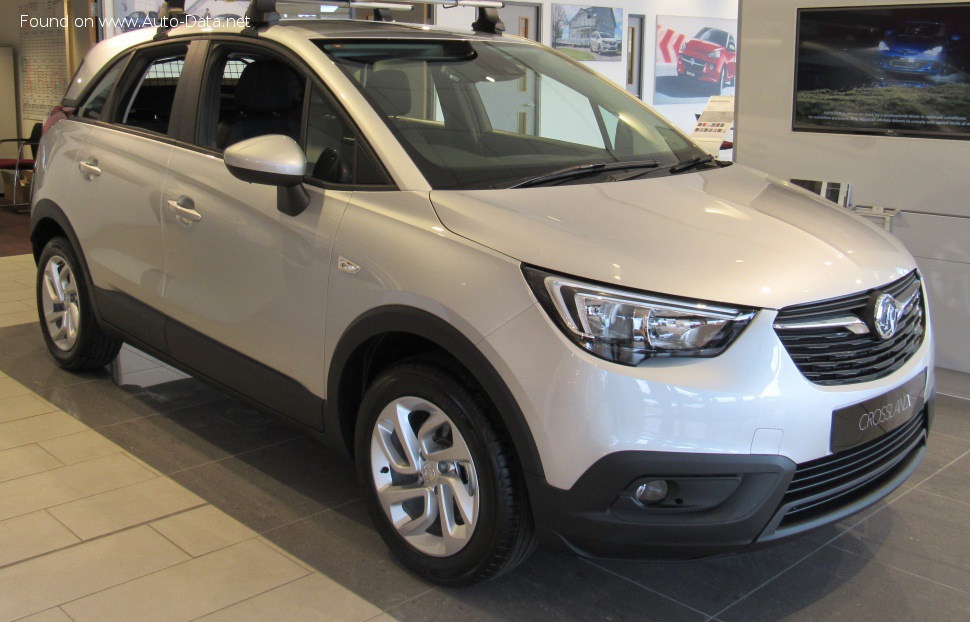
The Vauxhall Crossland, a compact crossover SUV, received a significant refresh in October 2020, dropping the “X” from its name and adopting a more assertive design language. This facelifted model, particularly the 1.2 Turbo (130 Hp) Automatic variant, represents Vauxhall’s continued commitment to the highly competitive European and UK B-segment SUV market. As a brand primarily focused on the United Kingdom, Vauxhall operates as a sister marque to Opel, sharing platforms and powertrains across many of its models. The Crossland, therefore, is a rebadged version of the Opel Crossland, tailored for the British market.
The 2020 Vauxhall Crossland 1.2 Turbo Automatic: Positioning and Overview
Positioned as a practical and versatile family vehicle, the 2020 Vauxhall Crossland facelift aimed to enhance its visual appeal, refine its driving dynamics, and integrate updated technology, all while retaining its core strengths of spaciousness and efficiency. This particular iteration, equipped with a potent yet economical 1.2-liter turbocharged gasoline engine and a smooth automatic transmission, offered a compelling package for urban commuters and small families seeking a blend of SUV practicality and hatchback maneuverability. It occupied a mid-range position within the Crossland lineup, offering a step up in performance and refinement from the base models while remaining more accessible than the higher-specification trims.
Powertrain & Engine Architecture
At the heart of this specific Vauxhall Crossland variant lies a sophisticated 1.2-liter (1199 cm3 or 73.17 cu. in.) F12XHT inline three-cylinder engine. This powerplant benefits from a turbocharger and intercooler, ensuring robust performance despite its relatively small displacement. The engine utilizes a DOHC (Double Overhead Camshaft) valvetrain with four valves per cylinder and a multi-port manifold injection system, optimized for efficiency and power delivery. It generates a respectable 130 horsepower at 5500 revolutions per minute (rpm), making it one of the more powerful options in the Crossland lineup.
More significantly, the engine produces a healthy 169.64 lb.-ft. (230 Nm) of torque, which is available from a low 1750 rpm. This broad torque band is crucial for a vehicle of this type, providing excellent responsiveness in city driving and ample power for highway cruising without constant downshifting. The power is efficiently managed by a 6-speed automatic transmission, which directs power to the front wheels. This front-wheel-drive architecture is typical for compact crossovers, prioritizing fuel economy and ease of use. The transmission itself is a conventional torque converter automatic, chosen for its smoothness and reliability, rather than a more complex dual-clutch system.
Engine Code and Fuel System
The F12XHT engine code designates a specific iteration of Vauxhall/Opel’s small displacement turbocharged gasoline engine family. The multi-port fuel injection system, while not as advanced as direct injection, provides a good balance of cost-effectiveness and efficiency. The engine is designed to meet stringent Euro 6d emission standards, incorporating a Start & Stop System and a particulate filter to minimize its environmental footprint.
Driving Characteristics
The Vauxhall Crossland 1.2 Turbo (130 Hp) Automatic delivers a comfortable and refined driving experience. While not a sports-oriented vehicle, the engine’s torque availability at low RPMs makes it feel responsive in everyday driving situations. Acceleration from 0 to 60 miles per hour takes a competitive 9.9 seconds, and its maximum speed is rated at 123.03 mph (198 km/h). Compared to the lower-powered 1.2-liter versions, the 130 hp variant offers noticeably improved performance, particularly when fully loaded or tackling inclines. Compared to a manual transmission equipped Crossland, the automatic provides a smoother, more effortless driving experience, but at the expense of some driver engagement and potentially slightly lower fuel economy.
The 6-speed automatic transmission is well-matched to the engine’s characteristics. Gear changes are generally smooth and unobtrusive. The transmission’s programming prioritizes fuel efficiency, meaning it will upshift quickly to maintain optimal engine speed. However, it will readily downshift when more power is needed, such as during overtaking maneuvers. The overall driving experience is geared towards comfort and ease of use, making it well-suited for urban environments and long-distance cruising.
Equipment & Trim Levels
The 2020 Vauxhall Crossland 1.2 Turbo Automatic typically came equipped with a respectable level of standard features. These generally included air conditioning, a touchscreen infotainment system with Apple CarPlay and Android Auto compatibility, Bluetooth connectivity, cruise control, and electric windows and mirrors. Safety features such as ABS, ESP (Electronic Stability Program), and multiple airbags were also standard. Interior upholstery was typically cloth, with options for upgraded materials available on higher trim levels.
Optional extras included features such as a panoramic sunroof, heated seats, parking sensors, a rear-view camera, and upgraded alloy wheels. Trim levels above the base model often added features like automatic headlights and rain-sensing wipers. The dashboard configuration was generally straightforward and user-friendly, with a focus on practicality and ease of use.
Chassis & Braking
The Crossland’s chassis setup is designed for comfort and predictable handling. It features an independent McPherson strut front suspension with coil springs and an anti-roll bar, providing good stability and ride quality. The rear suspension utilizes a dependent spring suspension, a common and cost-effective solution for compact vehicles, balancing ride comfort with cargo capacity. Braking performance is handled by ventilated discs at the front (283 mm) and solid discs at the rear (249 mm), complemented by an Anti-lock Braking System (ABS) for enhanced safety during emergency stops. The steering system is an electric power-assisted rack and pinion setup, offering light and precise control, particularly beneficial for parking and maneuvering in tight spaces. The minimum turning circle is 36.78 feet (11.21 m), further aiding urban agility.
Market Reception & Comparison
Critics generally viewed the 1.2 Turbo Automatic Crossland favorably, praising its comfortable ride, spacious interior, and fuel efficiency. The engine was considered a good compromise between performance and economy, and the automatic transmission provided a smooth and effortless driving experience. However, some reviewers noted that the interior materials were not as premium as those found in some competitors.
Compared to other trims in the Crossland lineup, the 1.2 Turbo Automatic offered a noticeable performance upgrade over the lower-powered engines. Fuel economy was comparable to the manual transmission versions, with a slight penalty for the convenience of the automatic. In terms of reliability, the F12XHT engine has generally proven to be a robust and dependable unit, although regular maintenance is essential. Compared to rivals like the Nissan Juke and Renault Captur, the Crossland offered a more spacious interior and a more comfortable ride, but lacked the sporty styling of the Juke.
Technical Specifications
| Category | Specification |
| General Information | |
| Brand | Vauxhall |
| Model | Crossland |
| Generation | Crossland (facelift 2020) |
| Engine Type | 1.2 Turbo (130 Hp) Automatic |
| Start of Production | October, 2020 |
| Powertrain Architecture | Internal Combustion Engine |
| Body Type | SUV |
| Seats | 5 |
| Doors | 5 |
| Performance Specifications | |
| Combined Fuel Consumption (WLTP) | 6.1-6.2 l/100 km (38.6 – 37.9 US mpg) |
| CO2 Emissions (WLTP) | 137-139 g/km |
| Fuel Type | Petrol (Gasoline) |
| Acceleration 0 – 60 mph | 9.9 sec |
| Maximum Speed | 123.03 mph (198 km/h) |
| Emission Standard | Euro 6d |
| Engine Specifications | |
| Power | 130 Hp @ 5500 rpm |
| Power per liter | 108.4 Hp/l |
| Torque | 169.64 lb.-ft. (230 Nm) @ 1750 rpm |
| Engine Layout | Front, Transverse |
| Engine Model/Code | F12XHT |
| Engine Displacement | 1199 cm3 (73.17 cu. in.) |
| Number of Cylinders | 3 Inline |
| Number of Valves per Cylinder | 4 |
| Fuel Injection System | Multi-port manifold injection |
| Engine Aspiration | Turbocharger, Intercooler |
| Valvetrain | DOHC |
| Engine Oil Capacity | 3.7 US qt (3.5 l) |
| Engine Oil Specification | Not specified |
| Coolant Capacity | 6.02 US qt (5.7 l) |
| Engine Systems | Start & Stop System, Particulate filter |
| Space, Volume and Weights | |
| Max. Weight (Gross Vehicle Weight) | 4045.48 lbs. (1835 kg) |
| Trunk (Boot) Space – minimum | 14.48 cu. ft. (410 l) |
| Trunk (Boot) Space – maximum | 44.32 cu. ft. (1255 l) |
| Fuel Tank Capacity | 11.89 US gal (45 l) |
| Permitted Trailer Load with Brakes (12%) | 1851.88 lbs. (840 kg) |
| Permitted Trailer Load without Brakes | 1322.77 lbs. (600 kg) |
| Dimensions | |
| Length | 165.83 in. (4212 mm) |
| Width | 69.49 in. (1765 mm) |
| Width including mirrors | 77.8 in. (1976 mm) |
| Height | 63.19 in. (1605 mm) |
| Wheelbase | 102.52 in. (2604 mm) |
| Front Overhang | 35.28 in. (896 mm) |
| Rear Overhang | 28.03 in. (712 mm) |
| Drag Coefficient (Cd) | 0.31 |
| Minimum Turning Circle (Turning Diameter) | 36.78 ft. (11.21 m) |
| Drivetrain, Brakes and Suspension Specifications | |
| Drivetrain Architecture | The Internal combustion engine (ICE) drives the front wheels of the vehicle. |
| Drive Wheel | Front wheel drive |
| Number of Gears and Type of Gearbox | 6 gears, automatic transmission |
| Front Suspension | Independent, type McPherson with coil spring and anti-roll bar |
| Rear Suspension | Dependent spring suspension |
| Front Brakes | Ventilated discs, 283 mm |
| Rear Brakes | Disc, 249 mm |
| Assisting Systems | ABS (Anti-lock braking system) |
| Steering Type | Steering rack and pinion |
| Power Steering | Electric Steering |
| Tires Size | 195/60 R16; 215/50 R17 |
| Wheel Rims Size | 16; 17 |
Legacy
The Vauxhall Crossland, particularly after its 2020 facelift, holds a significant position within the crowded European and UK compact SUV segment. It competes directly with popular models such as the Nissan Juke, Renault Captur, Ford Puma, Volkswagen T-Cross, and its platform sibling, the Peugeot 2008. In a market increasingly favoring crossovers over traditional hatchbacks, the Crossland provided Vauxhall with a crucial offering for customers seeking elevated driving positions, versatile interiors, and a rugged aesthetic without the larger footprint or higher running costs of a full-size SUV. The 1.2 Turbo Automatic powertrain has proven to be relatively reliable, with few widespread issues reported. On the used car market, these models represent a good value proposition for buyers seeking a practical and economical family vehicle. Regular maintenance, including oil changes and timing belt replacements (where applicable), is crucial for ensuring long-term reliability.