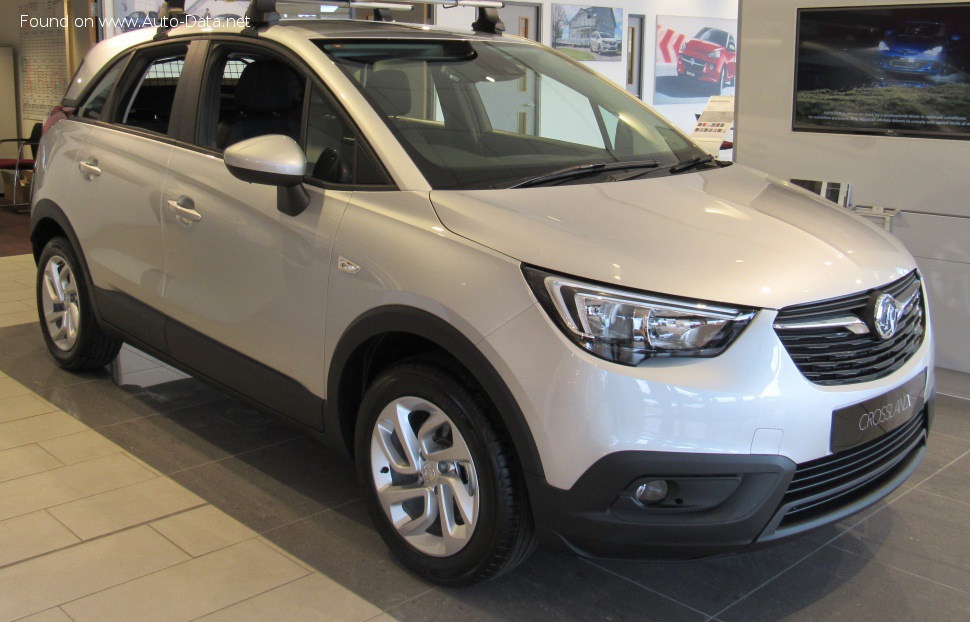
The Vauxhall Crossland X 1.2 Turbo (110 Hp) Automatic represents a significant entry in the burgeoning subcompact SUV (or crossover) segment, primarily targeting the European market. Introduced in June 2017, the Crossland X, a rebadged version of the Opel Crossland X for the United Kingdom, marked Vauxhall’s strategic shift towards more SUV-oriented offerings. This particular variant, equipped with a 1.2-liter turbocharged engine and an automatic transmission, was positioned as a practical, efficient, and versatile vehicle designed to navigate the demands of urban living while offering sufficient capability for longer journeys. It competed in a fiercely contested segment, emphasizing practicality, connectivity, and a raised driving position over rugged off-road prowess, aligning with the preferences of modern European consumers. The Crossland X generation was developed under Opel’s (and thus Vauxhall’s) partnership with PSA Group (now Stellantis) before the full acquisition, sharing its platform with vehicles like the Citroën C3 Aircross and Peugeot 2008. This collaboration allowed Vauxhall to quickly expand its SUV lineup, sitting below the larger Grandland X and offering a more family-friendly alternative to the Mokka X. Its production run for this specific 1.2 Turbo (110 Hp) Automatic variant spanned from June 2017 to May 2018, establishing its initial footprint in a crucial market segment.
Powertrain & Engine Architecture
At the heart of the Vauxhall Crossland X 1.2 Turbo (110 Hp) Automatic lies a compact yet potent 1.2-liter (1199 cm3 or 73.17 cu. in.) inline three-cylinder engine, designated with the B12XHL code. This powerplant is a testament to modern engine downsizing, employing direct injection and a turbocharger with an intercooler to deliver a respectable 110 horsepower at 5500 rpm. The specific power output of 91.7 horsepower per liter highlights its efficiency and advanced engineering for its class. This engine falls into the category of a downsized, turbocharged gasoline engine, a trend increasingly common in the automotive industry to balance performance with fuel economy and emissions regulations.
More crucial for daily driving, especially in urban environments, is the engine’s torque output. It generates a robust 205 Nm (151.2 lb.-ft.) available from a low 1500 rpm. This broad torque band ensures responsive acceleration from a standstill and flexible in-gear performance, reducing the need for frequent downshifts and enhancing the driving experience. The engine’s front, transverse layout contributes to efficient packaging and maximizes interior space. The B12XHL engine utilizes a timing chain, reducing the need for periodic belt replacements common in older engine designs. The direct injection system precisely meters fuel into the cylinders, optimizing combustion and reducing emissions.
Power is delivered to the front wheels via a smooth-shifting 6-speed automatic transmission. This transmission, sourced from Aisin Seiki, is known for its reliability and smooth operation. It features a torque converter for smooth launches and low-speed driving, and electronically controlled gear changes for optimal efficiency. The drivetrain architecture is straightforward front-wheel drive, consistent with its urban crossover role rather than an off-road utility vehicle. The automatic transmission was specifically chosen to appeal to drivers prioritizing convenience and ease of use, particularly in congested urban environments.
Driving Characteristics
The Vauxhall Crossland X 1.2 Turbo (110 Hp) Automatic offers a driving experience geared towards comfort and practicality rather than outright performance. With 110 horsepower and 151.2 lb-ft of torque, acceleration is adequate for everyday driving, but it won’t provide the briskness of higher-powered variants. The 0-60 mph time is estimated to be around 11.5 seconds. The 6-speed automatic transmission is tuned for fuel efficiency, often upshifting quickly to maintain lower engine speeds. This can sometimes result in a slight hesitation when requesting sudden acceleration, such as when overtaking on a highway.
Compared to a manual transmission version of the same engine, the automatic offers a smoother, more effortless driving experience, particularly in stop-and-go traffic. However, it does come with a slight penalty in fuel economy and a less engaging driving feel. The gear ratios are optimized for everyday driving conditions, with a relatively tall final drive to improve fuel efficiency. The suspension is tuned for comfort, absorbing bumps and imperfections in the road well, but this can also result in some body roll during cornering. Overall, the driving characteristics of this variant are best described as relaxed and refined, making it a suitable choice for drivers who prioritize comfort and convenience over sporty handling.
Equipment & Trim Levels
The Crossland X 1.2 Turbo (110 Hp) Automatic was typically offered in several trim levels, including Energy, Design, and Elite. The base Energy trim included standard features such as air conditioning, a touchscreen infotainment system with Bluetooth connectivity, electric front windows, and remote central locking. The Design trim added features like alloy wheels, cruise control, a leather-wrapped steering wheel, and front fog lights. The top-of-the-line Elite trim included features such as heated front seats, rear parking sensors, a panoramic sunroof, and advanced safety features like lane departure warning and automatic emergency braking.
Interior upholstery varied depending on the trim level, with base models featuring cloth seats and higher trims offering leather or partial leather options. The dashboard configuration was generally consistent across all trims, featuring a clean and modern design with intuitive controls. Optional extras available for this trim included a navigation system, a premium sound system, and a rear-view camera. The Crossland X prioritized practicality, with numerous storage compartments throughout the cabin and a versatile rear seating arrangement that could be folded down to increase cargo space.
Chassis & Braking
The Vauxhall Crossland X utilizes a front-wheel-drive chassis with a MacPherson strut suspension at the front and a torsion beam suspension at the rear. This suspension setup provides a good balance of comfort and handling, suitable for everyday driving conditions. The torsion beam rear suspension is a cost-effective solution that minimizes weight and complexity. The steering system is an electric power-assisted steering (EPAS) system, providing light and precise steering feel. The EPAS system adjusts the level of assistance based on vehicle speed, providing more assistance at low speeds for easier maneuvering and less assistance at high speeds for improved stability.
The braking system consists of ventilated disc brakes at the front and solid disc brakes at the rear. The Anti-lock Braking System (ABS) with Electronic Stability Program (ESP) is standard, providing enhanced braking performance and stability in emergency situations. The brake discs are sized appropriately for the vehicle’s weight and performance, providing adequate stopping power. The Crossland X’s chassis and braking system are designed to provide a safe and comfortable driving experience, prioritizing stability and control over sporty handling.
Market Reception & Comparison
Critics generally viewed the Vauxhall Crossland X 1.2 Turbo (110 Hp) Automatic as a practical and well-rounded subcompact SUV. It was praised for its spacious interior, comfortable ride, and efficient engine. However, some critics noted that the engine could feel underpowered when fully loaded or when driving uphill. Compared to other trims in the lineup, the 1.2 Turbo Automatic offered a good balance of performance and fuel economy, making it a popular choice for drivers who prioritized convenience and efficiency. The higher-powered 1.6-liter diesel engine offered more performance but came with a higher price tag and potentially higher running costs.
In terms of fuel economy, the 1.2 Turbo Automatic achieved competitive figures for its segment, averaging around 43.6 US mpg (5.4 l/100 km). Its reliability was generally considered to be good, with few reported issues. However, like all modern vehicles, it is important to follow the manufacturer’s recommended maintenance schedule to ensure long-term reliability. Compared to rivals like the Nissan Juke and Renault Captur, the Crossland X offered a more spacious interior and a more comfortable ride, but it lacked the sporty styling of the Juke.
Technical Specifications
| Category | Specification |
| Brand | Vauxhall |
| Model | Crossland |
| Generation | Crossland X |
| Type (Engine) | 1.2 Turbo (110 Hp) Automatic |
| Start of Production | June, 2017 |
| End of Production | May, 2018 |
| Powertrain Architecture | Internal Combustion engine |
| Body Type | SUV |
| Seats | 5 |
| Doors | 5 |
| Fuel Consumption (Economy) – Urban | 6.5 l/100 km (36.2 US mpg) |
| Fuel Consumption (Economy) – Extra Urban | 4.8 l/100 km (49 US mpg) |
| Fuel Consumption (Economy) – Combined | 5.4 l/100 km (43.6 US mpg) |
| CO2 Emissions | 123 g/km |
| Fuel Type | Petrol (Gasoline) |
| Maximum Speed | 187 km/h (116.2 mph) |
| Emission Standard | Euro 6 |
| Power | 110 Hp @ 5500 rpm |
| Power per Liter | 91.7 Hp/l |
| Torque | 205 Nm @ 1500 rpm (151.2 lb.-ft. @ 1500 rpm) |
| Engine Layout | Front, Transverse |
| Engine Model/Code | B12XHL |
| Engine Displacement | 1199 cm3 (73.17 cu. in.) |
| Number of Cylinders | 3 |
| Engine Configuration | Inline |
| Number of Valves per Cylinder | 4 |
| Fuel Injection System | Direct injection |
| Engine Aspiration | Turbocharger, Intercooler |
| Trunk (Boot) Space – Minimum | 410 l (14.48 cu. ft.) |
| Trunk (Boot) Space – Maximum | 1255 l (44.32 cu. ft.) |
| Fuel Tank Capacity | 45 l (11.89 US gal) |
| Length | 4212 mm (165.83 in.) |
| Width | 1765 mm (69.49 in.) |
| Width Including Mirrors | 1976 mm (77.8 in.) |
| Height | 1605 mm (63.19 in.) |
| Wheelbase | 2604 mm (102.52 in.) |
| Number of Gears and Type of Gearbox | 6 gears, automatic transmission |
Legacy
The Vauxhall Crossland X 1.2 Turbo (110 Hp) Automatic, while not a long-lived variant, has established a reasonable reputation for reliability in the used car market. The B12XHL engine, when properly maintained, is known to be a durable and efficient powerplant. The Aisin Seiki 6-speed automatic transmission is also considered to be reliable. Common issues reported by owners include occasional problems with the infotainment system and minor electrical glitches, but these are generally not major concerns. Today, these vehicles represent a relatively affordable entry point into the subcompact SUV segment, offering a practical and fuel-efficient option for budget-conscious buyers. Its legacy is that of a sensible and dependable urban crossover that provided a valuable option for families and individuals seeking a versatile and affordable vehicle.