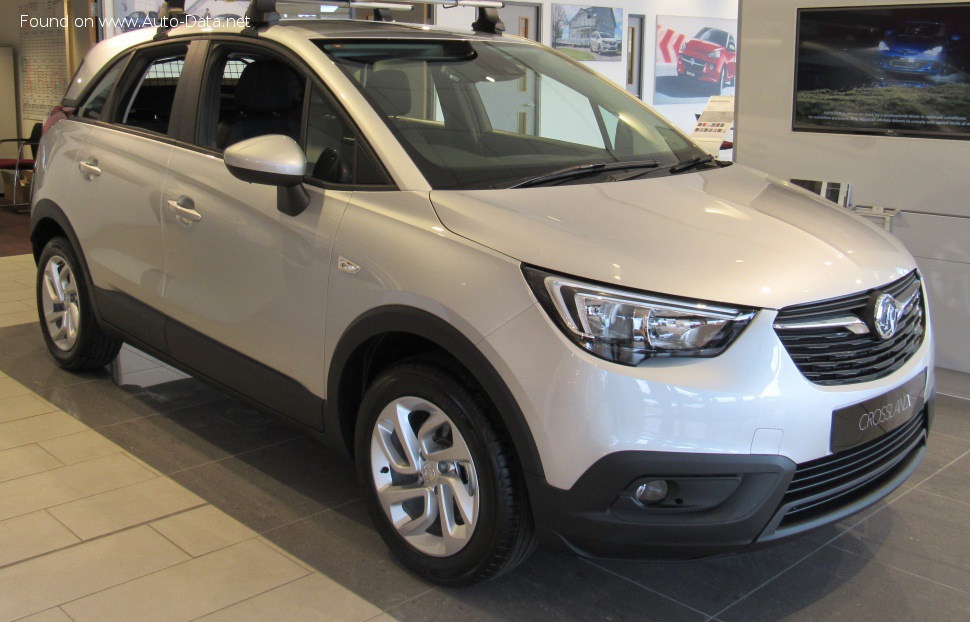
The Vauxhall Crossland X, specifically the 1.5 Turbo D (120 Hp) Automatic variant, represents a significant offering in the European subcompact crossover segment. Introduced in July 2018 as part of the Crossland X generation, this model was a key player for Vauxhall in the highly competitive market for small, versatile SUVs. Produced until October 2020, the Vauxhall Crossland X was developed under the ownership of Groupe PSA (now Stellantis), sharing platforms and powertrains with its Opel counterpart, the Crossland X. While Vauxhall is a British brand, its models are essentially rebadged Opels, designed primarily for the European market and not officially sold in the United States. This particular iteration, with its efficient diesel powertrain and automatic transmission, was tailored to meet the demands of European consumers seeking a blend of practicality, fuel economy, and compact dimensions for urban and suburban environments.
The Vauxhall Crossland X: A European Crossover Contender
The Vauxhall Crossland X was positioned as a practical and family-friendly compact SUV, offering a higher driving position and more flexible interior space than a conventional hatchback. It succeeded the Meriva MPV, reflecting the broader market shift from multi-purpose vehicles to more fashionable crossovers. Its design, while sharing elements with other PSA group vehicles, maintained a distinct Vauxhall identity, particularly in the UK market where the brand has a long-standing heritage. The Crossland X aimed to provide a comfortable ride, decent cargo capacity, and modern amenities, making it a strong contender against rivals like the Nissan Juke, Renault Captur, and its platform-mate, the Peugeot 2008.
Powertrain & Engine Architecture
At the heart of the Vauxhall Crossland X 1.5 Turbo D (120 Hp) Automatic lies a robust and efficient 1.5-liter (1499 cm3 or 91.47 cu. in.) inline four-cylinder diesel engine. Designated by engine codes D15DTH or F15DTH, this powerplant features a DOHC (Double Overhead Camshaft) valvetrain with four valves per cylinder, ensuring optimal airflow and combustion efficiency. The engine benefits from a turbocharger and intercooler, which significantly boost its power output and torque delivery across the rev range. This setup allows the engine to produce a respectable 120 horsepower at 3750 rpm, providing ample power for daily driving.
More impressively for a diesel, the engine generates a substantial 221.27 lb.-ft. (300 Nm) of torque, available at a low 1750 rpm. This strong low-end torque is characteristic of modern diesel engines and contributes to excellent drivability, particularly in urban settings and when carrying passengers or cargo. Power is channeled to the front wheels via a smooth 6-speed automatic transmission, offering a comfortable and effortless driving experience. The transmission itself is an Aisin-sourced unit, known for its reliability and smooth shifting characteristics. It features a torque converter and electronic control, optimizing gear selection based on driving conditions and throttle input.
Fuel Injection and Emissions Control
The 1.5 Turbo D engine utilizes a common rail direct injection system, delivering fuel directly into the combustion chamber at extremely high pressure. This precise fuel delivery enhances combustion efficiency and reduces emissions. To meet stringent European emission standards, the engine incorporates a diesel particulate filter (DPF) to trap soot particles, and a Selective Catalytic Reduction (SCR) system utilizing AdBlue (Diesel Exhaust Fluid) to reduce nitrogen oxide (NOx) emissions. The 15-liter (3.96 US gal) AdBlue tank requires periodic refills, typically every 6,000-9,000 miles, depending on driving style and conditions.
Driving Characteristics
The Crossland X 1.5 Turbo D Automatic offers a comfortable and relaxed driving experience. The engine’s strong low-end torque makes it feel responsive in everyday driving situations, such as accelerating from a standstill or overtaking slower vehicles. While not a performance-oriented vehicle, the 120 hp output provides sufficient power for most driving needs. The 6-speed automatic transmission shifts smoothly and efficiently, contributing to a refined driving experience. Compared to the manual transmission versions, the automatic offers greater convenience, particularly in urban traffic. However, the automatic transmission does result in a slight decrease in fuel economy and a marginally slower 0-60 mph acceleration time (10.8 seconds) compared to the manual.
The gear ratios are tuned for fuel efficiency and drivability, with a relatively tall final drive. This allows for relaxed cruising at highway speeds, but may require the transmission to downshift when climbing steep hills or accelerating quickly. The steering is light and precise, making it easy to maneuver in tight spaces. The suspension provides a comfortable ride, absorbing bumps and imperfections in the road surface effectively. However, it’s not particularly sporty, with some body roll noticeable during cornering.
Equipment & Trim Levels
The Vauxhall Crossland X 1.5 Turbo D Automatic was available in several trim levels, including Energy, Design, Elite Nav, and Ultimate Nav. The base Energy trim included standard features such as air conditioning, electric front windows, a touchscreen infotainment system with Bluetooth connectivity, and a range of safety features including ABS, ESP (Electronic Stability Program), and multiple airbags. The Design trim added features such as alloy wheels, cruise control, and a leather-wrapped steering wheel. The Elite Nav trim further enhanced the equipment list with a larger touchscreen infotainment system with navigation, parking sensors, and automatic headlights and wipers. The top-of-the-line Ultimate Nav trim included features such as leather upholstery, heated front seats, a panoramic sunroof, and advanced safety features like lane departure warning and forward collision alert.
Interior upholstery varied depending on the trim level, ranging from cloth in the base models to leather in the higher trims. The dashboard layout was generally functional and user-friendly, with a focus on practicality. Optional extras included a rear-view camera, a premium sound system, and various styling enhancements.
Chassis & Braking
The Crossland X features an independent McPherson strut front suspension with coil springs and an anti-roll bar, providing responsive steering and comfort. The rear utilizes a torsion beam suspension, a common and cost-effective solution for this segment. Braking is handled by disc brakes at both the front and rear, complemented by an Anti-lock Braking System (ABS) for enhanced safety. The electric power steering system, with a steering rack and pinion setup, offers light and precise control, ideal for navigating city streets. The vehicle was offered with tire sizes 195/60 R16 or 215/50 R17, mounted on corresponding 16-inch or 17-inch wheel rims. The rear drums were standard on lower trim levels, while higher trims received rear disc brakes.
Market Reception & Comparison
Critics generally viewed the Vauxhall Crossland X 1.5 Turbo D Automatic as a competent and practical crossover. Its strengths included its fuel efficiency, comfortable ride, and spacious interior. However, some critics noted that its styling was somewhat conservative and that its driving dynamics were not particularly engaging. Compared to other trims in the Crossland X lineup, the 1.5 Turbo D Automatic offered a good balance of performance and economy. The petrol versions were generally less fuel-efficient, while the more powerful diesel variants offered more performance but at a higher price point. Against competitors like the Nissan Juke and Renault Captur, the Crossland X offered a more spacious interior and a more comfortable ride, but lacked the sporty styling of the Juke. Its fuel economy was comparable to other diesel-powered crossovers in its class.
Technical Specifications
| Category | Specification |
| Brand | Vauxhall |
| Model | Crossland |
| Generation | Crossland X |
| Type (Engine) | 1.5 Turbo D (120 Hp) Automatic |
| Start of Production | July, 2018 |
| End of Production | October, 2020 |
| Powertrain Architecture | Internal Combustion engine |
| Body type | SUV |
| Seats | 5 |
| Doors | 5 |
| Combined Fuel Consumption (WLTP) | 46.1 – 43.6 US mpg (5.1-5.4 l/100 km) |
| CO2 Emissions (NEDC, WLTP equivalent) | 103 g/km |
| Fuel Type | Diesel |
| Acceleration 0 – 60 mph | 10.8 sec |
| Maximum Speed | 113.71 mph (183 km/h) |
| Emission Standard | Euro 6d-TEMP |
| Power | 120 Hp @ 3750 rpm |
| Power per liter | 80.1 Hp/l |
| Torque | 221.27 lb.-ft. (300 Nm) @ 1750 rpm |
| Engine Layout | Front, Transverse |
| Engine Model/Code | D15DTH, F15DTH |
| Engine Displacement | 1.5 liters (1499 cm3 / 91.47 cu. in.) |
| Number of Cylinders | 4 |
| Engine Configuration | Inline |
| Number of Valves per Cylinder | 4 |
| Fuel Injection System | Diesel Commonrail |
| Engine Aspiration | Turbocharger, Intercooler |
| Valvetrain | DOHC |
| Engine Oil Capacity | 4.23 US qt (4 l) |
| Engine Systems | Start & Stop System, Particulate filter |
| Max. Weight (Gross Vehicle Weight) | 4089.57 lbs. (1855 kg) |
| Trunk (boot) space – minimum | 14.48 cu. ft. (410 l) |
| Trunk (boot) space – maximum | 44.32 cu. ft. (1255 l) |
| Fuel Tank Capacity | 11.89 US gal (45 l) |
| AdBlue Tank | 3.96 US gal (15 l) |
| Permitted Trailer Load with brakes (12%) | 1918.02 lbs. (870 kg) |
| Permitted Trailer Load without brakes | 1433 lbs. (650 kg) |
| Length | 165.83 in. (4212 mm) |
| Width | 69.49 in. (1765 mm) |
| Width including mirrors | 77.8 in. (1976 mm) |
| Height | 63.19 in. (1605 mm) |
| Wheelbase | 102.52 in. (2604 mm) |
| Front Overhang | 35.28 in. (896 mm) |
| Rear Overhang | 28.03 in. (712 mm) |
| Drag Coefficient (Cd) | 0.31 |
| Minimum Turning Circle (turning diameter) | 36.78 ft (11.21 m) |
| Drivetrain Architecture | Front wheel drive. Internal Combustion engine. |
| Drive Wheel | Front wheel drive |
| Number of Gears and Type of Gearbox | 6 gears, automatic transmission |
| Front Suspension | Independent, type McPherson with coil spring and anti-roll bar |
| Rear Suspension | Dependent spring suspension |
| Front Brakes | Disc |
| Rear Brakes | Disc |
| Assisting Systems | ABS (Anti-lock braking system) |
| Steering Type | Steering rack and pinion |
| Power Steering | Electric Steering |
| Tires Size | 195/60 R16; 215/50 R17 |
| Wheel Rims Size | 16; 17 |
Legacy
The Vauxhall Crossland X, particularly the 1.5 Turbo D (120 Hp) Automatic variant, has proven to be a relatively reliable powertrain combination. The 1.5-liter diesel engine, while subject to the inherent complexities of modern diesel technology (such as DPF maintenance), has generally demonstrated good durability. The Aisin-sourced automatic transmission is also known for its robustness. In the used car market, these models represent a good value proposition for buyers seeking a practical and fuel-efficient crossover. However, potential buyers should be aware of the maintenance requirements associated with diesel engines, including regular servicing and the occasional DPF regeneration or replacement. The Crossland X, while superseded by newer models, remains a viable option for those seeking a well-rounded and affordable compact SUV.