
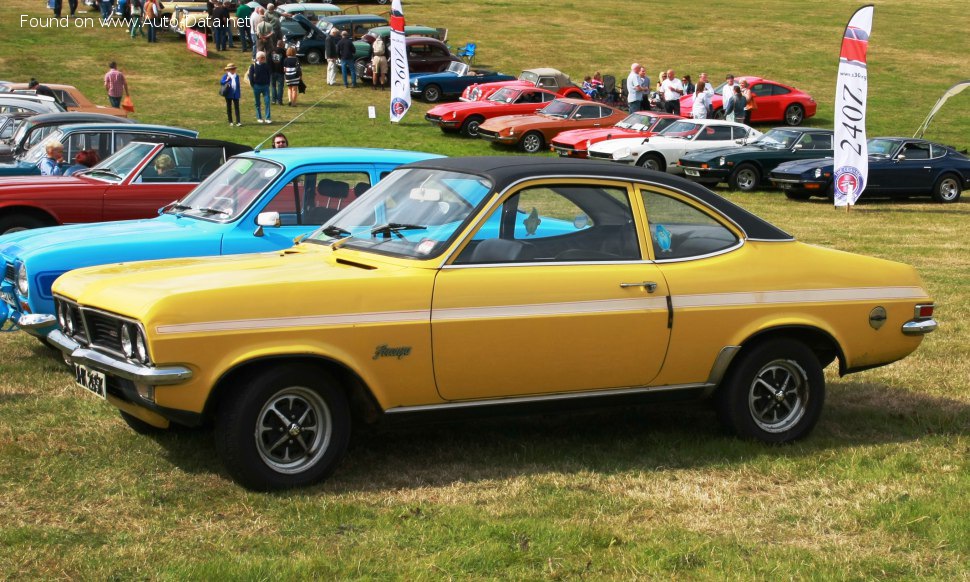
The Vauxhall Firenza Coupe 1300 (54 Hp) represents a distinctive chapter in British automotive history, emerging from Vauxhall Motors, the UK-based subsidiary of General Motors (GM). Introduced in 1972, the Firenza Coupe was Vauxhall’s answer to the burgeoning demand for stylish, accessible two-door coupes, a segment popularized by vehicles like the Ford Capri. While the Firenza range encompassed various engine options and trim levels, the 1300 (54 Hp) variant served as the entry point, offering an appealing blend of sporty aesthetics and economical motoring for its time. It positioned itself as a more dynamic and visually engaging alternative to the standard Vauxhall Viva, upon which its underpinnings were largely based, aiming to capture the hearts of drivers seeking a touch of flair without breaking the bank. Produced until 1975, this generation of the Firenza Coupe, particularly with its 1.3-liter engine, embodied the spirit of early 1970s European automotive design and engineering principles.
Powertrain & Engine Architecture
Under the hood of the Vauxhall Firenza Coupe 1300 (54 Hp) lay a straightforward yet dependable powertrain architecture. The vehicle was equipped with an internal combustion engine, specifically a 1.3-liter (1300 cc) unit. This engine, characteristic of many British cars of the era, was a naturally aspirated petrol (gasoline) engine, designed for reliability and ease of maintenance rather than outright performance. It delivered a modest 54 horsepower, a figure that, while seemingly low by modern standards, was perfectly adequate for daily driving and light touring in the early 1970s.
The engine was based on Vauxhall’s established overhead valve (OHV) design, utilizing a single camshaft in the block to actuate the valves. Fuel delivery was managed by a single Zenith 36mm carburetor, a common setup for engines of this displacement and power output at the time. The engine featured a compression ratio of approximately 8.5:1, balancing performance with the fuel quality available in the early 1970s. The engine code is generally identified as 1300cc, though specific castings and minor variations existed throughout the production run. The engine’s power delivery was linear and predictable, typical of a naturally aspirated setup. It was paired with a drivetrain architecture that sent power to the rear wheels, a common configuration for vehicles of this period and one often favored by enthusiasts for its predictable handling characteristics. This rear-wheel-drive setup, combined with the Firenza’s relatively light weight, offered a degree of driving engagement that was appreciated by its target audience. The engine oil capacity was 2.8 liters (2.96 US quarts), indicating a compact and efficient design for its time. The transmission was a three-speed automatic, a Borg-Warner Type 35 unit, offering a relatively smooth, if not particularly sporty, driving experience. This automatic transmission was chosen to broaden the Firenza’s appeal to drivers who preferred the convenience of automatic operation over a manual gearbox.
Transmission Details
The Borg-Warner Type 35 automatic transmission used in the Firenza Coupe 1300 was a three-speed unit with a torque converter. It was a relatively simple and robust design, known for its reliability. Gear ratios were optimized for fuel economy and comfortable cruising rather than outright acceleration. The transmission lacked a kickdown feature common in later automatics, meaning drivers needed to manually downshift for quicker acceleration. The transmission was controlled mechanically, with a cable linkage connecting the gear selector to the transmission itself.
Driving Characteristics
The Vauxhall Firenza Coupe 1300 (54 Hp) with the automatic transmission offered a distinctly different driving experience compared to its manual counterparts or the higher-output versions like the 2.0-liter models. Acceleration was modest, with a 0-60 mph time estimated to be around 16-18 seconds. The automatic transmission, while convenient, did sap some of the engine’s power, resulting in a slower overall pace. However, the rear-wheel-drive layout provided a balanced feel, and the relatively light weight of the car made it reasonably nimble in corners. The steering was unassisted, requiring a bit of effort at low speeds, but providing good feedback. The suspension, while basic, offered a comfortable ride on most road surfaces. Compared to the manual transmission versions, the automatic Firenza felt less engaging to drive, but it was more accessible to a wider range of drivers. The automatic transmission’s gear ratios were spaced to prioritize fuel economy and smooth cruising, making it a suitable vehicle for long-distance journeys, albeit at a leisurely pace. The lack of overdrive meant that engine speeds were relatively high at highway speeds, contributing to a moderate level of engine noise.
Equipment & Trim Levels
The Firenza Coupe 1300 (54 Hp) served as the entry-level model in the Firenza Coupe range. As such, it came equipped with a relatively basic level of standard features. The interior typically featured cloth upholstery, often in a patterned design. The dashboard was functional, with a speedometer, fuel gauge, and temperature gauge. A three-spoke steering wheel was standard. Exterior features included chrome bumpers, brightwork around the windows, and steel wheels with hubcaps. Optional extras included a vinyl roof, upgraded upholstery, a radio, and a heater. The trim level was generally consistent across the 1300 models, with limited options for customization. The focus was on providing a stylish and affordable coupe without the added expense of luxury features. The interior space was adequate for four adults, although rear seat legroom was limited. The boot (trunk) offered a reasonable amount of storage space for a coupe of its size.
Chassis & Braking
The Vauxhall Firenza Coupe 1300 utilized a body-on-frame construction, sharing its platform with the Vauxhall Viva. The front suspension consisted of independent coil springs and wishbones, while the rear suspension employed a live axle with leaf springs. This setup provided a comfortable ride, but it wasn’t particularly sophisticated in terms of handling. The braking system was initially equipped with drum brakes on all four wheels. Later models, particularly those produced after 1973, often featured front disc brakes for improved stopping power. The braking system was hydraulic, with a dual-circuit master cylinder for added safety. Stabilizer bars were not standard on the 1300 model, contributing to a slightly more pronounced degree of body roll in corners. The tires were typically 165-15 radial tires, providing adequate grip for the car’s power output and weight.
Market Reception & Comparison
Critics generally viewed the Vauxhall Firenza Coupe 1300 (54 Hp) as a stylish and affordable coupe, but they also acknowledged its limitations in terms of performance. It was praised for its attractive design and comfortable ride, but criticized for its modest power output and somewhat dated interior. Compared to its rivals, such as the Ford Capri, the Firenza 1300 offered a more affordable entry point into the coupe segment. However, the Capri offered a wider range of engine options and a more sophisticated driving experience. The Firenza 1300’s fuel economy was reasonable for its time, averaging around 28-32 mpg. Reliability was generally good, thanks to the simplicity of the engine and transmission. However, the Firenza was prone to rust, particularly in coastal areas. Compared to the higher-output Firenza models, the 1300 was significantly slower and less engaging to drive. However, it was also more affordable to purchase and maintain, making it a popular choice for budget-conscious buyers.
Technical Specifications
| Category | Specification |
| Brand | Vauxhall |
| Model | Firenza Coupe |
| Generation | Firenza Coupe |
| Type (Engine) | 1300 (54 Hp) |
| Start of Production | 1972 year |
| End of Production | 1975 year |
| Powertrain Architecture | Internal Combustion engine |
| Body Type | Coupe |
| Seats | 5 |
| Doors | 2 |
| Fuel Type | Petrol (Gasoline) |
| Power | 54 Hp |
| Engine Aspiration | Naturally aspirated engine |
| Engine Oil Capacity | 2.8 l (2.96 US qt | 2.46 UK qt) |
| Drivetrain Architecture | The Internal combustion engine (ICE) drives the rear wheels of the vehicle. |
| Drive Wheel | Rear wheel drive |
| Transmission | 3-speed Automatic (Borg-Warner Type 35) |
Legacy
The Vauxhall Firenza Coupe, particularly the 1300 (54 Hp) variant, carved out a significant niche in the British and European automotive markets during its production run. In an era dominated by practical family sedans and the rise of more accessible sporting cars, the Firenza offered a compelling alternative. While the 1300 model provided the accessible entry point, the Firenza lineage would later culminate in the legendary “Droopsnoot” HP Firenza, a high-performance homologation special that showcased the platform’s ultimate potential and secured the Firenza’s place in rally and racing history. Today, the Vauxhall Firenza Coupe, especially the early models like the 1300, is appreciated by classic car enthusiasts, particularly in the UK. Its distinctive styling, historical significance as a product of GM’s British arm, and its role in the evolution of accessible sporting coupes ensure its continued relevance. The 1.3-liter engine and automatic transmission combination, while not known for its performance, proved to be relatively reliable. Parts availability is reasonable, although some components can be difficult to find. Well-maintained examples of the Firenza Coupe 1300 are becoming increasingly collectible, representing a charming and historically significant classic, representing a unique blend of British engineering and early 1970s automotive panache.
