
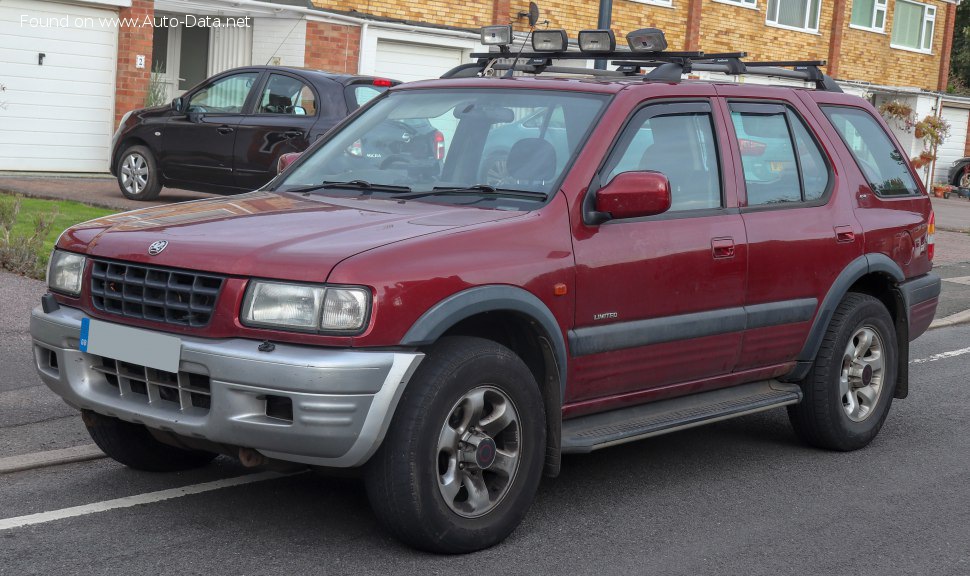
The Vauxhall Frontera Mk II 3.2i V6 (205 Hp) represents a significant chapter in the evolution of sport utility vehicles (SUVs) in the European market during the late 1990s. Produced by Vauxhall, the British subsidiary of General Motors’ Opel division, the Frontera was essentially a rebadged version of the Isuzu Rodeo (also known as the Isuzu Wizard in some markets). The second generation, launched in 1997, aimed to build upon the success of its predecessor by offering improved refinement, enhanced performance, and a more contemporary design, positioning it as a robust and versatile option for families and adventurers alike. The 3.2i V6 variant, in particular, stood out for its powerful engine, offering a more dynamic driving experience compared to its four-cylinder siblings. This model was manufactured between 1997 and 2000, serving as a key player in the increasingly competitive European SUV landscape.
The Vauxhall Frontera Mk II 3.2i V6: A European SUV Contender
The Frontera Mk II emerged during a period when SUVs were transitioning from specialized off-road vehicles to more mainstream family transport. Vauxhall, leveraging its partnership with Isuzu, aimed to capitalize on this growing demand with a vehicle that offered a balance of practicality, performance, and affordability. The Mk II represented a substantial upgrade over the original Frontera, with a more refined interior, improved handling, and a wider range of engine options, including the potent 3.2-liter V6.
Engine & Performance: Powering the Frontera
At the heart of the Vauxhall Frontera Mk II 3.2i V6 (205 Hp) lies a robust 3.2-liter (3165 cm³ or 193.14 cu. in.) naturally aspirated V6 engine, designated with the model code 6VD1-W. This powerplant was engineered for both durability and spirited performance, delivering 205 horsepower at 5400 rpm. Torque figures were equally impressive for its time, peaking at 213.89 lb.-ft. (290 Nm) at 3000 rpm, providing strong pulling power – a desirable trait for an SUV. The engine featured a Double Overhead Camshaft (DOHC) valvetrain with four valves per cylinder, optimizing breathing and combustion efficiency. Fuel delivery was managed by a multi-port manifold injection system, further enhancing performance and fuel economy.
The 3.2i V6 was typically paired with a 5-speed manual transmission, channeling power to an all-wheel-drive (4×4) system. This configuration provided confident traction in various driving conditions. Performance metrics were respectable for the era: a 0 to 60 mph acceleration time of 9.8 seconds and a top speed of 114.33 mph (184 km/h). While not a sports car, these figures offered ample power for highway cruising and overtaking, setting it apart from many of its less powerful competitors. The engine’s front, longitudinal layout contributed to a balanced weight distribution and a robust drivetrain architecture.
Fuel consumption, however, reflected the technology of the time and the vehicle’s weight. Urban driving yielded approximately 13.2 US mpg, while extra-urban conditions improved to about 23.3 US mpg. These figures, while modest by modern standards, were competitive for a V6-powered SUV of its generation, particularly one designed with off-road capability in mind.
Design & Features: A Practical SUV
The Vauxhall Frontera Mk II adopted a more rounded and contemporary aesthetic compared to its angular first-generation predecessor. As a five-door SUV with seating for five occupants, it offered a practical and family-friendly package. Its dimensions – 183.39 inches in length, 70.28 inches in width, and 68.5 inches in height – gave it a substantial road presence without being overly cumbersome. The 106.38-inch wheelbase contributed to a stable ride and a spacious interior.
Inside, the Frontera Mk II aimed for improved comfort and ergonomics. While not luxurious, the cabin was functional and durable, designed to withstand the rigors of family use and light off-roading. Cargo versatility was a key selling point, with a minimum trunk space of 13.74 cu. ft. (389 liters) expanding to a generous 63.21 cu. ft. (1790 liters) with the rear seats folded. This made it suitable for carrying luggage, sports equipment, or larger items.
Safety features included ventilated disc brakes at the front and solid disc brakes at the rear, providing adequate stopping power. An Anti-lock Braking System (ABS) was standard, enhancing control during emergency braking. The hydraulic power steering, utilizing a worm-reduction unit, offered a traditional SUV steering feel, prioritizing robustness and off-road capability. The vehicle rode on 245/70 R16 tires mounted on 7J x 16-inch wheel rims, a common setup for SUVs of the period, balancing on-road comfort with off-road traction.
Technical Specifications: Vauxhall Frontera Mk II 3.2i V6 (205 Hp)
| Category | Specification |
| General Information | |
| Brand | Vauxhall |
| Model | Frontera Mk II |
| Type (Engine) | 3.2i V6 (205 Hp) |
| Production Start | 1997 |
| Production End | 2000 |
| Powertrain Architecture | Internal Combustion Engine |
| Body Type | SUV |
| Seats | 5 |
| Doors | 5 |
| Performance Specs | |
| Fuel Consumption (Urban) | 13.2 US mpg (17.8 l/100 km) |
| Fuel Consumption (Extra Urban) | 23.3 US mpg (10.1 l/100 km) |
| Fuel Type | Petrol (Gasoline) |
| Acceleration 0-60 mph | 9.8 sec |
| Maximum Speed | 114.33 mph (184 km/h) |
| Weight-to-Power Ratio | 8.7 kg/Hp (114.8 Hp/tonne) |
| Weight-to-Torque Ratio | 6.2 kg/Nm (162.5 Nm/tonne) |
| Engine Specs | |
| Power | 205 Hp @ 5400 rpm |
| Power per liter | 64.8 Hp/l |
| Torque | 213.89 lb.-ft. (290 Nm) @ 3000 rpm |
| Engine Layout | Front, Longitudinal |
| Engine Model/Code | 6VD1-W |
| Engine Displacement | 3.2 liters (3165 cm³ / 193.14 cu. in.) |
| Number of Cylinders | 6 |
| Engine Configuration | V-engine |
| Cylinder Bore | 3.68 in. (93.4 mm) |
| Piston Stroke | 3.03 in. (77 mm) |
| Compression Ratio | 9.4:1 |
| Valves per Cylinder | 4 |
| Fuel Injection System | Multi-port manifold injection |
| Engine Aspiration | Naturally aspirated |
| Valvetrain | DOHC |
| Engine Oil Capacity | 5.6 US qt (5.3 l) |
| Coolant Capacity | 11.73 US qt (11.1 l) |
| Space, Volume, and Weights | |
| Kerb Weight | 3935.25 lbs. (1785 kg) |
| Max. Weight (GVWR) | 5401.33 lbs. (2450 kg) |
| Max Load | 1466.07 lbs. (665 kg) |
| Trunk (Boot) Space – Minimum | 13.74 cu. ft. (389 l) |
| Trunk (Boot) Space – Maximum | 63.21 cu. ft. (1790 l) |
| Fuel Tank Capacity | 19.81 US gal (75 l) |
| Dimensions | |
| Length | 183.39 in. (4658 mm) |
| Width | 70.28 in. (1785 mm) |
| Height | 68.5 in. (1740 mm) |
| Wheelbase | 106.38 in. (2702 mm) |
| Front Track | 59.65 in. (1515 mm) |
| Rear Track | 59.84 in. (1520 mm) |
| Drivetrain, Brakes, and Suspension | |
| Drive Wheel | All-wheel drive (4×4) |
| Gearbox Type | 5 gears, Manual Transmission |
| Front Brakes | Ventilated Discs |
| Rear Brakes | Discs |
| Assisting Systems | ABS (Anti-lock Braking System) |
| Steering Type | Worm-reduction unit |
| Power Steering | Hydraulic Steering |
| Tire Size | 245/70 R16 |
| Wheel Rims Size | 7J x 16 |
Legacy and Market Impact
The Vauxhall Frontera Mk II, and particularly the 3.2i V6 (205 Hp) model, played a notable role in the European SUV market during a period of rapid growth and diversification for the segment. As a rebadged Isuzu, it was part of General Motors’ strategy to offer a competitive SUV without significant in-house development costs for its European brands, Opel and Vauxhall. This approach allowed it to compete with both established Japanese rivals and emerging European offerings.
In its primary European market, the Frontera Mk II faced competition from vehicles like the Land Rover Freelander, Toyota RAV4, Honda CR-V, and the Nissan Terrano II (also sold as the Ford Maverick in some markets). While some competitors leaned towards more car-like comfort and urban practicality, the Frontera maintained a reputation for ruggedness and genuine off-road capability, attributes inherited from its Isuzu roots. The 3.2-liter V6 engine further enhanced this appeal, providing the power needed for towing and more demanding terrain.
The Frontera’s legacy is somewhat mixed. It was praised for its robust chassis, spacious interior, and decent off-road prowess for a family SUV. However, it was also criticized for its relatively high fuel consumption, somewhat agricultural driving dynamics compared to more refined rivals, and a perception that it lagged behind in interior quality. Despite these criticisms, it sold reasonably well, contributing to the popularization of the SUV body style in Europe.
The production run of the Frontera Mk II 3.2i V6 was relatively short, ending in 2000. Today, the Vauxhall Frontera Mk II 3.2i V6 is remembered as a sturdy, no-nonsense SUV that offered a blend of practicality, power, and genuine all-wheel-drive capability for its time. It represents an interesting example of badge engineering within the global automotive industry and a significant step in the journey of SUVs from niche off-roaders to mainstream family vehicles in Europe.

