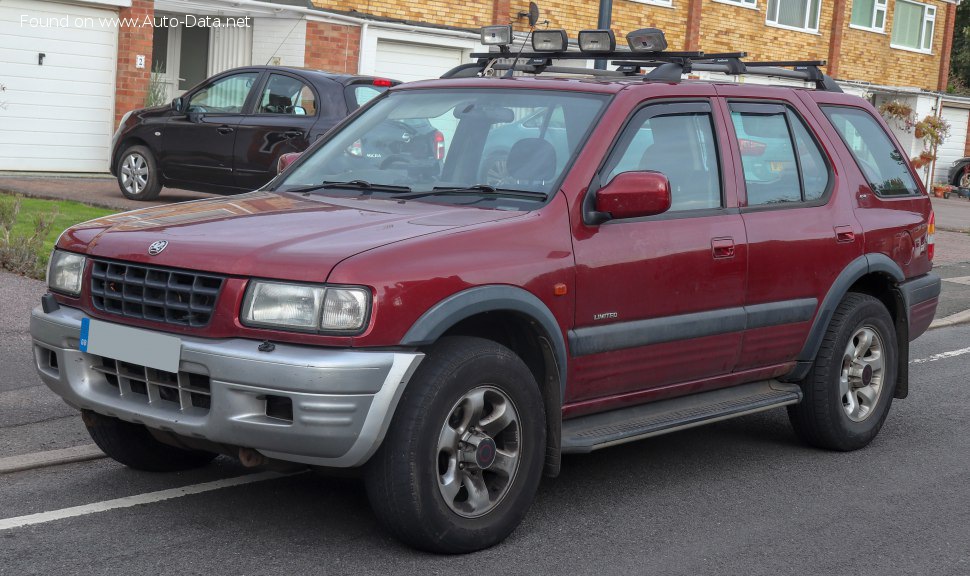
The Vauxhall Frontera Mk II Sport 2.0 (116 Hp) emerged during the surge in popularity of sport utility vehicles in the 1990s, primarily serving the United Kingdom and European markets. This compact, three-door SUV was essentially a rebadged version of the Isuzu Amigo, known as the Isuzu Rodeo Sport in North America and the Opel Frontera Sport elsewhere in Europe. While the Frontera name wasn’t directly marketed in the United States, the underlying platform and engineering were familiar through its Isuzu counterparts. Produced from 1992 until 1998, the Mk II Sport targeted buyers seeking a versatile vehicle capable of both off-road adventures and everyday practicality, offering a more manageable size compared to its five-door sibling. It represented an accessible and affordable entry point into the growing SUV segment, contributing to its widespread adoption across Europe.
Vauxhall Frontera Mk II Sport: A Detailed Overview
The Frontera Mk II Sport aimed to bridge the gap between rugged off-road capability and the convenience of a daily driver. Its compact dimensions and relatively affordable price point made it an attractive option for those seeking a vehicle that could handle both urban commutes and weekend excursions. The vehicle’s success lay in its ability to offer a blend of practicality, durability, and a touch of sporty styling, appealing to a broad range of customers.
Engine & Performance
At the heart of the Vauxhall Frontera Mk II Sport lay a 2.0-liter (1998 cm3 or 121.93 cubic inches) naturally aspirated inline-four gasoline engine, designated the X20SE. This engine was engineered for reliability and a balance between performance and fuel efficiency, suitable for both on-road and light off-road applications. It produced 116 horsepower at 5200 rpm, providing adequate power for the compact SUV. Torque output was 126.86 lb.-ft. (172 Nm) at 2800 rpm, contributing to strong low-end responsiveness, beneficial for navigating challenging terrain and providing confident acceleration in city driving. The engine featured an Overhead Camshaft (OHC) valvetrain and multi-port fuel injection, a straightforward and dependable configuration.
Power was transmitted to all four wheels via a five-speed manual transmission and an all-wheel-drive (4×4) system, enhancing the vehicle’s versatility and off-road prowess. Performance figures were typical for its class and era. Acceleration from 0 to 60 mph took approximately 14.8 seconds, while the top speed reached around 98.18 mph (158 km/h). Fuel economy, while not a primary focus for SUVs of the time, was estimated at 20.3 US mpg in urban conditions and 30.2 US mpg on the extra-urban cycle, making it a reasonably economical choice within its segment. The vehicle’s weight-to-power ratio was 13.5 kg/Hp, or 74.1 Hp/tonne, indicative of its robust build.
Design & Features
The Vauxhall Frontera Mk II Sport showcased a classic three-door SUV body style, characterized by its short wheelbase and compact overall dimensions. These dimensions contributed to its agility and maneuverability, particularly in off-road scenarios. Measuring 168.03 inches in length, 70.35 inches in width, and 66.61 inches in height, with a wheelbase of 96.93 inches, the Frontera Sport offered a more nimble alternative to its five-door counterpart. The design aesthetic was representative of 1990s SUVs, featuring a robust, somewhat boxy silhouette, prominent wheel arches, and a spare tire mounted on the rear tailgate, emphasizing its utilitarian nature.
The interior was designed to accommodate up to five passengers, although rear seating in a three-door configuration could be somewhat limited. Cargo space was practical for its size, offering a minimum of 10.59 cubic feet (300 liters) with the rear seats up, expanding to 40.97 cubic feet (1160 liters) when folded. The interior prioritized functionality and durability, designed to withstand the demands of an active lifestyle.
Mechanically, the Frontera Mk II Sport featured an independent front suspension with torsion bars and a coil spring rear suspension, aiming for a balance between on-road comfort and off-road articulation. Braking was provided by disc brakes on all four wheels, enhanced by an Anti-lock Braking System (ABS), a significant safety feature for vehicles of that era. Steering was hydraulic power-assisted, utilizing a worm-reduction system for predictable control. The vehicle rode on 235/70 R16 tires mounted on 6.5J x 16-inch wheel rims, providing a good compromise between road grip and off-road capability. A fuel tank capacity of 80 liters (21.13 US gallons) offered a respectable driving range.
Technical Specifications
| Engine Type | 2.0L Inline-4 Gasoline |
| Engine Displacement | 1998 cc (121.93 cu in) |
| Horsepower | 116 hp @ 5200 rpm |
| Torque | 172 Nm (126.86 lb-ft) @ 2800 rpm |
| Transmission | 5-Speed Manual |
| Drivetrain | All-Wheel Drive (4×4) |
| 0-60 mph | 14.8 seconds |
| Top Speed | 158 km/h (98.18 mph) |
| Urban Fuel Economy | 20.3 US mpg |
| Extra-Urban Fuel Economy | 30.2 US mpg |
| Weight-to-Power Ratio | 13.5 kg/Hp |
| Power-to-Weight Ratio | 74.1 Hp/tonne |
| Length | 4267 mm (168.03 in) |
| Width | 1781 mm (70.35 in) |
| Height | 1684 mm (66.61 in) |
| Wheelbase | 2457 mm (96.93 in) |
| Trunk Capacity (min) | 300 liters (10.59 cu ft) |
| Trunk Capacity (max) | 1160 liters (40.97 cu ft) |
| Fuel Tank Capacity | 80 liters (21.13 US gallons) |